10 Best Upfluence Alternatives With Built-In CRM and Workflow Automation
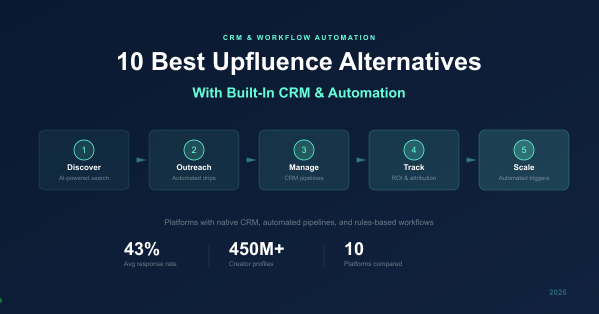
Managing influencer relationships in spreadsheets, email threads, and disconnected tools works until it doesn’t. At five or ten active partnerships, the manual approach is tolerable. At fifty or a hundred, it breaks. Conversations get lost. Follow-ups slip through the cracks. There’s no single view of where each creator stands in your pipeline – from first outreach to content delivery to payment.
This is why CRM and workflow automation have become the dividing line between platforms that scale and platforms that don’t. The best influencer marketing tools now offer built-in relationship management with pipeline stages, conversation history, rules-based triggers, automated drip campaigns, and bulk actions that eliminate the repetitive work slowing your team down.
Upfluence has a CRM, but it was designed for basic relationship tracking – not for automating multi-step workflows across hundreds of creators. If you’ve hit the ceiling on what Upfluence can manage, these ten platforms offer deeper CRM capabilities and genuine workflow automation. Influencer Hero leads the list with its automation engine and rules-based triggers, but each tool on this list brings something different to the CRM and automation conversation.
- Influencer Hero
- GRIN
- Aspire
- Modash
- CreatorIQ
- Meltwater
- Later
- Traackr
- Sprout Social
- Heepsy
Why Upfluence’s CRM Isn’t Enough for Modern Programs
Upfluence offers a performance CRM and Jace AI for outreach, but brands running programs at scale consistently run into the same limitations:
- Basic Relationship Tracking, Not Workflow Automation: Upfluence’s CRM stores contact information and campaign history, but it doesn’t offer rules-based triggers that automate actions across your pipeline. There’s no way to auto-generate a Shopify discount code when a contract is signed, or automatically advance a creator to the next stage when content is approved.
- Manual Outreach at Scale: While Jace AI assists with drafting messages, the outreach workflow lacks multi-step drip sequences with conditional logic. Sending personalized follow-ups to 200 creators who haven’t responded requires manual intervention rather than automated cadences.
- No Rules-Based Triggers: Modern influencer CRMs let you define if-then automations – if a creator signs, trigger product shipment; if content goes live, flag it for review; if a campaign ends, send a feedback survey. Upfluence doesn’t support this kind of event-driven workflow.
- Limited Pipeline Visibility: Managing 100+ creator relationships requires visual pipeline stages, bulk status updates, and filterable views by campaign, stage, or priority. Upfluence’s CRM wasn’t architected for this level of operational complexity.
- Contract Friction on Top of Feature Gaps: Mandatory 12-month contracts starting at $24,000+ for two seats mean you’re locked into these CRM limitations for a full year before you can switch.
Best Upfluence Alternatives With CRM and Automation
1. Influencer Hero

Influencer Hero was built around the idea that CRM and automation should be the core of an influencer marketing platform – not an afterthought bolted onto a discovery tool. The platform’s automation engine uses rules-based triggers to eliminate manual steps across the entire creator lifecycle: auto-generate Shopify discount codes on contract sign, advance pipeline stages when content is submitted, trigger payment workflows on campaign completion, and send personalized drip sequences to thousands of creators simultaneously.
The CRM itself operates through campaign boards with visual pipeline stages, deal pages for each creator relationship, full conversation history, and bulk actions for managing large rosters efficiently. Everything from discovery through a 450M+ creator database to product gifting, UGC collection, affiliate tracking, and creator storefronts connects back to the CRM – so no data lives in a silo.
Best for: Brands that need a true automation engine at the center of their influencer program – with rules-based triggers, drip campaigns, and CRM pipeline management that scales beyond manual workflows.
Pricing:
- Standard: $649/month (1 seat, up to 1,000 creators, 1,000 outreach/mo)
- Pro: $1,049/month (3 seats, up to 5,000 creators, 5,000 outreach/mo)
- Business: $2,490/month (8 seats, up to 10,000 creators, 10,000 outreach/mo)
- Custom & Agency plans available with unlimited outreach
Standout features:
- Automation Engine With Rules-Based Triggers: Define if-then workflows across the creator lifecycle – auto-generate discount codes, advance pipeline stages, trigger shipments, and send follow-ups based on creator actions.
- AI-Powered Drip Campaigns (43% Response Rate): Automated multi-step outreach sequences with AI-personalized first lines tailored to each creator’s recent content. Handles thousands of sequences simultaneously without manual intervention.
- CRM With Campaign Boards and Deal Pages: Visual pipeline management with per-creator deal pages, conversation history, bulk actions, and filterable views across campaigns, stages, and performance metrics.
- 450M+ Creator Database Across 8 Platforms: Instagram, TikTok, YouTube, Pinterest, Snapchat, Twitch, and X with audience quality scoring, fraud detection, and lookalike recommendations feeding directly into CRM workflows.
- Five eCommerce Integrations: Shopify, WooCommerce, Magento, BigCommerce, and Prestashop for product gifting from CRM, affiliate tracking, and per-creator revenue attribution.
- Creator Storefronts (Up to 8x ROI): Branded storefronts where creators sell products with affiliate commissions – managed and tracked through the CRM.
The depth of the automation engine and CRM means teams adopting workflow-driven influencer marketing for the first time will need time to configure their triggers and pipeline stages. Brands running only a handful of partnerships per quarter may not use every capability, though the architecture ensures you won’t outgrow it.
2. GRIN
GRIN takes a creator-portal approach to relationship management. Rather than managing everything from the brand side, GRIN gives each influencer a private dashboard where they view briefs, submit content, track earnings, and communicate with your team. This decentralizes some of the CRM workload by putting creators in charge of their own workflow stages.
The platform offers unlimited creator partnerships with no caps, which matters for brands scaling to hundreds of active relationships. Content reuse rights are embedded in the booking flow, and a searchable UGC library captures everything including Stories.
Best for: Enterprise eCommerce brands with large creator rosters that want to shift relationship management partially to creators through self-serve portals.
Pricing:
- Custom; entry tier typically starts around $2,500/month
- 12-month minimum commitment; $25,000+/year
Standout features:
- Creator Portals: Private dashboards where influencers manage briefs, submissions, and earnings – reducing back-and-forth communication overhead.
- Unlimited Creator Partnerships: No caps on relationship count, designed for brands managing hundreds of active collaborations.
- AI Discovery (Gia): Intelligent assistant for surfacing and evaluating creators based on brand criteria and campaign requirements.
- Automatic Media Rights: Content reuse rights embedded in the booking flow, eliminating separate licensing negotiations.
- Native Shopify Integration: Direct connection for product shipping, payments via PayPal, and affiliate tracking within the platform.
GRIN’s $25,000+/year minimum and 12-month lock-in create the same contract friction brands are trying to escape from Upfluence. The CRM workflow is capable but relies heavily on the creator portal model – brands wanting rules-based automation triggers and multi-step drip campaigns from the brand side will find the automation layer thinner than platforms with dedicated automation engines. The interface can also slow down under heavy use.
3. Aspire
Aspire flips the traditional outreach model by running an inbound creator marketplace where over a million creators actively apply to brand campaigns. From a CRM perspective, this changes the workflow from cold outreach and follow-up management to application review, vetting, and selection – a fundamentally different pipeline structure.
The platform provides end-to-end campaign workflows covering discovery, contracts, content approvals, and performance tracking. First-party data integrations with Meta, TikTok, and Pinterest give you reliable audience metrics for creator evaluation within the CRM.
Best for: Mid-market brands with existing recognition that want to shift from outbound outreach workflows to inbound creator applications and structured approval pipelines.
Pricing:
- Custom; mid-tier packages quoted around $2,300/month
Standout features:
- Inbound Creator Marketplace: 1M+ creators applying to campaigns inverts the CRM workflow from outreach management to selection and vetting.
- First-Party Social Data: Direct API integrations with Meta, TikTok, and Pinterest deliver reliable audience metrics for creator evaluation.
- End-to-End Campaign Pipeline: Discovery, contracts, content approvals, and tracking managed through a single structured workflow.
- Shopify Fulfillment Integration: Creators select products from your catalog, and Aspire handles fulfillment coordination within the campaign workflow.
- Dedicated Strategic Support: Onboarding and ongoing guidance included, which helps teams new to workflow-driven platforms get up to speed faster.
Custom pricing limits transparency – you won’t know your costs until after a sales call. The inbound model favors brands that already have recognition; newer companies will still need to rely on outbound outreach, where platforms with AI-powered drip campaigns and databases of 350M-450M+ creators deliver stronger results. Aspire’s automation capabilities are workflow-oriented but lack the rules-based trigger depth of more automation-focused platforms.
4. Modash
Modash pairs one of the largest public creator databases (350M+ profiles) with Shopify-native affiliate workflows and a built-in CRM that syncs with Gmail and Outlook. The CRM handles relationship tracking, outreach coordination, and pipeline management with an emphasis on affiliate program operations.
The platform’s AI visual discovery lets you describe a creator “vibe” or upload a reference image to find matching profiles – a creative approach to sourcing that feeds directly into CRM outreach. Automated affiliate payouts and creator dashboards reduce the administrative overhead of managing commission-based partnerships.
Best for: Shopify-based brands that want strong discovery paired with affiliate CRM workflows at mid-market pricing with month-to-month flexibility.
Pricing:
- Essentials: $199-$299/month
- Performance: $499-$599/month
- Enterprise: Custom (annual billing)
Standout features:
- 350M+ Public Creator Database: Non-opt-in profiles provide one of the widest discovery nets on the market, feeding directly into CRM workflows.
- Gmail/Outlook CRM Sync: Outreach and conversations sync with your existing email client, keeping relationship history centralized.
- AI Visual Discovery: Describe a visual style or upload a reference image to find aesthetically aligned creators.
- Automated Affiliate Payouts: Commission tracking and monthly creator payments handled in-platform with automated workflows.
- Creator Dashboards: Creators view their own performance, commissions, and product selections through self-serve interfaces.
Modash’s deep integrations only work with Shopify – a dealbreaker for brands on WooCommerce, Magento, or BigCommerce. The CRM is functional but doesn’t offer rules-based triggers or automated drip campaigns with AI personalization. For teams that need multi-step automation workflows and broader eCommerce coverage, platforms like Influencer Hero provide deeper CRM automation across more commerce platforms.
5. CreatorIQ
CreatorIQ targets enterprise organizations running complex, multi-market influencer programs. Its CRM is built for scale – advanced creator one-sheets for internal review and approval, UGC rights management workflows, and live reporting dashboards powered by direct API integrations with social platforms.
The platform’s strength lies in governance and compliance features that large organizations need: built-in tax documentation, payment compliance handling, and structured approval workflows. Global creator coverage makes it viable for brands running programs across multiple countries and languages.
Best for: Enterprise brands with global programs, compliance requirements, and dedicated teams that need advanced CRM governance and reporting.
Pricing:
- Starts at $35,000/year
- Enterprise tiers up to $200,000/year
Standout features:
- Advanced CRM With Creator One-Sheets: Detailed creator profiles for internal review and approval workflows, streamlining stakeholder sign-off.
- Enterprise Reporting Dashboards: Live analytics powered by direct API integrations with social platforms – not scraped data.
- UGC Rights Management: Request, track, and manage content usage rights within the CRM workflow.
- Payment Compliance: Built-in tax documentation and payout handling for managing creator payments across jurisdictions.
- Global Creator Coverage: Strong international data for brands running multi-market programs.
CreatorIQ’s pricing starts at $35,000/year and scales to $200,000/year, making it prohibitive for most brands. The CRM is governance-heavy – excellent for compliance but not built around the kind of automation triggers and drip campaign workflows that mid-market teams need to move fast. Smaller organizations will find the platform oversized for their requirements.
6. Meltwater
Meltwater (incorporating Klear) combines influencer marketing with media monitoring and social listening – a unique CRM angle for brands that need to track creator relationships alongside broader PR and reputation management. The platform’s “True Reach” technology uses AI to estimate real audience reach beyond follower counts, adding depth to creator evaluation within the CRM.
Integrated chat and payments let you manage negotiations and payouts without leaving the platform. Audience sentiment analysis – which reads comment section tone – adds a layer of relationship intelligence that pure influencer platforms don’t offer.
Best for: Brands that need influencer CRM integrated with media monitoring, PR workflows, and reputation tracking in a single ecosystem.
Pricing:
- Klear plans: ~$33,100-$45,000/year discounted
- Standard Meltwater pricing: $50,000+/year
Standout features:
- “True Reach” Technology: AI estimates real audience reach beyond follower counts, improving creator evaluation accuracy in CRM.
- Integrated Chat and Payments: Negotiate and pay creators in-platform, keeping financial workflows connected to relationship data.
- Audience Sentiment Analysis: Comment section sentiment tracking adds relationship intelligence beyond standard engagement metrics.
- Cross-Channel Reporting: Influencer performance combined with media intelligence for unified campaign analysis.
- Visual AI Search: Find creators by image themes and content patterns using 30M influencer profiles.
Enterprise pricing ($33,100-$50,000+/year) and heavy setup requirements make Meltwater unsuitable for smaller brands. The influencer CRM is strong on the intelligence side but lacks the outreach automation depth – drip campaigns, rules-based triggers, AI-personalized sequences – that dedicated influencer platforms offer. It’s a better fit for brands that need media monitoring and influencer management in one place than for teams focused purely on scaling creator partnerships.
7. Later
Later expanded from social media scheduling into influencer marketing, and its CRM reflects that origin – centralized communication, content planning synergy, and brand safety tools that align influencer output with your broader content calendar. The platform offers 15M contactable creators with verified emails, custom application pages for vetting, and Shopify gifting workflows.
The content planning angle is Later’s CRM differentiator. You can align influencer deliverables with your scheduled brand content, ensuring consistent messaging across owned and earned channels. AI-powered brand safety scanning reviews creator content for potential risks.
Best for: Brands that want influencer relationship management integrated with social media content planning and scheduling.
Pricing:
- Social management: Starter $25/mo, Growth $50/mo, Scale $110/mo
- Influencer marketing plans: ~$28,500-$60,000/year
Standout features:
- Content Planning Synergy: Align influencer deliverables with your scheduled brand content for consistent cross-channel messaging.
- 15M Contactable Creators: Verified email addresses reduce outreach bounce rates and improve initial contact success.
- Custom Application Pages: Creator vetting through branded application forms that feed into your CRM pipeline.
- Brand Safety AI Scanning: Automated content review for risky keywords and topics before approving creator partnerships.
- Shopify Gifting Workflows: Product gifting and discount code management connected to campaign workflows.
Later’s influencer marketing plans start at ~$28,500/year – a significant jump from its affordable social management tiers. The CRM is built around content coordination rather than outreach automation, so teams that need multi-step drip campaigns, rules-based triggers, or AI-powered personalization will find the automation layer limited compared to platforms built specifically for scaled influencer outreach.
8. Traackr
Traackr approaches CRM through the lens of performance data and benchmarking. Its proprietary Brand Vitality Score (BVS) quantifies brand visibility, trust, and influence over time – giving CRM records a strategic layer that goes beyond contact details and campaign history. Advanced reporting covers CPC, CPE, CPV, and ROI with historical benchmarking to track program performance across quarters.
Product gifting workflows with delivery-to-result correlation connect operational CRM actions (shipping a product) directly to performance outcomes (engagement, conversions). Exportable executive reports make it straightforward to share influencer program results with leadership.
Best for: Data-driven teams that need performance benchmarking and spend optimization layered into their creator relationship management.
Pricing:
- Starts at ~$32,500/year
Standout features:
- Brand Vitality Score (BVS): Proprietary metric that quantifies brand visibility and influence over time within creator relationships.
- Advanced Performance Reporting: CPC, CPE, CPV, and ROI tracking with historical benchmarking for quarter-over-quarter comparison.
- Gifting-to-Result Correlation: Connect product shipments to performance outcomes, measuring the ROI of gifting workflows directly.
- Exportable Executive Reports: Presentation-ready reports in formats suitable for leadership and stakeholder reviews.
Traackr’s $32,500/year starting price positions it firmly in enterprise territory. The platform excels at measurement and benchmarking but doesn’t offer the operational automation – drip campaigns, rules-based triggers, bulk outreach – that teams need for day-to-day relationship management at scale. Brands wanting both deep analytics and workflow automation often need to pair Traackr with another tool, or choose a platform that combines both.
9. Sprout Social
Sprout Social brings influencer marketing into its broader social media management suite, offering CRM features tuned for brand safety and content governance. Its AI-powered Brand Fit Score evaluates creator-brand alignment, and advanced safety filters screen for risky keywords and content topics before you commit to a partnership.
Content approval workflows let creators submit deliverables for review before publishing – a CRM feature that matters for regulated industries or brands with strict messaging guidelines. Competitive benchmarking includes creator overlap analysis, showing which influencers your competitors are working with.
Best for: Brands in regulated industries or with strict brand guidelines that need content approval workflows and safety screening integrated into their influencer CRM.
Pricing:
- $1,599/user/month
- 12-month minimum; additional seats extra
Standout features:
- AI Brand Fit Score: Automated creator-brand alignment scoring that feeds into CRM evaluation workflows.
- Content Approval Workflows: Creators submit content for brand review before publishing – essential for compliance-sensitive industries.
- Advanced Brand Safety Filters: Screen creators for risky keywords, content topics, and audience concerns before partnership commitment.
- Competitive Creator Benchmarking: Analyze which creators your competitors are partnering with and identify overlap opportunities.
- EMV Analytics: Deep earned media value reporting with exportable formats for stakeholder communication.
Sprout Social’s per-user pricing ($1,599/user/month) gets expensive fast for teams of any size – a three-person team pays nearly $58,000/year. The CRM is strong on governance and safety but thin on outreach automation. There’s no visual or vibe-based search, no built-in UGC licensing tools, and no AI-driven drip campaigns. Teams focused on scaling outreach and managing large creator pipelines will likely need a more automation-oriented platform alongside Sprout Social’s monitoring capabilities.
10. Heepsy
Heepsy makes influencer CRM accessible at entry-level pricing. Its Kanban-style pipeline gives teams a visual way to track creators through campaign stages – from initial outreach to content delivery – without the complexity of enterprise platforms. Bulk email outreach handles up to 3,000 emails per month with automated follow-up sequences.
A 50M+ influencer database with authenticity filters and fake follower detection feeds into the CRM, and Shopify and WooCommerce integrations (on advanced plans) connect affiliate tracking to relationship data. The free plan lets teams test the CRM workflow before committing.
Best for: Small to mid-sized brands that need visual pipeline management and basic outreach automation at accessible pricing.
Pricing:
- Free plan available
- Starter: $89/month
- Plus: $249/month
- Advanced: $369/month (required for Shopify sales tracking)
Standout features:
- Kanban-Style CRM Pipeline: Visual drag-and-drop pipeline for tracking creators through campaign stages intuitively.
- Bulk Email Outreach: Up to 3,000 emails per month with automated follow-up sequences for scaling partnerships.
- Authenticity Filters: Fake follower detection and audience quality scoring integrated into the discovery-to-CRM workflow.
- Shopify and WooCommerce Integration: Affiliate tracking and sales attribution connected to CRM records on advanced plans.
- Free Entry Point: Test the CRM pipeline and discovery features at zero cost before upgrading.
Heepsy’s best CRM features – Shopify sales tracking, affiliate management – require the $369/month Advanced plan. The outreach tools don’t use AI for email personalization, meaning manual effort scales linearly with your creator list. The Kanban CRM is intuitive for small programs but lacks the rules-based triggers, automation engine, and bulk action depth that teams managing 100+ relationships need. Brands scaling beyond 50 active partnerships will eventually need the deeper automation capabilities of a full-suite platform like Influencer Hero.
Final Thoughts
CRM and workflow automation are no longer optional features in influencer marketing platforms – they’re the infrastructure that separates programs that scale from programs that stall. The right choice depends on where your CRM needs sit today and where they’re headed.
For teams that need outreach automation with rules-based triggers and pipeline management at the core, Influencer Hero’s automation engine covers the widest range of use cases across five eCommerce platforms. GRIN’s creator portal model works well for enterprise Shopify brands that want to shift some CRM workload to creators themselves. Aspire’s inbound marketplace changes the CRM equation entirely for brands with existing recognition. Modash pairs strong discovery with affiliate CRM workflows at accessible pricing. CreatorIQ and Meltwater serve enterprise needs – compliance governance and media intelligence, respectively. Later integrates CRM with content planning. Traackr adds performance benchmarking depth. Sprout Social excels at brand safety and content approval governance. Heepsy makes visual pipeline management accessible from a free plan.
It’s also worth noting that many influencer marketing agencies now build their operations on platforms with strong CRM and automation features – offering managed services for brands that want the benefits of workflow automation without building the internal team to run it.
Whatever your program size, the key is matching your platform’s CRM depth to your operational reality. A tool that automates the right workflows will free your team to focus on creative strategy and relationship building – the parts of influencer marketing that still require a human touch.
FAQs
What CRM features should I look for in an influencer marketing platform?
Prioritize visual pipeline management (tracking creators through stages), conversation history, rules-based triggers (automated actions when certain events occur), bulk actions for managing large rosters, and integrations with your eCommerce platform. The ability to auto-generate discount codes, advance pipeline stages, and trigger follow-ups based on creator actions separates basic contact management from true workflow automation.
Can Upfluence’s CRM handle 100+ creator relationships effectively?
Upfluence’s CRM provides basic relationship tracking and campaign history, but it wasn’t built for the automation demands of managing 100+ active partnerships. It lacks rules-based triggers, automated drip campaigns, and the bulk action capabilities that platforms like Influencer Hero and GRIN offer for high-volume relationship management.
What are rules-based triggers in influencer CRM?
Rules-based triggers are if-then automations that fire when specific events occur. For example: when a creator signs a contract, automatically generate a Shopify discount code; when content is submitted, notify the review team; when a campaign ends, trigger a payment workflow. These eliminate manual steps and ensure nothing falls through the cracks as you scale.
Which platform is best for brands just starting to build an influencer CRM?
Heepsy offers a free plan with a Kanban-style CRM pipeline – a visual, intuitive way to start tracking creator relationships. Modash starts at $199/month with Gmail and Outlook CRM sync. For brands ready to invest in full automation from the start, Influencer Hero’s Standard plan at $649/month provides the most complete CRM and automation feature set among all-in-one platforms.
Do I need a dedicated influencer CRM or can I use my existing CRM?
General-purpose CRMs like HubSpot or Salesforce can track contacts, but they lack influencer-specific workflows: content approval stages, gifting coordination, affiliate tracking, UGC collection, and performance attribution per creator. A dedicated influencer CRM connects these workflows to discovery, outreach, and analytics in ways that generic tools cannot replicate without heavy customization.
How do CRM automation features affect influencer response rates?
Automated drip campaigns with AI personalization significantly improve response rates by sending timely, relevant follow-ups based on creator behavior. Influencer Hero reports a 43% average response rate using AI-personalized first lines and multi-step sequences. Without automation, teams typically see lower response rates because manual follow-ups are inconsistent and often delayed.
Keywords: Upfluence alternatives CRM, influencer marketing CRM software, influencer workflow automation, best influencer CRM platforms 2026, Upfluence CRM limitations, influencer marketing automation tools, Influencer Hero vs Upfluence CRM, influencer pipeline management