How to Price Sterling Silver Jewelry for Better Profit Margins
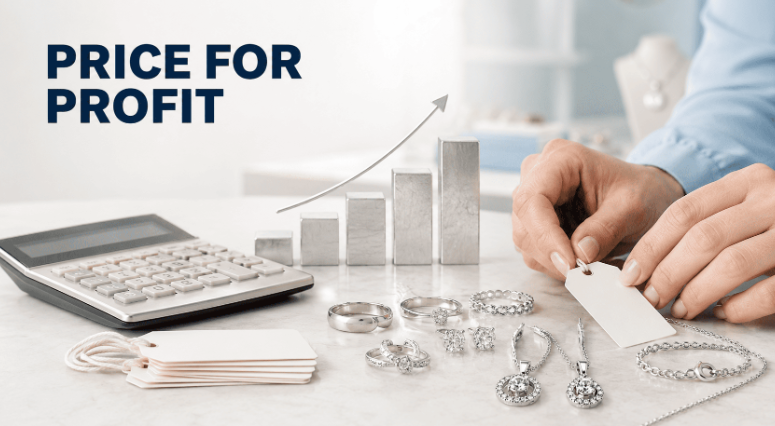
Pricing sterling silver jewelry is about more than adding a markup to the purchase cost. Your prices must cover sourcing, packaging, marketing, operating expenses, discounts, and unexpected losses while still remaining attractive to buyers.
Whether you purchase from wholesale jewelry suppliers or manufacture your own collection, a clear pricing strategy will help you protect your profit margins and build a sustainable jewelry business.
Understand the True Cost of Each Product
Before setting a retail price, calculate the complete cost of bringing each jewelry piece to market. The supplier’s price is only one part of the equation.
Your total product cost may include:
- Wholesale or manufacturing cost
- Shipping and freight charges
- Import duties and taxes
- Packaging materials
- Product photography
- Marketplace or payment-processing fees
- Advertising expenses
- Labor and order-fulfillment costs
- Expected returns, defects, or damages
- General business overhead
For example, a sterling silver ring may cost $18 from a supplier, but shipping, packaging, payment fees, and marketing could increase its actual cost to $28. If you calculate your price using only the original $18 cost, your real profit will be much lower than expected.
Reliable wholesale jewelry suppliers should provide clear product pricing, metal specifications, minimum order requirements, and shipping terms. This information makes it easier to calculate an accurate landed cost.
Know the Difference Between Markup and Profit Margin
Markup and profit margin are closely connected, but they are not the same.
Markup measures how much you add to the product cost:
Markup Percentage = (Selling Price − Product Cost) ÷ Product Cost × 100
Profit margin measures the percentage of the selling price that remains after the product cost:
Profit Margin = (Selling Price − Product Cost) ÷ Selling Price × 100
Suppose the total cost of a sterling silver pendant is $25 and you sell it for $50. Your markup is 100%, but your gross profit margin is only 50%.
Confusing these two calculations can lead to underpricing. Always set prices according to your required margin rather than relying on a simple markup alone.
Choose a Target Profit Margin
There is no single profit margin that works for every jewelry business. Your ideal margin will depend on your sales channel, competition, operating costs, product quality, and brand positioning.
To calculate a selling price based on your target margin, use:
Selling Price = Total Product Cost ÷ (1 − Target Margin)
If the complete cost of a ring is $28 and you want a 60% gross margin:
$28 ÷ (1 − 0.60) = $70
The suggested retail price would therefore be $70.
When purchasing wholesale jewelry, calculate the desired margin before placing a large order. A low supplier price does not automatically guarantee strong profits if shipping, marketing, and fulfillment costs are high.
Select the Right Pricing Method
Different products may require different pricing approaches. The following methods are commonly used by sterling silver jewelry retailers.
Cost-Plus Pricing
With cost-plus pricing, you calculate the complete product cost and add a fixed markup. This method is easy to manage, but it may not reflect the product’s perceived value or market demand.
Keystone Pricing
Keystone pricing generally means doubling the product cost to establish the retail price. For example, a $30 item would be sold for $60.
Although this method provides a useful starting point, it may not generate enough margin after advertising, packaging, marketplace fees, and discounts are included.
Market-Based Pricing
Market-based pricing involves comparing similar products sold by competing retailers. Examine the metal purity, weight, stone type, design complexity, finish, packaging, and brand reputation before making comparisons.
Avoid copying the lowest competitor price. A cheaper-looking product may use less silver, lighter construction, lower-grade stones, or basic packaging.
Value-Based Pricing
Value-based pricing focuses on what buyers are willing to pay based on the design, quality, presentation, and overall buying experience.
Distinctive craftsmanship, detailed oxidized work, premium gemstones, elegant packaging, and strong product photography can support a higher selling price. This method is especially effective for exclusive or design-focused collections.
Study the Competition Without Starting a Price War
Competitor research is important, but competing only on price can quickly reduce profitability. Compare products that are genuinely similar in material, weight, design, finish, and presentation.
Review:
- Retail selling prices
- Promotional discounts
- Product descriptions
- Shipping charges
- Packaging quality
- Buyer reviews
- Available sizes and variations
- Return policies
Use this information to identify a realistic price range. You do not always need to be the cheapest option. Buyers may willingly pay more for clearer product information, better images, faster delivery, trusted quality, and responsive service.
Build Discounts Into the Regular Price
Discounts can increase conversions, but frequent promotions may reduce your actual margin. If you regularly offer 10%, 15%, or 20% discounts, your standard retail price should account for them.
For example, if a ring is priced at $75 and sold with a 20% discount, the final selling price becomes $60. Your profit calculation should therefore be based on $60, not $75.
Before launching any promotion, confirm that the discounted price still covers:
- Product cost
- Packaging
- Shipping support
- Payment fees
- Advertising expenses
- Desired minimum profit
Planning for promotions is particularly important when ordering large quantities from wholesale jewelry suppliers. Excess inventory often leads to deeper discounts, which can reduce margins further.
Use Tiered Pricing for Different Product Categories
Not every jewelry item requires the same markup. A flexible pricing structure can help you balance sales volume and profitability.
For example:
- Basic silver bands may use a lower margin to attract price-conscious buyers.
- Gemstone rings may support a higher margin because of their visual appeal.
- Detailed handcrafted pieces may justify premium pricing.
- Fast-selling essentials may produce strong profits through volume.
- Limited or distinctive designs may command higher prices due to lower availability.
A tiered system allows your affordable products to bring new buyers into the store while premium pieces increase the average order value.
Consider the Perceived Value of Sterling Silver Jewelry
Buyers do not judge jewelry only by its metal cost. Presentation strongly influences how valuable a product feels.
You can improve perceived value through:
- Professional product photography
- Accurate measurements
- Clear stone and material descriptions
- Premium branded packaging
- Lifestyle images
- Care instructions
- Consistent brand presentation
- Detailed craftsmanship information
A well-presented sterling silver ring can often command a better price than the same ring shown in poor lighting with an incomplete description.
The same principle applies when evaluating wholesale jewelry. Look beyond the unit price and consider design quality, finishing, consistency, packaging options, and the supplier’s ability to restock successful products.
Negotiate With Suppliers Strategically
Better sourcing terms can improve margins without increasing retail prices. Ask about volume discounts, mixed-design orders, lower minimum quantities, shipping rates, payment terms, and repeat-order incentives.
Established wholesale jewelry vendors may offer better pricing as your order volume grows. However, avoid buying excessive inventory simply to receive a small discount. A slightly higher unit cost is often safer than investing heavily in products that may sell slowly.
Strong supplier relationships can also provide access to new designs, more consistent stock, and flexible ordering options.
Review Pricing Regularly
Jewelry pricing should not remain unchanged forever. Sterling silver prices, freight charges, advertising costs, marketplace fees, and buyer demand can change over time.
Review your prices at least every three to six months. Track:
- Gross profit per item
- Gross margin percentage
- Advertising cost per sale
- Return rate
- Inventory turnover
- Average order value
- Discount frequency
- Best-selling and slow-moving products
Increase prices gradually when costs rise or when certain designs consistently sell well. Small, calculated adjustments are usually easier for buyers to accept than sudden, significant increases.
Final Thoughts
Profitable sterling silver jewelry pricing begins with knowing your complete costs. From there, select a target margin, compare the market, account for discounts, and adjust prices according to the value each product offers.
Working with dependable wholesale jewelry suppliers can help you access competitive pricing, consistent quality, and better inventory options. However, the strongest margins come from combining smart sourcing with professional presentation, accurate cost calculations, and regular performance reviews.
When wholesale jewelry is priced strategically, every sale contributes not only to revenue but also to the long-term growth and financial stability of your business.