Best 150+ Simple Synonyms for Which in English 2026
Synonyms for which are words and phrases you can use in place of the word “which” to keep your writing fresh, clear, and varied. The word “which” works as a relative pronoun, interrogative pronoun, and determiner in English sentences. Using the same word repeatedly makes your writing dull and repetitive. Whether you are writing an essay, email, blog post, or report, knowing the right synonym for which helps you write with more confidence and precision. This complete guide gives you 150+ simple synonyms for which in English 2026 organized by grammar role, formality level, and context so you always pick the right word.
What Is the Word “Which” in English Grammar
The word “which” is one of the most flexible words in the English language. It plays several different roles depending on how it is used in a sentence.
As a relative pronoun, “which” introduces a clause that gives more information about a noun. As an interrogative pronoun, it asks a question about one thing chosen from a defined set. As a determiner, it modifies a noun directly in both questions and relative clauses.
Understanding the grammatical role of “which” in each sentence helps you choose the most accurate synonym. A synonym that works perfectly in a relative clause may not work at all in a question.
Synonyms for Which as a Relative Pronoun
When “which” introduces a relative clause to give extra information about a noun, these are the best words and phrases to use instead.
That
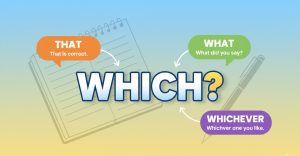
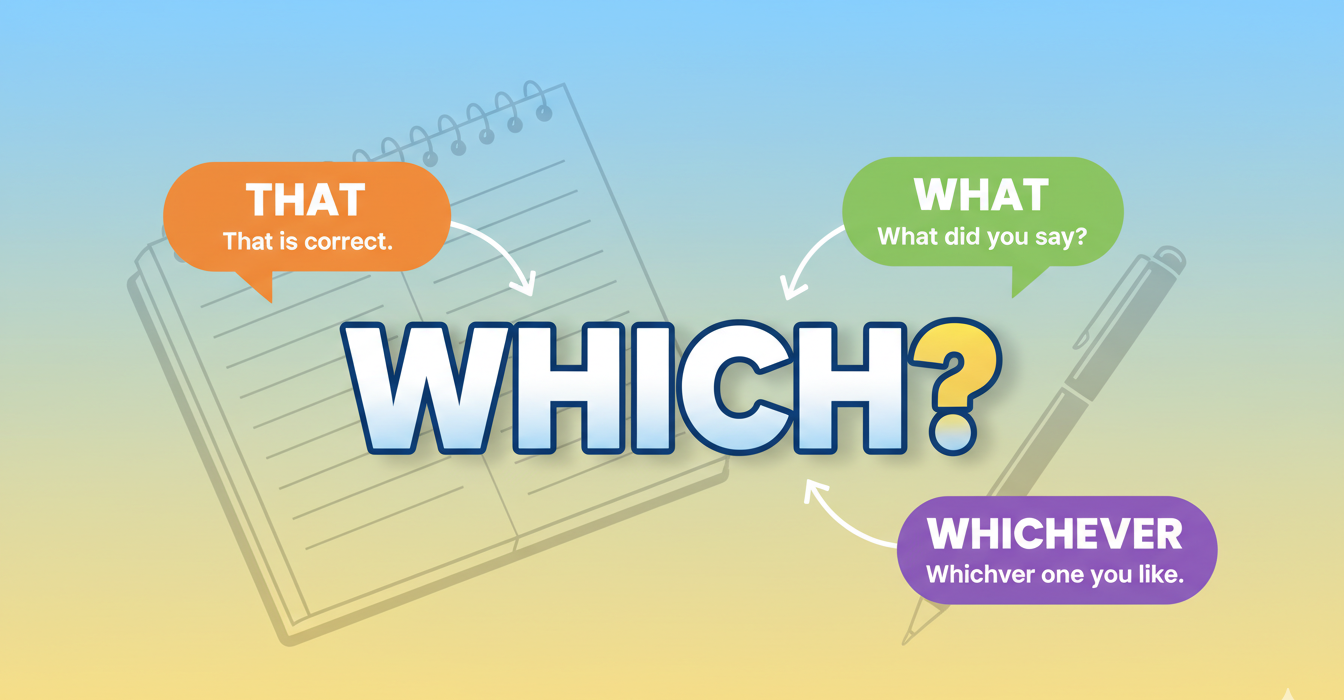
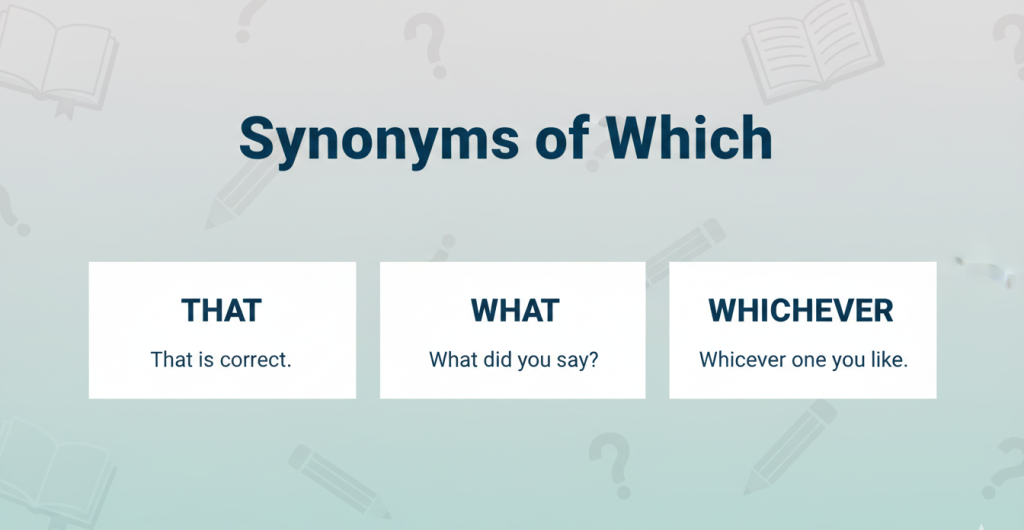
“That” is the most common and widely used synonym for which in relative clauses. It is especially natural in defining or restrictive clauses where the information is essential to the meaning.
Example: The report that you submitted was excellent. Example: The car that I bought last year is still running well.
“That” sounds more informal than “which” but is perfectly acceptable in both spoken and written English. In American English, “that” is preferred over “which” in restrictive clauses.
Who
“Who” is the correct synonym for which when the antecedent is a person or group of people. Using “which” for people is technically incorrect in standard grammar.
Example: The manager who approved the request is on leave. Example: The students who passed the exam were celebrated.
“Who” works in both restrictive and non-restrictive relative clauses when referring to human subjects. It is appropriate at every level of formality.
Whom
“Whom” replaces “which” in formal writing when the pronoun functions as the object of a verb or preposition. It is the object form of “who.”
Example: The consultant whom we hired delivered excellent results. Example: The professor to whom I submitted my paper has not responded.
“Whom” is declining in everyday speech but remains the grammatically correct choice in academic, legal, and formal written contexts.
Whose
“Whose” replaces “which” when possession or ownership is being expressed in the relative clause. It can refer to both people and things.
Example: The company whose shares rose the most won the investor award. Example: The book whose cover was torn belongs to the library.
“Whose” is the only possessive relative pronoun in English and cannot be substituted by any other word in possessive relative clauses.
Where
“Where” replaces “which” when the antecedent is a place. It replaces constructions like “in which” or “at which.”
Example: The city where I grew up has changed a lot. Example: This is the building where the conference will take place.
Using “where” instead of “in which” simplifies sentences considerably. It is suitable for both formal and informal contexts.
When
“When” replaces “which” when the antecedent refers to a time or period. It replaces phrases like “at which time” or “during which.”
Example: I remember the day when everything changed. Example: There was a period when nobody spoke openly about this.
“When” makes time-based relative clauses much more readable. It is always preferred over “at which” in everyday writing.
Why
“Why” replaces “which” or “for which” when the antecedent is a reason. It is used primarily in informal and everyday writing.
Example: That is the reason why I left early. Example: She explained the cause why the project failed.
In formal writing, “for which” is preferred over “why” in relative clauses. In informal writing and speech, “why” is entirely natural.
Synonyms for Which as an Interrogative Pronoun
When “which” is used in questions to ask someone to identify or choose something from a set, these are the best alternatives.
What
“What” is the most natural interrogative synonym for “which” when the choice is open rather than limited to a specific known set.
Example: What color do you prefer? Example: What time does the meeting start?
The key difference is that “which” implies a limited set of choices while “what” implies an open-ended field. Both are grammatically correct in most questions.
Whichever
“Whichever” replaces “which” when expressing that any choice from the available options is acceptable. It carries an emphatic or permissive meaning.
Example: Choose whichever option works best for you. Example: Whichever road you take leads to the city center.
“Whichever” adds a sense of flexibility or indifference to the choice. It is suitable for both formal and informal writing.
Whatever
“Whatever” is used in place of “which” when referring to any option from a completely open set, often with a tone of indifference or generality.
Example: Take whatever you need from the shelf. Example: Whatever decision you make, I will support you.
“Whatever” is stronger and more emphatic than “whichever.” It implies that the full range of options is available rather than a defined subset.
Which One
“Which one” is a phrase that replaces “which” in questions when you want to make it clearer that you are asking the listener to identify a specific item.
Example: Which one of these reports did you mean? Example: Which one is your favorite?
This construction adds clarity and is especially useful in spoken conversation where pointing or gesturing accompanies the question.
Relative Pronoun Synonyms for Which
- That
- Who
- Whom
- Whose
- Where
- When
- Why
- In which
- At which
- On which
- By which
- For which
- Through which
- From which
- With which
- Of which
- About which
- During which
- After which
- Before which
- Upon which
- Into which
- Over which
- Under which
- Across which
- Beyond which
- Among which
- Between which
- Around which
- Beneath which
Interrogative Synonyms for Which
- What
- Whichever
- Whatever
- Which one
- Which type
- Which kind
- Which sort
- Which particular
- Which exact
- Which specific
- What kind of
- What type of
- What sort of
- What particular
- What exact
- What specifically
- What exactly
- What in particular
- Which of the two
- Which among these
Formal Synonyms for Which in Writing
- The aforementioned
- Said (legal writing)
- The foregoing
- The latter
- The former
- The abovementioned
- In question
- Therein
- Thereto
- Thereof
- Therewith
- Thereupon
- Whereby
- Wherein
- Whereof
- Whereon
- Whereat
- Whereto
- Whereunto
- Wherethrough
Informal and Conversational Replacements for Which
- That
- What
- Who
- The one that
- The thing that
- The part that
- The bit that
- The piece that
- The item that
- The one where
- The spot where
- The time when
- The reason why
- The way in which
- The manner in which
- The method by which
- The means by which
- The case in which
- The instance in which
- The situation in which
Phrase Synonyms and Expressions for Which
- In that case
- In which case
- Under which circumstances
- For which purpose
- On the basis of which
- As a result of which
- As a consequence of which
- On account of which
- Due to which
- Owing to which
- Because of which
- In light of which
- In view of which
- Given which
- After which point
- Following which
- Subsequent to which
- Prior to which
- Before which point
- In the course of which
Words Similar to Which for Academic Writing
- That
- Whom
- Whereby
- Wherein
- Whereof
- The nature of which
- The extent of which
- The degree to which
- The manner in which
- The extent to which
- The basis upon which
- The grounds on which
- The conditions under which
- The context in which
- The framework within which
- The scope of which
- The purpose for which
- The means through which
- The process by which
- The mechanism through which

One-Word Alternatives to Which
- That
- Who
- Whom
- Whose
- Where
- When
- Why
- Whether
- Whichever
- Whatever
- Whoever
- Wherever
- Whenever
- However
- Thereby
- Therein
- Wherein
- Whereby
- Thereof
- Wherewith
Formal Legal and Academic Alternatives to Which
In legal, academic, and highly formal writing, English has a set of archaic but still valid pronoun alternatives to “which.” These are called “relative adverbs” or “compound relative forms.”
- Whereby means by which or through which. Example: They signed an agreement whereby all disputes would be settled through arbitration.
- Wherein means in which or in what. Example: They described the conditions wherein the contract would be void.
- Whereof means of which or of what. Example: A document whereof the contents remain confidential.
- Whereupon means after which or upon which. Example: The judge made a ruling, whereupon the defendant left the courtroom.
- Therein means in that place, document, or matter. Example: The clause therein supersedes all previous agreements.
- Thereof means of that or of it. Example: The terms thereof have been agreed upon by both parties.
- Thereto means to that place or document. Example: All provisions attached thereto remain valid.
- Thereby means by that means or as a result. Example: He completed the task on time, thereby earning a bonus.
- Therewith means with that or immediately after. Example: The document was signed and therewith became legally binding.
- Thereunder means under that authority or provision. Example: Benefits offered thereunder are subject to tax.
These terms are rarely used in casual writing but appear frequently in contracts, legislation, academic journals, and formal reports.
Synonyms for Which in Everyday Sentences with Examples
Seeing synonyms for which in real sentences is the fastest way to understand when and how to use them. Here are practical example sets.
- Original: The book which I borrowed was interesting. Alternative with that: The book that I borrowed was interesting.
- Original: The company which we visited had great facilities. Alternative with that: The company that we visited had great facilities.
- Original: This is the house which my grandfather built. Alternative with that: This is the house that my grandfather built.
- Original: The river which runs through the city is polluted. Alternative with that: The river that runs through the city is polluted.
- Original: The plan which was approved has now been cancelled. Alternative with that: The plan that was approved has now been cancelled.
- Original: The city which I grew up in has many parks. Alternative with where: The city where I grew up has many parks.
- Original: The decade which I remember most is the nineties. Alternative with when: The decade when I remember most is the nineties.
- Original: Tell me the reason which made you leave. Alternative with why: Tell me the reason why you left.
- Original: The colleague which helped me has now moved abroad. Alternative with who: The colleague who helped me has now moved abroad.
- Original: The office which they work in is on the fifth floor. Alternative with where: The office where they work is on the fifth floor.
Frequently Asked Questions
What is the best synonym for which in a relative clause?
The best synonym for which in a relative clause is “that” for restrictive clauses and “who” when the antecedent is a person. For places use “where” and for times use “when.”
Can I always use that instead of which?
No. “That” can only replace “which” in restrictive or defining relative clauses. In non-restrictive clauses set off by commas, “which” must be used and cannot be replaced by “that.”
What is the difference between which and what as synonyms?
“Which” refers to a choice from a limited defined set. “What” refers to an open-ended choice with no predefined options. Use “which” when options are known and “what” when they are open.
Is whichever a synonym for which?
Yes. “Whichever” is a synonym for “which” that adds emphasis and means any one from a group. It is used when expressing that all choices are equally acceptable.
When should I use whereby instead of which?
Use “whereby” instead of “which” in formal and legal writing when “which” follows a preposition or describes a method or process. Example: An agreement whereby both parties share costs.
Can which be replaced by who?
Yes, but only when the noun being referred to is a person or group of people. “Who” replaces “which” for human antecedents. For objects and animals, “which” or “that” are used.
What is a synonym for which in formal writing?
In formal writing, strong synonyms for which include whereby, wherein, whereof, thereof, therein, and the prepositional phrase alternatives such as in which, on which, and by which.
Is where a synonym for which?
Yes. “Where” is a synonym for “which” when the antecedent is a place. It replaces the construction “in which” or “at which” and makes sentences simpler and more natural.
What is the synonym for which in a question?
In a question, the most common synonyms for which are “what” and “whichever.” Use “what” for open-ended questions and “whichever” when all options from a defined set are acceptable.
How many synonyms does the word which have?
The word which has dozens of synonyms covering its different grammatical roles. The most common are that, what, who, whom, whose, where, when, why, whichever, and whatever.
Conclusion
Synonyms for which give your writing more variety, precision, and flow without changing the core meaning of your sentences.
From “that” in everyday writing to “whereby” in legal documents, every synonym for which serves a different purpose depending on grammar role and formality level.
This guide covered 150+ synonyms for which organized by context, style, and sentence type so you always have the right word ready. The most important takeaway is to first identify the grammatical role of “which” in your sentence, then match the correct synonym to your writing style.
Master these alternatives and your English writing will instantly feel cleaner, smarter, and more professional in 2026 and beyond.