The Walk In Shower That Ran Cold Until Someone Checked The Whole House
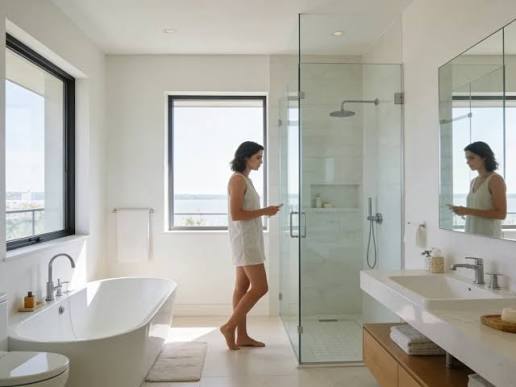
The grout was six days old when the complaints started. A family in a 1970s Scottsdale ranch house had just spent close to six thousand dollars turning a hall bathroom into an accessible walk-in shower for the 81-year-old father who had moved into the back bedroom, and inside a week they were calling a residential plumber Scottsdale AZ instead of the tile setter, because the new shower went weak and cold every time the washing machine filled. Here is the part worth carrying into your own project: an accessibility retrofit only works as well as the pipe feeding it, so the supply system should be inspected before anyone buys another fixture.
Three Generations Doubled Demand On One Old Line
The house went up in 1974 with two bathrooms and galvanized steel branch lines, which was ordinary for the era and perfectly adequate for the couple who raised two kids in it. Then the household became four adults. Dad showers every morning at seven, which is the same hour the laundry runs and the kitchen tap gets used for breakfast. Nothing about that routine is unreasonable. The supply lines were simply never sized for it. Galvanized steel corrodes from the inside out, and the interior diameter of a fifty-year-old three-quarter-inch line can shrink until it moves about as much water as a garden hose with a kink in it. Job after job in these ranch houses, the same thing turns up: the horizontal hot branch running to the back of the house is the most restricted piece in the system, and it is also the one feeding the bathroom somebody just remodeled.
Fifty years ago galvanized was what you used, and the plumber who pulled the permit in 1974 was not making a mistake. Today that same repipe in Arizona goes in as PEX or copper, sized for the fixtures actually on the run rather than the ones that were there when the house was new, and a decent estimator will ask how many people shower between six and eight in the morning before quoting anything. That question sounds like small talk. It is the load calculation.
The Fixture Swap Was Never The Real Fix
Nobody needed to replace the new shower valve. The inspection took static pressure at the hose bib, then flow pressure with two fixtures open, and the gap told the story before a single wall came open: 62 psi sitting still, 21 psi under load. A residential plumber Scottsdale AZ families hire for older houses tends to look for that gap first, because a pressure reading taken with everything shut off says almost nothing about what happens at seven in the morning. How much of the loss came from the corroded branch and how much came from an undersized run back to the water heater, I honestly cannot tell you. Nobody meters a fifty-year-old house room by room before the work starts, and once the old pipe is out of the wall it leaves in the truck.
One thing does not get left to guesswork, and that is temperature. Set the water heater deliberately, install a thermostatic mixing valve at the shower, and verify the actual temperature at the fixture with a thermometer. Never judge a safe shower temperature by hand for someone else, because an older adult with reduced skin sensation can be badly scalded by water that feels only pleasantly warm to you. A review published in the NIH’s PubMed Central recommends water delivered at fixtures between 105 and 120 degrees Fahrenheit for people with reduced sensation or mobility, a range its authors frame as balancing burn prevention against the growth of waterborne organisms inside the system.
The budget is where families feel all of this. A January 2026 accessible bathroom cost guide from Horow puts a standard 60 by 36 inch roll-in shower installation at roughly $3,200, which swallows more than half of a six thousand dollar retrofit before anyone touches a pipe. Say the branch repipe across the back half of that house runs 46 feet of hot and cold at $38 a foot installed, or $1,748; add a thermostatic mixing valve at $310, a permit at $175, and drywall patch and texture at $260, and the plumbing side comes to $2,493. Set that against a $3,200 shower nobody can use at seven in the morning, and the order of operations stops being a matter of opinion.
What Week One And Month Three Look Like
Plan on the first day being loud. Repiping one branch usually means water off for most of a working day, two or three sections of drywall opened, and the household showering somewhere else that evening. Through the first week the patch and texture work comes and goes, and the practical difference shows up right away: the shower holds temperature with the laundry running, which was the entire point of the money. By month three the family has stopped thinking about the bathroom at all, and that is the real test, though it is often around then that someone notices the water heater recovering faster now that it is not pushing through a restricted line. Within 90 days, ask for one follow-up check of the mixing valve setting, since valves drift and nobody catches that by feel.
The mistake in this story was not the shower, the tile, or the budget. It was assuming a bathroom that served two people would serve four once a fixture got swapped. A house being adapted for a parent moving in is asking its plumbing to do a job it was never sized for, and an inspection of the whole supply system costs a small fraction of the remodel it protects. Answer the pipe question first, then go buy the shower.