Stats Spotify: Your Listening Habits & Top Tracks 2026
Stats Spotify tools give every listener a detailed window into their personal music world — top artists, most-played tracks, favorite genres, and total listening time — all available right now without waiting for Spotify Wrapped in December.
Whether you want to see your all-time favorites, what you have been obsessing over for the last four weeks, or how your taste has shifted across six months, Spotify’s own built-in features and a powerful set of third-party tools make it easy.
What Are Stats Spotify and Why Do They Matter
Spotify stats are the listening data Spotify collects every time you press play — every song, artist, genre, and podcast session is logged and analyzed.
This data powers algorithmic playlists like Discover Weekly, Daily Mix, and Release Radar. It also surfaces as personal insights in Spotify Wrapped each December and through third-party tools available throughout the year.
Understanding your stats helps you discover new music that fits your taste, track how your preferences evolve over time, and even share your listening identity with friends.
How Spotify Calculates Your Top Artists and Tracks
Spotify calculates your top artists and tracks using two core metrics: how frequently you listen to them and how recently those listens happened.
Recent listening weighs more heavily than older plays. A song you streamed 30 times last week will rank above a track you played 100 times two years ago.
This recency bias means your stats are always alive and shifting — they reflect your current musical mood, not just a historical archive of everything you have ever streamed.
Three Time Periods You Can View
Every major Spotify stats tool gives you data across three distinct time windows, each revealing a different layer of your listening identity.
The last four weeks shows your most current obsessions — the songs and artists dominating your headphones right now. The last six months gives a broader seasonal picture of your taste. All time reflects your complete history on Spotify from the day you signed up.
Toggling between all three time periods is the fastest way to spot how your listening habits have changed and which artists have held your attention the longest.
How to Check Your Spotify Stats Inside the App
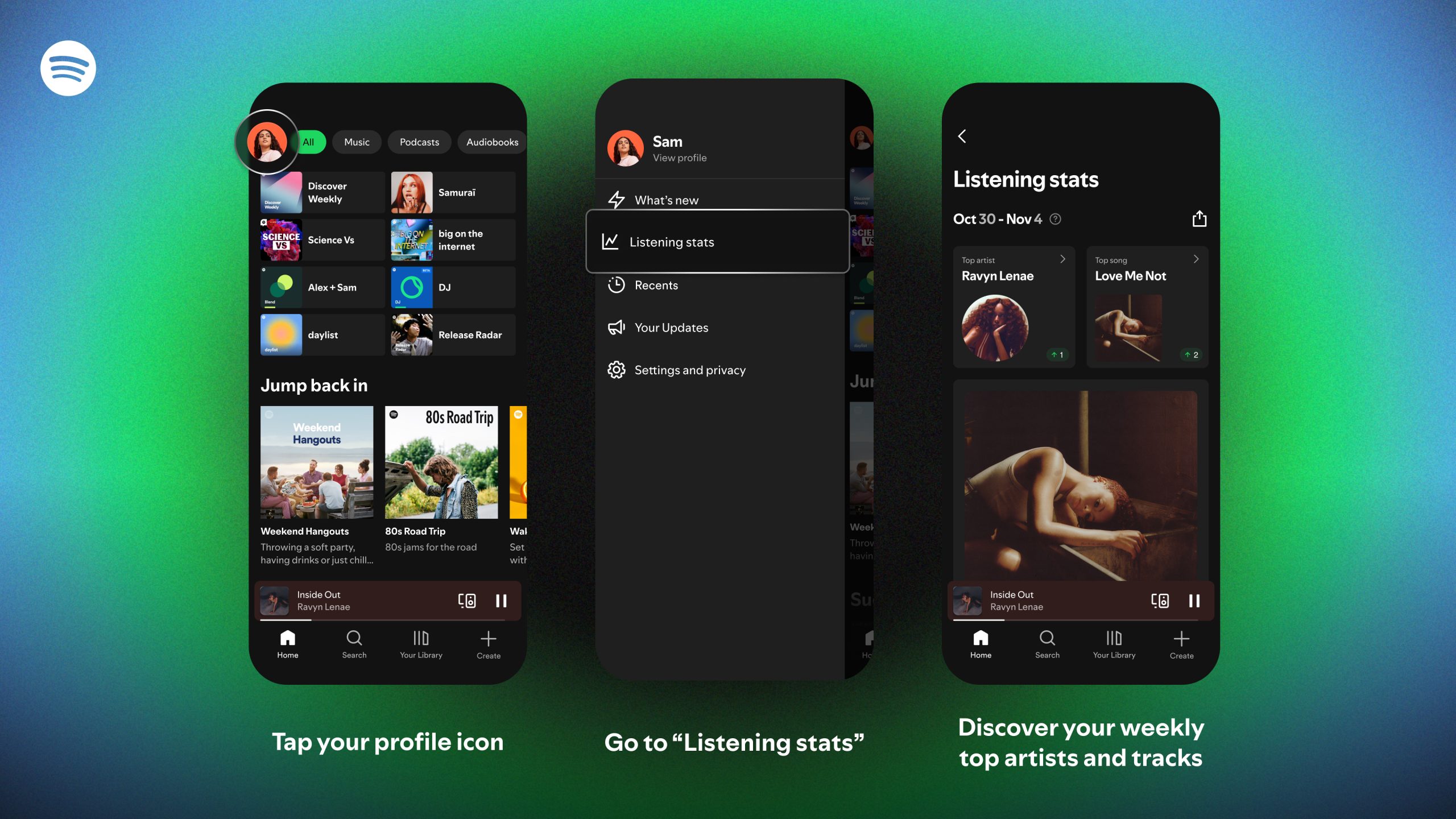
Spotify’s native mobile app gives you basic but useful listening data without needing to install or log into anything else.
On the mobile app, go to your Profile page and you will see a list of recently played artists. To enable this, go to Settings and switch on the Recently Played Artists toggle first.
On the web player, visit your Profile and your top artists and top tracks for the past month are displayed automatically. Tap Show All to expand the list to your top 10 artists and top 50 tracks.
Your Top 50 Artists and Tracks: What the Numbers Show
Spotify surfaces up to 50 top artists and 50 top tracks in your profile, ranked entirely by listening frequency and recency rather than by manual curation.
The ordering updates daily, so a weekend binge on a new album can push a previously unknown artist into your top five almost overnight. This makes the list a real-time reflection of your listening rather than a frozen snapshot.
Artists you have saved to your library also receive a slight ranking boost in some third-party tools, though Spotify’s native ranking is based purely on stream count and recency.
The Best Third-Party Tools to View Your Spotify Stats in 2026
Several reliable third-party platforms connect to the official Spotify API and display your personal data in more detail and with better visuals than the native app allows.
All of these tools use Spotify’s official OAuth login — you authorize them with your existing Spotify account and they read your listening data with limited read-only permissions. None of them store your personal data.
| Tool | Best For | Time Periods | Extra Features |
|---|---|---|---|
| Stats for Spotify (statsforspotify.com) | Top tracks, artists, genres | 4 weeks, 6 months, all time | Genre breakdown |
| Chosic | Mood analysis, decade breakdown | 4 weeks, 6 months, all time | Danceability, energy scores |
| Trackify | Play counts, listening minutes | Real-time + history | 999+ top tracks |
| Musicalyst | Shareable profiles | Monthly, 6 months, all time | Share with friends |
| My Top Spotify (mytopspotify.io) | Top albums, artists, tracks | Monthly, 6 months, all time | Top 20 albums |
| Spotify Pie | Genre visualization | Last month | Pie chart by genre |
| Receiptify | Receipt-style track list | 4 weeks, 6 months, all time | Shareable image |
Stats for Spotify: The Most Popular Tool
Stats for Spotify at statsforspotify.com is consistently the most recommended third-party stats tool in 2026, known for its clean interface and straightforward data presentation.
After logging in with your Spotify credentials and accepting the read-only permissions on the agreement page, it displays your top tracks, top artists, and top genres for all three time periods instantly.
It does not store your personal Spotify data, updates daily, and is widely regarded as safe for regular use. The genre breakdown it provides is one feature the native Spotify app does not offer at all.
How to Use Stats for Spotify Step by Step
Getting your full stats on Stats for Spotify takes less than two minutes and requires no downloads or installations whatsoever.
Go to statsforspotify.com in any browser. Read and click Agree on the permission agreement page to allow the tool to view your Spotify data with read-only access. Select from the three time period options — short term (four weeks), medium term (six months), or long term (all time) — and your ranked lists appear immediately.
Your data refreshes daily, so checking back weekly gives you a moving picture of how your listening evolves across the month.
Chosic: Mood, Energy, and Decade Stats
Chosic goes deeper than most tools by analyzing the audio characteristics of your top tracks and translating them into mood and energy scores.
After logging in via Spotify, it shows your top 50 artists and tracks plus your top main genres, sub-genres, and even the decades your listening skews toward. The mood metrics include happiness, danceability, energy, acousticness, and instrumentalness — all derived from Spotify’s own audio analysis data for each track.
The decade breakdown is particularly fun: it shows whether your taste runs toward 1980s classics, 1990s alternative, 2000s pop, or current releases, making it one of the most revealing stats tools available in 2026.
Trackify: Play Counts and Listening Minutes
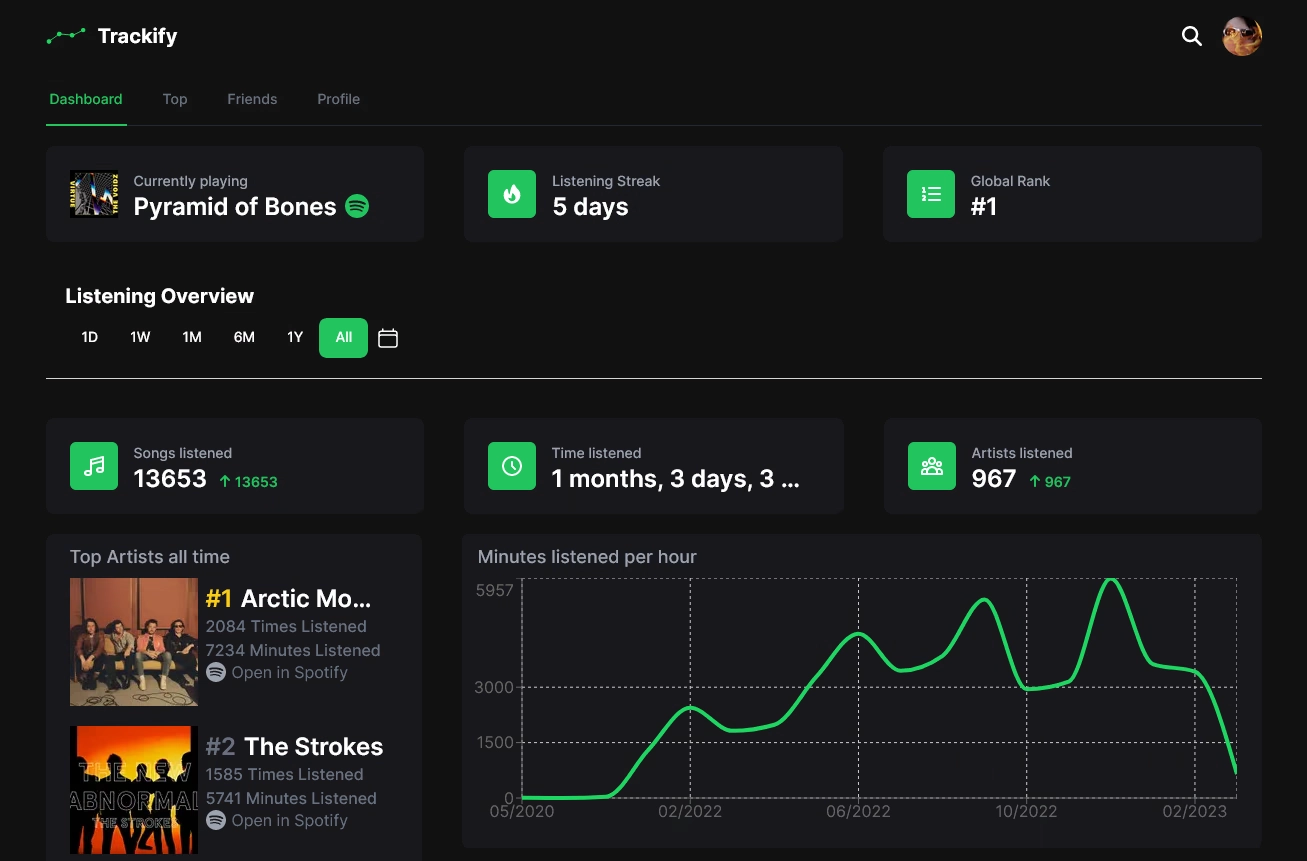
Trackify is the only widely available tool in 2026 that shows your actual play counts and total listening time in minutes rather than just ranked lists.
It goes beyond the top 50 tracks that most tools are limited to and displays up to 999-plus top artists and tracks. For listeners who want raw numbers — exactly how many times you played a specific song, or your total hours on the platform this year — Trackify fills the gap that Spotify and most other tools leave open.
It is particularly popular among listeners who want to track whether their listening minutes are growing, holding steady, or declining across different seasons of the year.
Receiptify and Spotify Pie: The Shareable Stats Experience
Receiptify transforms your top Spotify tracks into a receipt-style image that has become one of the most shared music-identity formats on social media since 2022.
It shows your top tracks with their streaming numbers in a clean, minimalist receipt layout for the last month, six months, or all time. The image format makes it instantly shareable to Instagram stories, Twitter, and TikTok without any editing.
Spotify Pie takes a different visual approach, generating a colorful pie chart that breaks your listening down by genre percentage. It is one of the fastest ways to see at a glance whether you lean 60% pop, 25% hip-hop, and 15% indie — or whatever your personal genre blend turns out to be.
Spotify Wrapped 2026: The Annual Stats Event
Spotify Wrapped is Spotify’s own official annual stats feature, released each December, and it remains the most anticipated personal data event in music each year.
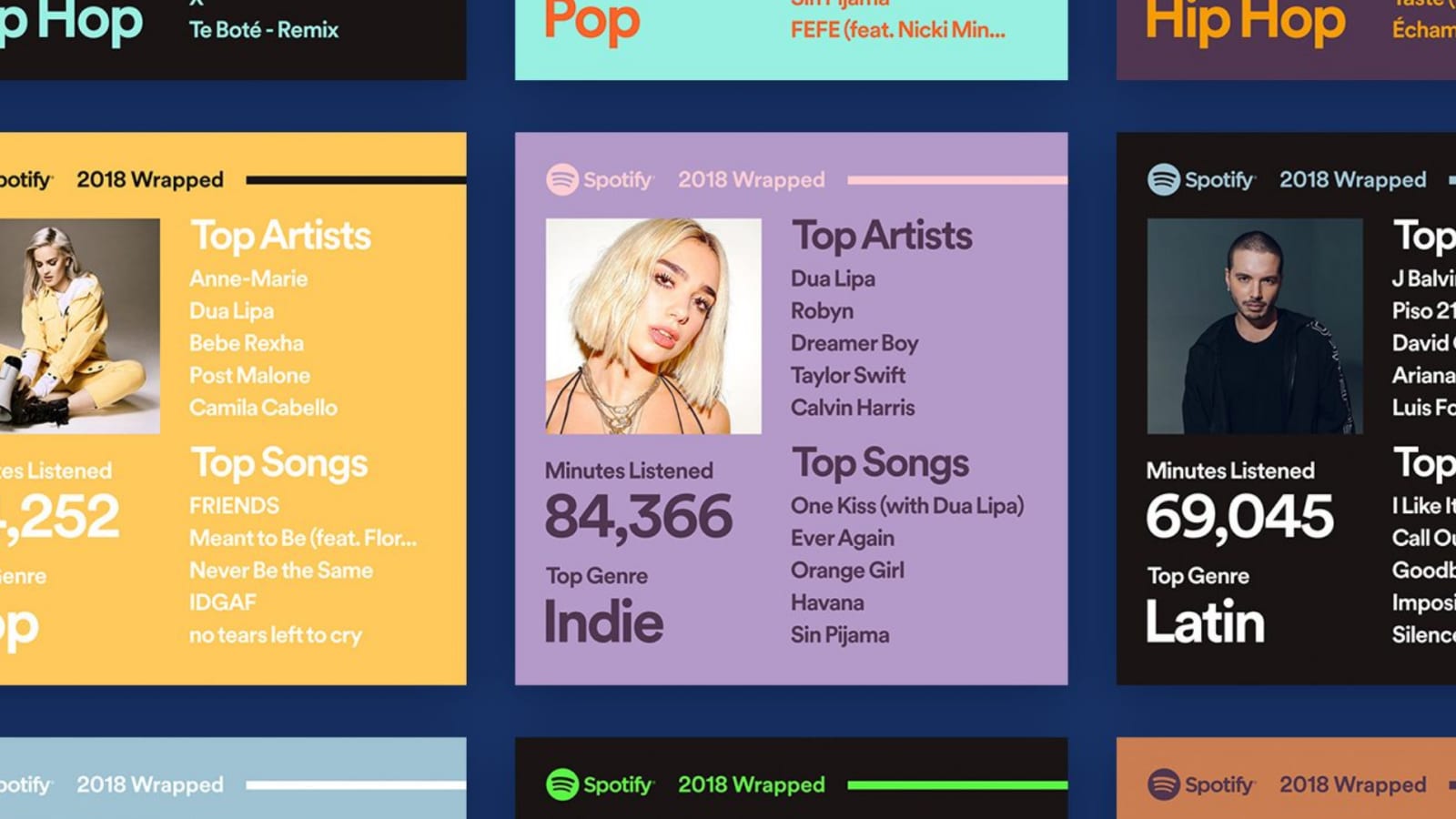
Wrapped gives every user a personalized summary of their most-played tracks, top artists, total listening minutes, top genres, and a custom personality type based on their musical preferences. Since 2015, it has been the cultural moment that brings hundreds of millions of listeners back to reflect on their year in music.
Wrapped 2025 (released December 2025) introduced an AI-powered summary feature and expanded the podcast stats section with minutes listened per show. Wrapped 2026 is expected in December 2026 with further AI personalization enhancements.
Global Spotify Statistics 2026: The Platform at Scale
Understanding your personal stats is more meaningful when you know the scale of the platform you are part of. Spotify in 2026 is the largest music streaming service in the world by a significant margin.
As of 2025, Spotify has 696 million monthly active users, up from 602 million in Q4 2023, making it the largest music streaming service in the world. Of those, 276 million listeners (39.7 percent) subscribe to Premium, while the rest use the free, ad-supported tier.
The average Spotify user streams 114 minutes per day, with Premium subscribers averaging 142 minutes. Gen Z leads at 126 minutes daily, while Brazil tops the world with 2.4 hours per day.
| Spotify Platform Stat | 2026 Data |
|---|---|
| Monthly Active Users | 696 million |
| Premium Subscribers | 276 million (39.7%) |
| Total Songs in Catalog | 126 million+ |
| New Tracks Added Daily | ~60,000 |
| Avg Daily Listening (All Users) | 114 minutes |
| Avg Daily Listening (Premium) | 142 minutes |
| Total Playlists on Platform | 8 billion+ |
| Podcast Titles Available | 6 million+ |
Most Streamed Artists on Spotify 2026
The global streaming leaderboard at the top of Spotify is a constantly shifting competition between a handful of mega-artists with enormous fan bases across every region of the world.
As of January 2026, Taylor Swift is the most-streamed artist on Spotify with 117.4 billion lead streams, followed by Bad Bunny with 101.7 billion and Drake at 97.51 billion streams.
Bruno Mars leads with more than 150 million monthly listeners, while Taylor Swift has surpassed 100 billion total streams. These figures shift daily as new releases and viral moments change the listening landscape.
| Rank | Artist | Total Lead Streams |
|---|---|---|
| 1 | Taylor Swift | 117.4 billion |
| 2 | Bad Bunny | 101.7 billion |
| 3 | Drake | 97.51 billion |
| 4 | The Weeknd | ~95 billion |
| 5 | Ed Sheeran | ~90 billion |
Most Streamed Songs on Spotify of All Time
The all-time streaming records on Spotify are dominated by a small group of crossover pop hits that achieved rare global saturation across every market and demographic.
Blinding Lights by The Weeknd is the most-streamed song of all time with over 5.23 billion streams recorded so far, followed by Shape of You by Ed Sheeran with 4.72 billion streams.
These numbers grow every single day as new listeners discover the tracks and existing fans return to them. The gap between the top 5 most-streamed songs and the next tier is enormous — most tracks on the platform never come close to these figures.
| Rank | Song | Artist | Streams |
|---|---|---|---|
| 1 | Blinding Lights | The Weeknd | 5.23 billion |
| 2 | Shape of You | Ed Sheeran | 4.72 billion |
| 3 | Someone You Loved | Lewis Capaldi | ~3.5 billion |
| 4 | Sunflower | Post Malone & Swae Lee | ~3.4 billion |
| 5 | Dance Monkey | Tones and I | ~3.3 billion |
Device Listening Habits: Where People Stream in 2026
How people access Spotify is just as revealing as what they listen to, and the device breakdown in 2026 shows that mobile completely dominates the listening experience.
Globally, 72% of sessions start on mobile, with desktop at 19% and smart speakers/wearables at 9%. Mobile listening peaks at 8 a.m. and 6 p.m. on weekdays, while desktop use is highest during work hours.
Cars are a growing Spotify channel. Android Auto and CarPlay represent 14% of all listening time in 2026, reflecting how streaming has replaced radio as the primary in-car music source for a growing share of drivers worldwide.
| Device | Share of Sessions |
|---|---|
| Mobile | 72% |
| Desktop | 19% |
| Smart Speakers / Wearables | 9% |
| Car (Android Auto / CarPlay) | 14% of listening time |
Genre Stats: What the World Is Listening To
Genre trends on Spotify shift constantly, but certain categories have maintained dominance across years while new micro-genres emerge and gain traction every few months.
Pop remains the most-streamed genre globally, followed by hip-hop/rap, Latin, and rock. The fastest-growing genre categories in recent years have included Afrobeats, K-pop, regional Mexican music, and amapiano — each driven by specific geographic markets growing rapidly in their Spotify user base.
Your personal genre breakdown from any stats tool may look completely different from these global trends — that contrast between your taste and the mainstream is exactly what makes personal stats so compelling.
How the Spotify Popularity Score Works
Every artist and track on Spotify has a hidden popularity score between 0 and 100 that most users never see but that directly influences what gets recommended.
The Spotify popularity score is a hidden 0–100 rating assigned by Spotify to every artist and track. A higher score means the artist or song is currently receiving more attention compared to others on the platform. This score is used internally to rank music in search results and to feed algorithmic playlists like Discover Weekly, Release Radar, and Daily Mix.
The score is mainly based on recent streams, engagement signals like saves, skips, playlist adds, and shares, the recency of releases, and global versus local trend spikes. Spotify updates these scores frequently, often daily.
Spotify Stats for Artists: A Different Layer of Data
Artists and their teams have access to a completely different and far more detailed set of Spotify statistics through Spotify for Artists, the platform’s dedicated analytics dashboard.
Spotify for Artists shows stream counts by track, monthly listener counts, follower growth, playlist placements, and detailed audience demographics including age, gender, and geographic location down to individual cities. This data is updated in near-real time and is far richer than what personal listener tools provide.
Third-party platforms like Soundcharts monitor Spotify stats across 2 million-plus artists, providing real-time analytics from Spotify followers and charts to playlist exposure and detailed consumption data by city and country.
Independent Artists and Streaming Reality in 2026
The scale and distribution of streaming success on Spotify in 2026 is far more unequal than most casual listeners realize.
Only 1.58 million artists (14%) attract more than 10 monthly listeners, showing how steep the curve is between uploading music and reaching an audience. Nearly 86% of all tracks stay under 1,000 plays, and about 45.6 million songs have never been played once.
Despite this, independent artists earned over $5 billion in royalties in 2024, nearly half of all payouts on Spotify, demonstrating that the platform remains a genuinely powerful income channel for artists who do build an audience, even outside the major label system.
How to Save Your Top Tracks as a Spotify Playlist
One of the most useful features offered by third-party stats tools is the ability to instantly convert your top-ranked tracks into a saved Spotify playlist with a single click.
Tools like Chosic and My Top Spotify include a Save to Spotify button next to your top tracks list. Clicking it creates a new playlist in your Spotify library containing your current top 50 tracks for whichever time period you selected.
This is a great way to preserve a snapshot of your current musical identity — especially useful if you know your taste is shifting and you want to look back later at where your listening was at a specific moment in time.
Privacy and Safety: Are Third-Party Spotify Stats Tools Safe
Every reputable Spotify stats tool in 2026 uses Spotify’s official OAuth API, which means they never see your password and can only read the specific data you authorize.
Tools like Chosic do not store any Spotify data about users. Your personal listening report is private, and your Spotify stats are updated daily. The same read-only, no-storage policy applies to Stats for Spotify, Musicalyst, My Top Spotify, and most other reputable tools.
The key safety practice is to read the permissions agreement before authorizing any tool, and to revoke access from tools you no longer use through Spotify’s connected apps settings page at spotify.com/account/apps.
Spotify Wrapped vs Year-Round Stats Tools: Key Differences
Many listeners do not realize that waiting for Spotify Wrapped in December means going eleven months of the year without deep personal listening insights — a gap that year-round tools fill completely.
| Feature | Spotify Wrapped | Third-Party Stats Tools |
|---|---|---|
| Availability | December only | Year-round, daily updates |
| Top Artists | Yes (annual) | Yes (4 weeks, 6 months, all time) |
| Top Tracks | Yes (annual) | Yes (4 weeks, 6 months, all time) |
| Genre Breakdown | Yes | Yes (more detailed) |
| Listening Minutes | Yes | Yes (Trackify only) |
| Play Counts | No | Trackify only |
| Mood / Energy Analysis | No | Chosic |
| Shareable Format | Yes (cards) | Yes (Receiptify, Pie) |
| Cost | Free | Free (most tools) |
Frequently Asked Questions (FAQs)
Q1. What is Stats for Spotify and how does it work?
Stats for Spotify is a free third-party tool at statsforspotify.com that connects to your Spotify account via read-only API access and shows your top artists, tracks, and genres for the last four weeks, six months, or all time.
Q2. How do I see my Spotify stats without waiting for Wrapped?
Log in to any third-party tool like Stats for Spotify, Chosic, or My Top Spotify using your Spotify account credentials to view your top artists, tracks, and genres at any time of year.
Q3. Is Stats for Spotify safe to use?
Yes — Stats for Spotify uses Spotify’s official OAuth API with read-only permissions and does not store your personal data, making it safe for regular use as long as you review the permissions agreement first.
Q4. How does Spotify calculate your top artists?
Spotify calculates top artists based on how frequently you stream them and how recently those listens occurred, with recent plays weighted more heavily than older ones to reflect your current taste.
Q5. What are the best tools to check Spotify stats in 2026?
The top tools in 2026 are Stats for Spotify, Chosic, Trackify, Receiptify, Spotify Pie, Musicalyst, and My Top Spotify — each offering different visualizations and data depths using Spotify’s official API.
Q6. Who is the most streamed artist on Spotify in 2026?
Taylor Swift holds the most-streamed artist title as of January 2026 with 117.4 billion lead streams, followed by Bad Bunny at 101.7 billion and Drake at 97.51 billion streams.
Q7. What is the most streamed song on Spotify of all time?
Blinding Lights by The Weeknd is the most-streamed song on Spotify of all time with over 5.23 billion streams, followed by Shape of You by Ed Sheeran at 4.72 billion streams.
Q8. Can I see my Spotify listening time in minutes?
Spotify does not show exact listening minutes natively outside of Wrapped, but Trackify is the most reliable third-party tool in 2026 for viewing your precise listening time in minutes and play counts by track.
Q9. How often are Spotify stats updated on third-party tools?
Most reputable third-party Spotify stats tools including Stats for Spotify, Chosic, and Musicalyst update your personal listening data once per day, giving you a fresh daily snapshot of your habits.
Q10. What is Spotify Pie and how do I make one?
Spotify Pie is a free tool that creates a colorful pie chart breaking down your listening by genre percentage. Log in with your Spotify account at the Spotify Pie site and your chart generates automatically based on your recent listening history.
Conclusion
Stats Spotify tools in 2026 give every listener a richer, more personal relationship with their own music taste than ever before.
Whether you use Spotify’s native app for a quick glance at your top artists, dive deep into Chosic’s mood and energy analysis, track your exact play counts on Trackify, or generate a shareable Receiptify image for social media, the data available to you is genuinely fascinating.
The platform itself has grown to 696 million monthly active users, 126 million songs, and 8 billion playlists — and your personal corner of that world is unique to you.
Checking your stats year-round rather than waiting for December’s Wrapped reveals how your taste evolves season by season, week by week. In 2026, understanding your Spotify stats is not just a fun exercise — it is the best way to discover what you actually love about music and find more of it.