Hell or High Water Meaning, Origin & Examples 2026
Hell or High Water is one of the most vivid and enduring idioms in the English language, used to express absolute determination in the face of any obstacle.
Whether you have heard it in everyday conversation, read it in a novel, spotted it in a news headline, or watched the acclaimed 2016 film that shares its name, this phrase carries a weight that very few expressions can match.
It combines two of the most powerful images of danger and destruction known to humanity into a single compact pledge of resolve.
What Does Hell or High Water Mean?
The phrase hell or high water means regardless of any difficulty, obstacle, or hardship that might arise. When someone says they will do something come hell or high water, they are declaring that nothing will stop them from achieving their goal.
It is used to express total commitment, unstoppable determination, and the refusal to give up no matter what circumstances stand in the way. The idiom implies that even the most extreme forces imaginable, whether supernatural terror or natural catastrophe, cannot prevent the speaker from following through.
Merriam-Webster defines it as something that will definitely happen or be done even though other events or situations might make it difficult. The Cambridge Dictionary puts it simply: determined to do something despite any difficulties that there might be.
The Two Images Behind the Phrase
The power of this idiom comes from two vivid, contrasting symbols of destruction packed into four short words.
Hell refers to a place of extreme suffering, eternal fire, and punishment in many religious traditions. It represents the worst imaginable spiritual or internal torment. Using “hell” as a metaphor signals that even divine punishment or catastrophic internal chaos cannot deter the speaker.
High water refers to flooding, rising rivers, and uncontrollable natural forces. Historically, floods meant death, displacement, destroyed crops, and ruined communities. In frontier America, high water was a literal life-threatening obstacle that could cut off entire towns for weeks.
Together, hell and high water represent both supernatural and natural extremes. The phrase says: even if the underworld itself opens up and the rivers swallow the land, I will still do this thing.
Origin and Etymology of Hell or High Water
The idiom originated in America, rooted deeply in the language and experience of 19th-century frontier life. Its precise birth date is debated among etymologists, but its American origins are not in question.
The Earliest Printed Reference
The earliest confirmed printed appearance comes from The Burlington Weekly Hawk Eye, an Iowa newspaper, in May 1882. The passage read, in dialect: “The devil had broke loose in many parts of the country and keeping up with the old saying, we’ve had unrevised hell and high water, and a mighty heap of high water, I tell you.”
Importantly, the text mentions “keeping up with the old saying,” which strongly suggests the phrase was already in common spoken use well before 1882. The newspaper was quoting an expression the readership would already have recognized.
Earlier Roots in the 1830s
Grammar Monster and other etymological sources point to a spike in the phrase’s usage in the 1830s, visible in Google’s Ngram viewer, which scans millions of printed books across two centuries. This supports the idea that the phrase was in circulation decades before the Iowa newspaper reference.
Some etymologists suggest the original version was simply “hell and high water” before “come” was added to the front, creating the more conversational command form still used today.
Possible Pioneer Origins
Many language historians believe the idiom was in everyday use among early American pioneers, possibly as far back as the early 1700s. Those settlers faced constant real obstacles from flooding rivers and extreme hardship, making “hell and high water” a naturally vivid description of the dangers they overcame daily.
The phrase may also have nautical roots. Some researchers suggest connections to sailing expressions about high tides and treacherous waters, where “high water” described impassable sea conditions that could wreck a ship.
The 1939 Literary Appearance
The Oxford English Dictionary’s earliest confirmed example of the full modern phrase “come hell or high water” comes from a 1939 memoir by Agnes Newton Keith titled Land Below the Wind. Keith wrote about British imperialism in North Borneo, using the phrase twice in close succession to describe the unstoppable drive to build and destroy empires regardless of difficulty.
Formalization Into 20th-Century Language
By the early 1900s, the phrase had fully stabilized into its modern form. Dictionary.com notes its first recorded appearance in 1915. From that point, it spread rapidly through American journalism, fiction, and everyday speech, becoming one of the most recognized informal expressions of determination in the English language.
Hell or High Water: Key Facts at a Glance
| Feature | Detail |
|---|---|
| Full phrase | Come hell or high water |
| Shortened form | Hell or high water |
| Type | Idiom, colloquial expression |
| Tone | Informal, emphatic |
| Meaning | No matter what obstacle or difficulty |
| Origin country | United States of America |
| Earliest print reference | May 1882, Burlington Weekly Hawk Eye, Iowa |
| Earliest literary use (OED) | 1939, Agnes Newton Keith, Land Below the Wind |
| Dictionary classification | Colloquial, somewhat informal/vulgar |
| Figurative device | Metaphor using alliteration |
Grammar and Structure of the Phrase
Understanding how the idiom is built helps you use it correctly and confidently.
The “Come” Prefix
The full phrase begins with “come,” which functions as an old conditional form meaning “when it comes to” or “even if it comes to.” This grammatical construction is archaic in most other contexts but survives in a handful of set expressions.
“Come what may” follows the exact same structure. “Come rain or shine” is another parallel idiom using the same grammatical pattern.
Alliteration as a Memory Tool
The phrase “hell and high water” is alliterative, with both key words starting with the “h” sound. Alliteration is one of the primary reasons idioms survive across generations. It makes phrases easy to say, easy to remember, and rhythmically satisfying.
Language experts note that alliterative expressions outlast non-alliterative equivalents precisely because the sound pattern lodges in memory more effectively.
Variation in the Conjunction
While the most common form is “hell or high water,” some historical versions use “and” instead of “or.” The phrase also appears as “hell and high water,” “through hell and high water,” and “by hell or high water.” All carry the same meaning. The conjunction “or” is now standard in modern usage.
Phrase Variations and How They Differ

| Variation | Notes |
|---|---|
| Come hell or high water | Standard modern form, most widely used |
| Hell or high water | Shortened form, equally accepted |
| Through hell and high water | Emphasizes the journey or process |
| Come hell and high water | Older form using “and” instead of “or” |
| In spite of hell or high water | More formal, less common variation |
| By hell or high water | Older alternative form |
| Hell or high water or both | Emphatic, humorous intensification |
All variations carry the same core meaning but differ slightly in register and emphasis. The standard modern form remains “come hell or high water,” with the shortened “hell or high water” equally acceptable in both formal writing and conversation.
Synonyms and Related Expressions
If you want to express the same idea with different words, these synonyms and related idioms work in similar contexts.
| Synonym / Related Phrase | Meaning |
|---|---|
| No matter what | Regardless of circumstances (neutral, direct) |
| Come what may | Whatever happens (formal, poetic) |
| Against all odds | Despite unfavorable chances |
| Rain or shine | Whether conditions are good or bad |
| By any means necessary | Using whatever method it takes |
| Through thick and thin | Despite all difficulties (especially in relationships) |
| At all costs | Whatever the price or consequence |
| Whatever it takes | Doing everything required to succeed |
| Come rain or shine | British equivalent in many contexts |
| Despite everything | General expression of persistence |
Each of these phrases captures part of the meaning of hell or high water, but none combines the dramatic vividness of hellfire and flood into the same compact expression.
30 Real-World Example Sentences
Seeing the phrase in action is the best way to understand exactly how and where it is used. These examples cover work, personal life, sports, relationships, and public discourse.
Everyday Personal Use
- She promised to be at her sister’s graduation, come hell or high water.
- He has been showing up to the gym every morning, hell or high water, for three years straight.
- I am finishing this novel before the year ends, come hell or high water.
- They decided to get married that weekend, come hell or high water, even though the weather forecast looked terrible.
- She told herself she would learn to drive, come hell or high water, before her 30th birthday.
Work and Professional Contexts
- The CEO declared the product launch would proceed on schedule, come hell or high water.
- His boss made it clear: the report would be on her desk by Friday, hell or high water.
- The startup founder told investors they would hit profitability by Q3, come hell or high water.
- She was going to close that deal, come hell or high water, even if it meant working through the weekend.
- The construction team committed to finishing the bridge by December, hell or high water.
Sports and Competition
- The coach told the team they would win the championship this season, come hell or high water.
- She trained through injury, exhaustion, and doubt, come hell or high water, and made the Olympic team.
- The runner had decided months ago: she would finish this marathon, hell or high water.
- Their team was going to make the playoffs this year, come hell or high water, according to the coach.
- He told reporters he was fighting for the title, come hell or high water.
Relationships and Family
- My grandfather came to every single one of our school plays, come hell or high water.
- She told him she would stand by him through the trial, hell or high water.
- We had planned this family reunion for two years and were going to have it, come hell or high water.
- He promised his daughter that she would go to college, come hell or high water.
Journalism and Media Quotes
- From The New York Times: “I wanted to be open to nature, come hell or high water, and open to new friendships.”
- From The Seattle Times: “I was going to find a way, come hell or high water, whether there was a clinic I was able to access or not.”
- From Salon: “He seems set on a path of doing what he believes is right, come hell or high water.”
- From Billboard Magazine: “Music is a force of energy, and come hell or high water, it will sustain.”
- From The Florida Phoenix: “I decided I was going to get involved, come hell or high water.”
Literary and Historical
- In 1932, King Kong novelist Delos Lovelace wrote: “Her crew knew that deep in her heart beat engines fit and able to push her blunt old nose ahead at a sweet fourteen knots, come Hell or high water.”
- In 1995, Ian Rankin’s novel Let It Bleed contains: “It was the one appointment he’d known all day he would keep, come hell or high water.”
- The pioneers were determined to build a community in the wilderness, come hell or high water.
- The senator declared that the legislation would pass this session, come hell or high water.
- The investigative journalist was going to publish the story, come hell or high water.
How to Use Hell or High Water Correctly
Using the phrase well means understanding both its grammar and its register.
Register and Formality
The phrase is informal and colloquial. It fits naturally in spoken conversation, journalism, sports commentary, personal writing, fiction, and casual professional contexts. It is generally inappropriate for formal academic writing, legal documents, or official business communications.
If you need to express the same idea in a formal context, substitute “regardless of the obstacles,” “no matter the difficulty,” or “under any circumstances.”
Placement in a Sentence
The phrase almost always appears at the end or beginning of a clause, never embedded mid-sentence. It works either before or after the main statement.
Correct: “Come hell or high water, I will be there.” Correct: “I will be there, come hell or high water.” Incorrect: “I will, come hell or high water, be there.” (too disruptive to sentence flow)
Audience Awareness
Merriam-Webster classifies it as informal. Because it contains the word “hell,” which some audiences consider mildly offensive, it is worth being mindful of context. In professional settings, read the room before using it. It is generally accepted in journalism, literature, and most casual workplace conversations in English-speaking countries.
Avoid Overuse
Like any emphatic expression, hell or high water loses impact if used too frequently. Reserve it for situations where the determination being expressed is genuinely significant. When used sparingly, it lands with full force. When overused, it becomes noise.
Hell or High Water in Popular Culture
The phrase has moved well beyond everyday speech into film, music, literature, and journalism, cementing its place as one of the most culturally embedded idioms in modern English.
The 2016 Film: Hell or High Water
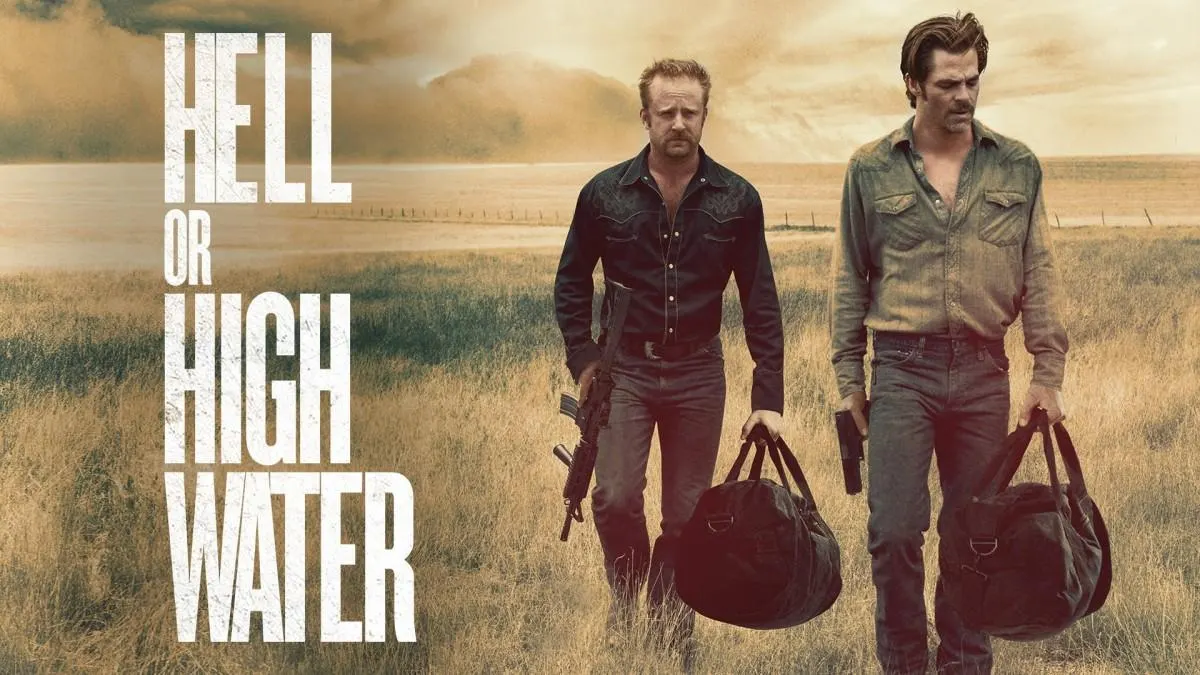
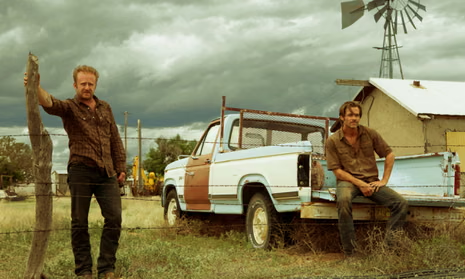
The most famous cultural use of this expression is the critically acclaimed 2016 neo-Western crime drama directed by David Mackenzie and written by Taylor Sheridan. The film stars Chris Pine and Ben Foster as brothers Toby and Tanner Howard, who rob branches of the Texas Midlands Bank to raise enough money to pay off a reverse mortgage and save their family ranch from foreclosure. Jeff Bridges plays Marcus Hamilton, the veteran Texas Ranger pursuing them.
The film title captures the idiom’s essence perfectly. The brothers are doing whatever it takes, come hell or high water, to hold onto their land, their legacy, and their children’s future. The title was changed from the original “Comancheria” specifically to reflect this thematic core of absolute determination against impossible odds.
The film earned four Academy Award nominations including Best Picture, Best Supporting Actor for Bridges, Best Original Screenplay, and Best Film Editing. It grossed $37.9 million on a $12 million budget and is widely considered one of the finest American films of the 2010s.
The film is the second installment in Taylor Sheridan’s informal trilogy of modern American frontier stories, alongside Sicario and Wind River.
Hell or High Water: Film Key Details
| Detail | Information |
|---|---|
| Title | Hell or High Water |
| Year | 2016 |
| Director | David Mackenzie |
| Writer | Taylor Sheridan |
| Stars | Chris Pine, Ben Foster, Jeff Bridges, Gil Birmingham |
| Genre | Neo-Western, crime drama |
| Budget | $12 million |
| Box office gross | $37.9 million worldwide |
| Oscar nominations | 4 (Best Picture, Best Supporting Actor, Best Screenplay, Best Editing) |
| Rotten Tomatoes score | 98% critics score |
| Setting | West Texas |
| Original title | Comancheria |
The Song “Hell or High Water” by Passenger
British singer-songwriter Passenger released a song titled “Hell or High Water” that uses the idiom to explore themes of loss, determination, and emotional resilience. The song uses the phrase to describe the extreme circumstances that either ended a relationship or the determination required to survive without it.
Literature
The phrase has appeared in dozens of novels across multiple genres, from westerns to thrillers. Its most notable literary use is in the 1939 memoir Land Below the Wind by Agnes Newton Keith, which the Oxford English Dictionary identifies as the earliest recorded use of the full modern phrase.
Journalism
The phrase is a favorite in sports journalism, political reporting, and human interest stories. It appears across major outlets including the New York Times, The Seattle Times, Billboard Magazine, Salon, The Florida Phoenix, and Collins COBUILD. It is used to describe politicians, athletes, activists, and ordinary people who refuse to abandon their goals.
Why This Idiom Has Lasted Over 150 Years
Language is ruthlessly efficient. Idioms that survive for more than a century do so because they perform a function that plain language cannot match as well.
Hell or high water endures for several distinct reasons. Its alliteration makes it phonetically satisfying and easy to remember. Its imagery is extreme, vivid, and universal, since virtually every culture has concepts of hellish punishment and catastrophic flooding. Its meaning is instantly clear even to people who have never consciously learned the phrase.
It also fills a specific emotional register that direct synonyms like “no matter what” cannot quite match. Saying “I will be there come hell or high water” communicates a fundamentally different level of conviction than “I will be there regardless.” The idiom amplifies the emotional weight of the promise.
Literal vs. Figurative Meaning
Because idioms are figurative by definition, it is important to understand what the phrase does not mean.
The literal reading would suggest an actual flood and the actual place of eternal punishment. Nobody using this phrase means that. The words “hell” and “high water” are not to be understood as real locations or events but as symbolic representatives of the worst conceivable obstacles.
This is why idioms must be learned as units rather than word by word. A new English speaker translating each word individually would reach a completely different and nonsensical interpretation. The meaning lives in the phrase as a whole, not in its individual components.
Hell or High Water in Different English Varieties
The phrase is primarily American in origin but has spread across English-speaking countries and is now understood in British English, Australian English, Canadian English, and beyond.
In British English, “come rain or shine” is a common near-equivalent, but “come hell or high water” is also widely understood and used. In Australian English, both forms appear naturally in journalism and conversation.
The phrase has been translated into numerous other languages with culturally equivalent expressions, though direct translation is rarely possible. Translators typically substitute a native idiom expressing the same unconditional determination rather than translating the words literally.
Frequently Asked Questions (FAQs)
What does “hell or high water” mean?
It means no matter what obstacle or difficulty arises, something will still be done. It expresses total determination to accomplish a goal regardless of circumstances.
Where does the phrase “come hell or high water” come from?
It originated in 19th-century America, with the first printed reference appearing in an Iowa newspaper in May 1882. Etymologists believe it was in spoken use even earlier, likely among American frontier communities.
Is “hell or high water” informal or formal?
It is an informal, colloquial expression. It fits naturally in everyday conversation, journalism, and creative writing but should be avoided in formal academic or official business writing.
What are the best synonyms for “hell or high water”?
The closest synonyms are “no matter what,” “come what may,” “against all odds,” “at all costs,” “through thick and thin,” and “whatever it takes.” None perfectly captures the vivid imagery of the original.
Is there a 2016 film called Hell or High Water?
Yes. Hell or High Water is a critically acclaimed neo-Western directed by David Mackenzie and written by Taylor Sheridan, starring Chris Pine, Ben Foster, and Jeff Bridges. It received four Oscar nominations including Best Picture and has a 98% score on Rotten Tomatoes.
What is the difference between “hell or high water” and “hell and high water”?
Both versions exist and carry the same meaning. The “or” version is now standard in modern usage. The “and” version is older and appears more frequently in historical texts. Both are grammatically correct.
Can “hell or high water” be used in professional settings?
In most casual professional environments, journalism, and public speaking, it is acceptable. In formal documents, legal writing, or academic papers, substitute a more neutral phrase like “regardless of the obstacles” or “under any circumstances.”
What does “come” mean in “come hell or high water”?
The word “come” functions as an archaic conditional form meaning “even if it comes to” or “regardless of whether.” The same construction appears in “come what may” and “come rain or shine.”
Is “hell or high water” used in British English?
Yes. While it originated in America, the phrase is widely understood and used throughout the English-speaking world, including the United Kingdom, Australia, Canada, and beyond.
What is the figurative meaning of “hell” and “high water” in this phrase?
“Hell” represents the worst imaginable spiritual or supernatural terror, while “high water” represents the worst natural disaster of flooding. Together they symbolize any extreme or impossible obstacle that might stand between someone and their goal.
Conclusion
Hell or high water is a phrase that has earned its place in the English language through over 150 years of continuous use, and shows no signs of fading. Its meaning is clear, its imagery is unforgettable, and its emotional power remains intact whether it appears in a frontier newspaper from 1882, a Pulitzer-contending screenplay from 2016, or a conversation happening today.
The phrase works because it says somethingdirect language cannot quite manage: that a person’s determination is so absolute that even the most extreme forces in existence cannot alter their course.
Understanding its origin in American frontier life, its evolution through literature and journalism, its role as a metaphor built from two catastrophic images, and its appearance in some of the most celebrated works of modern culture gives you not just the ability to use it correctly but the deeper appreciation of why powerful language endures across generations. Come hell or high water, some expressions are simply built to last.