Why Does My Cat Sleep on My Chest? What It Means 2026
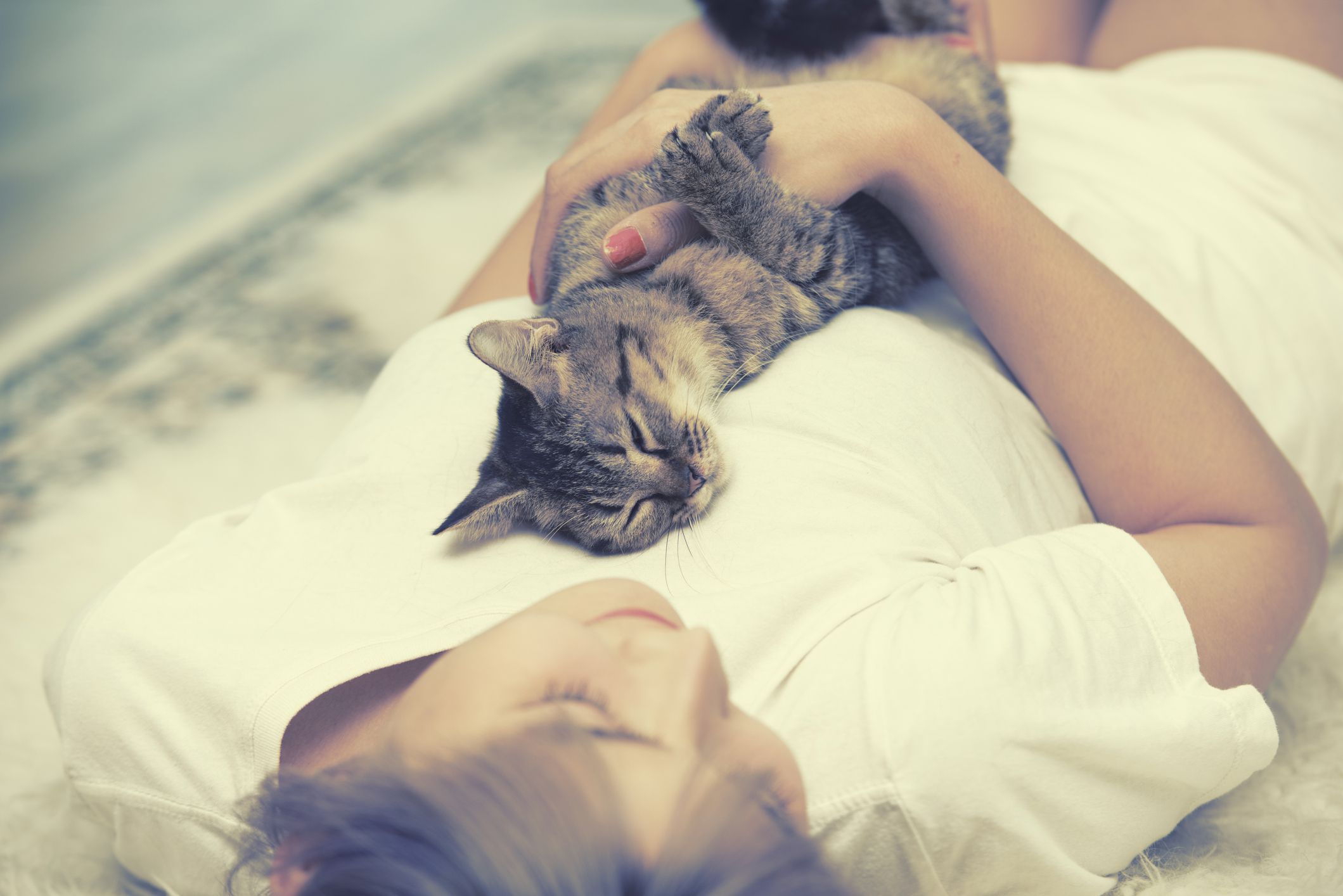
Why does my cat sleep on my chest is a question millions of cat owners ask — and the answer reveals far more than simple feline quirk.
When your cat chooses to curl up on your chest, it is sending you one of the clearest messages of trust, affection, and security a cat can give. This behaviour is rooted in instinct, emotion, and the deep bond between cats and their humans.
From the soothing rhythm of your heartbeat to the warmth of your body and the comfort of your scent, your chest offers a cat everything it craves during rest.
What Does It Mean When Your Cat Sleeps on Your Chest?
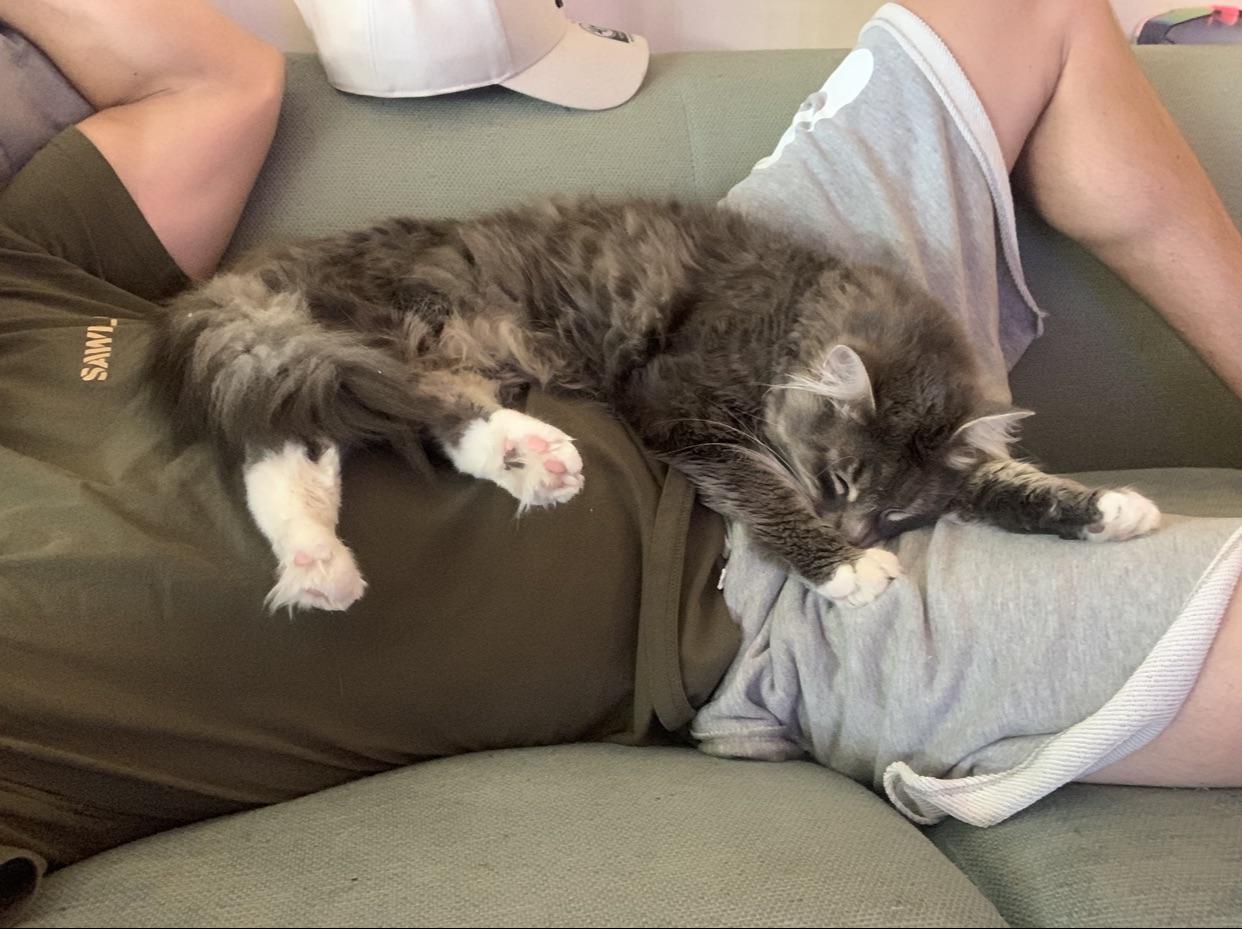
When your cat lies down on your chest and settles in for sleep, it is not a random choice. Cats are highly deliberate about where they choose to rest, and your chest is one of the most meaningful spots they can pick.
It means your cat trusts you completely. Sleep is the moment when animals are at their most vulnerable. By choosing to sleep on top of you, your cat is saying it feels safe, protected, and at ease in your presence.
It is one of the strongest signs of feline affection and emotional bonding you will ever witness.
Why Does My Cat Sleep on My Chest? 12 Real Reasons
There is not a single reason why cats sleep on their owner’s chest — there are many, and they often work together. Here is a complete breakdown of every reason behind this behaviour.
Your Cat Trusts You Completely
Trust is the foundation of this behaviour. Cats are naturally cautious animals. In the wild, sleeping makes them vulnerable to predators. A cat that chooses to sleep on your chest has decided, without any doubt, that you are a safe place.
This trust does not come automatically. It builds through consistent, gentle interactions over time — feeding routines, play, calm handling, and positive experiences. When your cat chooses your chest for sleep, it is the culmination of all that trust.
It is a compliment of the highest order in the feline world.
Your Body Heat Is Irresistible
Cats have a higher natural body temperature than humans — typically between 101°F and 102.5°F (38.3°C to 39.2°C). To maintain that temperature comfortably, they are instinctively drawn to warm places.
Your chest provides a consistent, natural heat source that no blanket or heated cat bed can fully replicate. The warmth radiates directly and steadily, making it deeply comfortable for a resting cat.
This is especially strong during cold months, cool evenings, or in air-conditioned homes where the ambient temperature drops.
Your Heartbeat Is Deeply Soothing
The sound of a heartbeat is one of the most comforting sounds a cat can hear. When your cat rests on your chest, it can hear your heart beating steadily beneath it.
This echoes the earliest comfort a cat ever felt — pressed against its mother as a newborn kitten, listening to her heartbeat while nursing and sleeping. That early sensory memory is deeply embedded in a cat’s emotional wiring.
Your heartbeat recreates that primal sense of safety and warmth. It is one of the most powerful reasons why cats choose the chest over other parts of the body.
Your Breathing Creates a Gentle Rocking Motion
The rise and fall of your chest as you breathe creates a slow, rhythmic rocking motion beneath your cat. This gentle movement acts like a lullaby — soothing, predictable, and deeply calming.
Think of how a parent rocks a baby to sleep, or how the gentle movement of a train carriage causes drowsiness. The same principle applies to your cat resting on your breathing chest.
When you are relaxed and breathing slowly, the effect is even more pronounced. Your cat can sense your calm state, and it reinforces its own relaxation.
Your Scent Makes Your Cat Feel Secure
Scent is one of the most important senses in a cat’s world. Your personal scent — built up from your skin, hair, clothing, and the hours you have spent together — is deeply familiar and associated with safety in your cat’s mind.
By resting directly on your chest, your cat is surrounding itself with your scent from every direction. It is not just smelling you — it is bathing in familiarity that signals home, safety, and belonging.
This is particularly noticeable with cats who seek out your worn clothing, your pillow, or any item that carries your scent strongly.
Your Cat Is Marking You as Its Territory
Cats have scent glands located on their cheeks, paws, and forehead. When your cat lies on your chest and kneads, rubs its face against you, or simply rests with its body pressed against yours, it is depositing its scent onto you.
This is a form of scent marking — the same process cats use to claim a favourite chair, a sunny windowsill, or a particular blanket. By leaving its scent on you, your cat is essentially labelling you as belonging to it.
This is not possessive in a negative sense. It is a bonding behaviour that says you are an important, trusted member of its world.
Your Cat Is Seeking Emotional Comfort
Cats are far more emotionally perceptive than most people realise. Research has shown that cats can detect changes in their owner’s emotional state — sensing stress, sadness, or anxiety through body language, scent changes, and vocal cues.
When your cat climbs onto your chest during a difficult evening or when you are lying quietly after a hard day, it may be responding to your emotional state as much as its own comfort needs.
A 2025 study published in Frontiers in Veterinary Science confirmed that close physical contact between cats and owners raises oxytocin levels in both — the hormone associated with trust, bonding, and emotional wellbeing. Your cat climbing onto your chest may genuinely be an act of emotional support.
Your Cat Wants Your Undivided Attention
Cats are smart, and they learn quickly what behaviours get results. If climbing onto your chest reliably makes you stop scrolling, put down your book, and start stroking them — they will keep doing it.
This is particularly evident when you are distracted — on your phone, working on a laptop, or reading. Your cat may choose precisely that moment to settle onto your chest because experience has taught it that your chest is where your attention returns to it.
It is a clever, affectionate strategy that most cat owners find impossible to resist.
Your Chest Offers an Elevated Vantage Point
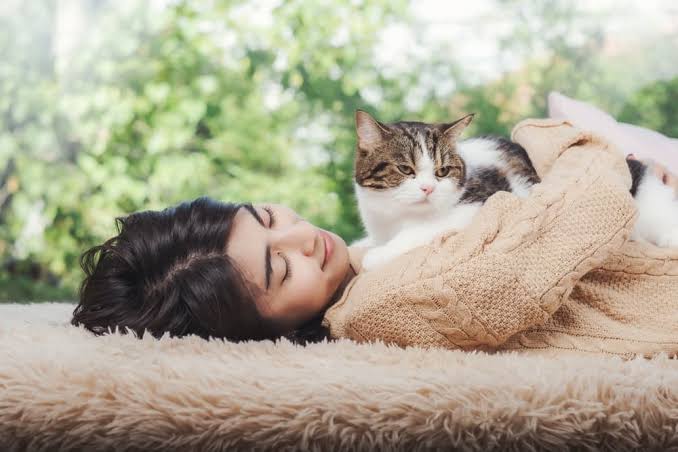
In the wild, elevation equals survival. Cats that rested at height had a better view of their surroundings, could spot prey more easily, and were safer from ground-level threats. This instinct remains hardwired in domestic cats.
When you are lying flat, your chest becomes one of the highest surfaces in the room relative to the floor and the bed itself. From that elevated position, your cat has a better view of its environment even while resting.
It offers the ideal combination — the warmth and comfort of your body, and the safety and perspective of an elevated position.
Your Cat Is Recreating Kittenhood Comfort
Young kittens spend their early weeks of life piled together with their littermates and pressed against their mother. That warmth, the sound of a heartbeat, the gentle breathing motion, and the feeling of being held and supported — all of it forms the foundation of what a cat considers safety and comfort.
When your adult cat sleeps on your chest, it may be subconsciously recreating that feeling. You become the surrogate source of the primal comfort it first experienced as a newborn.
This is particularly common in cats that were hand-reared, separated early from their mother, or that are deeply bonded to their owner as their primary attachment figure.
Your Cat Chooses to Stay Still With You
One reason cats prefer sleeping on a lying-down human rather than a sitting one is simple physics. When you are upright, you shift, fidget, change position, and move unpredictably. When you are lying down for sleep, you become still and stable.
A cat seeking a restful nap needs its sleeping surface to be calm and predictable. Your lying body offers exactly that — a warm, still, comfortable platform that will not suddenly disappear or change shape.
This is why many cats that do not sit on your lap during the day will happily settle on your chest at night.
Your Cat Has Simply Claimed Its Favourite Spot
In multi-cat households, cats often compete for prime resources — the best sunny spot, the most comfortable perch, the closest sleeping position to their favourite person. Lying on your chest is a way of claiming exclusive access to you.
Even in single-cat homes, a cat that regularly sleeps on your chest has simply decided that this is its spot. Habit and positive reinforcement make the behaviour stronger over time until it becomes a nightly ritual.
Your cat is not confused about where it belongs — it has made a deliberate, considered decision, and your chest is the answer.
The Science Behind Why Your Cat Purrs on Your Chest
When your cat purrs while lying on your chest, something remarkable is happening from a scientific perspective.
A cat’s purr produces vibrations in the frequency range of 20 to 150 Hertz. Research has shown that vibrations in this frequency range are associated with promoting tissue repair, reducing inflammation, and supporting bone density in cats themselves.
For humans, the effects are measurable and significant. Listening to and feeling a cat purr lowers heart rate, reduces blood pressure, and decreases cortisol — the primary stress hormone. The presence of a purring cat triggers the release of oxytocin and serotonin in the human brain, boosting mood and promoting emotional calm.
A 2025 study found that petting and cuddling a cat in a relaxed setting increased oxytocin levels in both humans and cats simultaneously. This means the bonding is genuinely mutual — you are both experiencing a hormonal response to closeness.
Research from the University of Minnesota found that cat owners have approximately 40% lower risk of dying from cardiovascular events, including heart attacks, compared to non-owners. While this cannot be attributed to chest-sleeping alone, the cumulative effect of close daily contact, purring, and oxytocin release all contribute to this remarkable finding.
Health Benefits of Letting Your Cat Sleep on Your Chest
The physical and emotional benefits of having a cat sleep on your chest are surprisingly well-documented.
| Health Benefit | What the Research Shows |
|---|---|
| Reduced stress | Purring and physical contact lower cortisol levels |
| Lower blood pressure | Cat owners show consistently lower BP readings |
| Improved mood | Oxytocin and serotonin release during petting |
| Better sleep quality | Rhythmic purring acts as white noise for many owners |
| Reduced anxiety | Purring frequencies (25–150 Hz) calm the nervous system |
| Emotional support | Cats detect and respond to owner distress |
| Cardiovascular protection | Cat owners have 40% lower risk of fatal heart attacks |
| Reduced loneliness | Physical closeness provides companionship and connection |
These benefits are real, measurable, and reciprocal. When your cat is on your chest and both of you are calm and content, you are both in a physiologically beneficial state.
What Different Cat Sleeping Positions on You Actually Mean
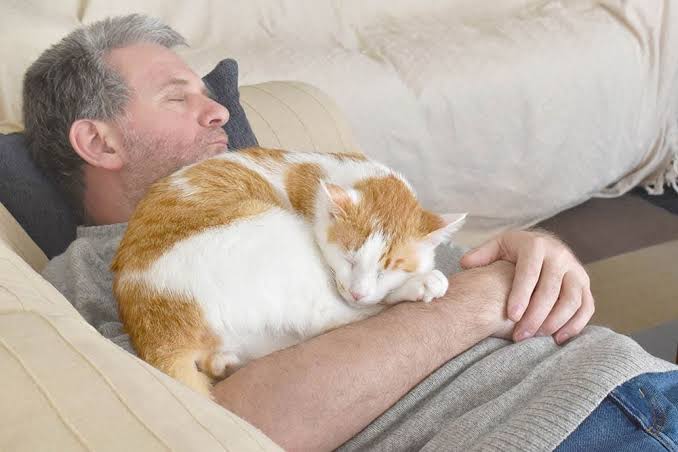
Not every cat sleeps the same way on their owner. The specific position your cat chooses while on your chest can add even more context to what it is communicating.
Cat Curled Into a Ball on Your Chest
A cat that curls tightly into a ball while lying on you is in deep relaxation mode. The curled position conserves heat and protects the vital organs — it is the position cats adopt when they feel completely safe and comfortable.
If your cat curls up on your chest like this, it is telling you it has let its guard down entirely in your presence.
Cat Stretched Out Flat Across Your Chest
A cat that lies stretched out long and flat across your chest is displaying maximum comfort and trust. The stretched position leaves the belly and vital organs fully exposed — the ultimate sign of vulnerability and security.
This cat is not just comfortable. It is completely relaxed, with no threat detected anywhere in its environment.
Cat Facing Your Face
Some cats lie on the chest while facing upward toward your face. This position allows your cat to maintain eye contact, watch your expressions, and stay connected to your emotional state.
It is a deeply social position that reflects how important you are to this cat. Cats in the wild do not typically expose their face to potential threats — facing your face means facing their most trusted companion.
Cat Kneading While on Your Chest
Kneading — the rhythmic pushing motion cats make with their front paws — while lying on your chest is one of the most affectionate behaviours a cat can display. It is a behaviour first learned as a newborn kitten, used to stimulate milk flow from the mother.
When your adult cat kneads on your chest, it is deep in a state of contentment and comfort that takes it back to its earliest, safest memories. It is an expression of happiness that is as instinctive as it is endearing.
Cat Sleeping on Chest With Eyes Half Closed
A cat with half-closed eyes while resting on your chest is in a light state of relaxed awareness. Cats rarely sleep with fully closed eyes around anyone they do not completely trust.
Half-closed eyes during a chest rest means your cat is comfortable enough to let go but still gently aware of its surroundings. The slow blink — where your cat opens and closes its eyes slowly — is an active signal of affection that cat behaviourists call a cat smile.
Why Does My Cat Sleep on My Chest and Not Elsewhere?
If your cat consistently chooses your chest over other comfortable options in the home, it is worth understanding what makes the chest specifically preferable.
Your chest combines multiple appealing factors simultaneously — warmth, heartbeat sound, breathing rhythm, scent, elevation, and closeness to your face. No other location in the home offers all of these elements at once.
A cat bed offers warmth but none of the sensory connection. A sunny windowsill offers warmth and elevation but lacks the heartbeat and scent of a trusted companion. Your feet offer closeness but less warmth and no heartbeat proximity.
Your chest is, quite simply, the optimal resting environment for a cat that is strongly bonded to you.
Why Does My Cat Only Sleep on My Chest at Night?
Many cat owners notice that chest-sleeping is primarily a night-time behaviour. There are several reasons for this.
At night, you are still. Your breathing slows and becomes rhythmic. Your body temperature warms the bed. You are not picking up your phone, getting up to get a drink, or making sudden movements. For a cat seeking an undisturbed rest, you become the ideal sleeping companion specifically because you are quiet and motionless.
Night-time is also when the household is at its quietest. Your cat’s crepuscular nature means it is most alert at dusk and dawn — and during the deep of night it often seeks the safest, warmest rest it can find.
Your still, warm, breathing body is the most appealing option available.
Why Does My Cat Sleep on My Chest When I Am Sick?
This is one of the most frequently asked variations of the question — and the answer is genuinely touching.
Cats are highly sensitive to changes in their owner’s body. When you are ill, your body temperature changes, your breathing pattern shifts, your heart rate may alter, and your scent changes slightly. Your behaviour changes too — you lie down more, move less, and are generally quieter and more still.
Many cat owners report that their cats become noticeably more attentive and clingy during periods of illness. The most likely explanation is that your cat has detected the changes in your physical state and is responding to them — seeking closeness, offering warmth, and staying near as a form of comfort.
Whether cats understand illness in the way humans do is debated. But the pattern of increased closeness during sickness is well-documented and widely observed.
Should You Let Your Cat Sleep on Your Chest?
For most cat owners, allowing a cat to sleep on the chest occasionally or regularly is perfectly fine and carries real benefits. However, there are some practical considerations worth thinking about.
Disrupted Sleep
Even a small cat can make it uncomfortable to breathe deeply or shift position during sleep. If your cat is heavy, restless, or prone to sudden movements, your sleep quality may suffer.
A 2024 study published in Scientific Reports found that 47.6% of U.S. pet owners co-sleep with their pets. While many report comfort from the arrangement, others find their sleep is disrupted by movement, weight, or the cat wanting to change position during the night.
If your sleep is being genuinely disturbed, it is reasonable to set boundaries — but do so gradually and gently.
Allergies
Close contact with a cat’s fur and dander concentrated near your face while you sleep can worsen cat allergy symptoms. Symptoms including sneezing, itchy eyes, congestion, and skin reactions may be noticeably worse in the morning if your cat sleeps on your chest near your face.
Regular washing of bedding and keeping your cat’s sleeping area clean can help. If symptoms are severe, keeping your cat out of the bedroom may be necessary.
Claws During Night Disturbance
If you move suddenly during sleep and startle your cat, its natural response is to grip — which means claws. While this is rarely serious, it can be startling and occasionally cause minor scratches.
Keeping your cat’s claws trimmed reduces this risk significantly.
Parasites and Hygiene
If your cat spends time outdoors, it can carry fleas, ticks, or other parasites that may transfer during close sleeping contact. Maintaining a regular flea prevention and parasite control routine is essential if your cat sleeps with you.
Ensure your cat is up to date with veterinary check-ups, vaccinations, and parasite treatments if you share sleeping space.
Vulnerable Sleepers
Very young infants, frail elderly people, or immunocompromised individuals may need to avoid close cat contact during sleep. Always follow medical advice specific to your situation if there is any health vulnerability in the household.
How to Gently Discourage Chest Sleeping If Needed
If your cat’s chest sleeping is disrupting your rest or causing problems, you can redirect the behaviour without damaging your bond.
The key is to provide a replacement that is as appealing as possible. Place a soft, warm cat bed directly beside you on the bed so your cat remains close but not on you. Put a worn T-shirt or pillowcase with your scent into the bed to make it smell familiar and safe.
Consider placing a self-heating cat pad or a low-level heated pet blanket in the cat bed to replicate the warmth your body provides.
Engage your cat in active play before bedtime to tire it out and encourage it to settle in its own space for sleep. A satisfying play session followed by a meal can trigger a natural sleep cycle that does not depend on your chest.
Never push your cat away abruptly or punish the behaviour. Cats respond to abrupt rejection with anxiety and confusion, which can worsen attachment behaviours or create stress. Redirect calmly, consistently, and with patience.
Different Cats, Different Reasons — How Breed and Personality Matter
Not all cats are equally likely to sleep on their owner’s chest. Breed and individual personality play a significant role.
| Cat Breed | Tendency to Sleep on Owners |
|---|---|
| Ragdoll | Extremely high — bred for human closeness and docility |
| Siamese | Very high — highly social and vocal, seeks constant contact |
| Maine Coon | High — affectionate and people-oriented despite large size |
| Burmese | Very high — known for dog-like attachment to owners |
| Sphynx | Extremely high — hairless, seeks body heat constantly |
| British Shorthair | Moderate — affectionate but more independent |
| Norwegian Forest Cat | Moderate — affectionate but prefers closeness over contact |
| Russian Blue | Lower — tends to bond deeply but prefers proximity over physical contact |
Rescue cats and cats with anxious attachment styles may actually sleep on their owner’s chest more often than confident, secure cats — as a way of self-soothing and managing uncertainty.
A cat that has been rehomed, experienced loss, or gone through a stressful change may use chest-sleeping as an anchor in a changing world.
When Chest Sleeping May Signal a Health Issue
While chest sleeping is almost always a positive, normal behaviour, a sudden change in patterns can occasionally signal something worth paying attention to.
If a cat that has never previously been clingy suddenly begins sleeping on your chest obsessively and following you everywhere, it may be experiencing anxiety, pain, or the onset of a health condition that is making it feel insecure.
Signs to watch for alongside sudden increased clinginess:
- Changes in appetite or water intake
- Lethargy or reduced activity outside of sleeping
- Changes in grooming habits (over-grooming or stopping grooming)
- Vocalisation, restlessness, or signs of discomfort
- Unusual litter box behaviour
If any of these accompany a new or intensified pattern of chest-sleeping, a veterinary check-up is a sensible next step to rule out underlying health or anxiety issues.
What to Do While Your Cat Sleeps on Your Chest
When your cat settles on your chest, how you respond matters.
Slow, gentle stroking along the back, behind the ears, and under the chin deepens the bonding experience and raises oxytocin in both of you. Keep your movements calm and predictable so your cat can fully relax.
Avoid picking up your phone, laughing loudly, or making sudden movements that might disturb your cat’s rest. Being still is part of what makes you the ideal resting place — honouring that stillness encourages your cat to stay and rest deeply.
Pay attention to your cat’s slow blinks. If your cat looks at you with half-closed eyes and blinks slowly, mirror it back. A slow blink from a human is understood by cats as a signal of calm and trust — the equivalent of a gentle smile between species.
Frequently Asked Questions (FAQs)
Why does my cat sleep on my chest and not anywhere else?
Your chest uniquely combines warmth, your heartbeat, your breathing rhythm, your scent, and physical closeness all in one spot. No other surface in the home offers all of these at once.
Is it safe to let my cat sleep on my chest at night?
For healthy adults, it is generally safe and carries real health benefits. Avoid it if you have severe cat allergies, are immunocompromised, or if your cat’s weight disrupts your breathing or sleep quality.
Why does my cat purr while sleeping on my chest?
Purring while resting on your chest signals deep contentment and comfort. It also releases oxytocin in both of you, reduces cortisol, and lowers blood pressure — benefiting you as much as your cat.
Does my cat sleep on my chest because it loves me?
Yes. Chest sleeping is one of the strongest signs of feline affection and trust. It means your cat feels completely safe, bonded, and emotionally connected to you.
Why does my cat sleep on my chest when I am sick?
Cats detect changes in your body temperature, breathing, and scent when you are unwell. Many cats respond to their owner being ill with increased closeness and attentiveness as a form of comfort.
Why does my cat knead while lying on my chest?
Kneading is a comfort behaviour that traces back to kittenhood. When your cat kneads on your chest, it is in a deeply happy, relaxed state that mirrors the safety and comfort it felt as a newborn with its mother.
Why does my cat only sleep on my chest and not my partner’s?
Cats form primary attachments to the person who feeds them most consistently, spends the most calm time with them, or whose scent and energy they find most reassuring. Your cat has simply bonded more deeply with you.
Can I train my cat to stop sleeping on my chest?
Yes, gradually. Provide a warm, scent-familiar cat bed beside you, use play to tire your cat before sleep, and calmly redirect rather than push your cat away. Never punish the behaviour.
Why does my cat sleep on my chest facing my face?
Facing your face while resting is a deeply trusting position. Your cat wants to stay visually and emotionally connected to you even during rest — it is watching over the most important thing in its world.
Does my cat sleeping on my chest mean it is anxious?
Not usually. Chest sleeping is most often a positive sign of bonding. However, if it begins suddenly alongside other behavioural changes, it can occasionally indicate anxiety or discomfort that a vet should assess.
Conclusion
Why does my cat sleep on my chest is ultimately a question with a beautiful answer — your cat trusts you more than anything else in its world. Every time your cat climbs onto your chest and settles in for sleep, it is choosing you as its safest, warmest, most comforting place to be.
It hears your heartbeat and relaxes. It feels your warmth and settles. It smells your scent and feels at home. And while it rests, its purring gives you something back — lower stress, a calmer heart rate, and a measurable boost in the hormones that make you feel connected and at peace.
In 2026, with all the science now available to back it up, we know that this simple, tender habit is one of the most genuinely mutual acts of affection between humans and animals. Let your cat sleep there. It is doing both of you more good than you might realise.