The B2B Repricing Decision Sellers Have to Make Before Every Bulk Order
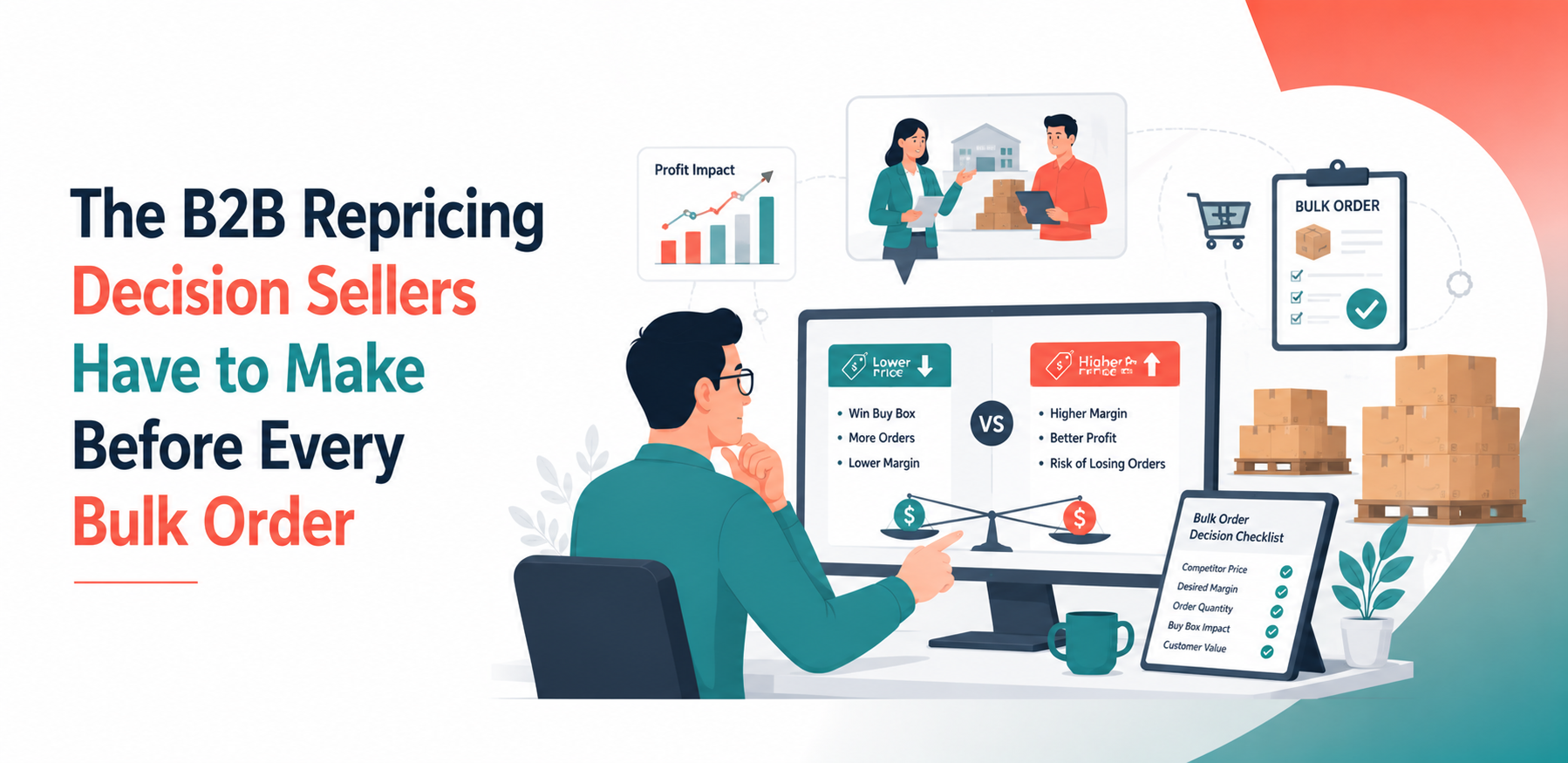
Every bulk order accepted on Amazon Business is the product of a pricing decision that was made before the buyer placed the order. The buyer evaluated the tier pricing displayed on the listing, compared it to competitors, and decided that this seller, at this price, at this volume, was the right choice for this procurement. The seller never makes an active decision on any individual bulk order, the tier pricing that was configured in advance made the decision for them.
This is exactly as it should be. No seller managing hundreds of B2B-active SKUs can evaluate pricing for each individual bulk order in real time. The tier structure does the work. But the tier structure does the work correctly only if it is answering the right question continuously: at this volume level, given today’s competitive environment and today’s cost structure, what is the price that wins the B2B Featured Offer without crossing below the tier-specific margin floor?
That is not a question that can be answered once and left static. It is a question that must be answered continuously as competitors change their tier pricing, cost structures shift with FBA fee updates, and demand patterns change across procurement cycles a core challenge aligned with the U.S. Small Business Administration’s market strategy guidance for evaluating competitive positioning and pricing dynamics.
B2B quantity tier repricing automation is the mechanism that answers this question continuously adjusting each tier price point within the correct floor and ceiling in response to competitive changes so that the pricing decision embedded in the tier structure is always the correct one for the current competitive moment.
What the Correct Pricing Decision Actually Requires
Breaking the decision down: at any given moment, for any given B2B-active SKU, for any given quantity tier, the correct price is the one that satisfies three conditions simultaneously.
Condition one: above the tier-specific margin floor
The floor for a 20-unit tier is not the same as the floor for a 1-unit order. The per-unit economics differ referral fee percentage, FBA fee as a proportion of revenue, and return risk premium all change at different price points and different volume levels. A price that is above the standard floor may be below the correct tier floor, and the difference represents margin being given away on every qualifying order.
Condition two: competitive for the B2B Featured Offer at that tier
The B2B Featured Offer algorithm evaluates the seller’s price at each tier against competitor pricing at the same tier level, alongside other signals including the business-specific price differential and seller credentials. A tier price that is correct on margin but uncompetitive for the Featured Offer wins no orders, the margin protection is irrelevant because the pricing is not generating the B2B Featured Offer position that drives volume.
Condition three: consistent with the business-specific price structure
Tier pricing on Amazon Business is applied as a discount relative to the business-specific price not relative to the consumer price. A change to the business-specific price affects the effective tier prices at every tier simultaneously. A pricing decision that focuses only on tier discount percentages without monitoring the business-specific price anchor may generate correct tier prices at one moment and incorrect ones the next time the business-specific price is adjusted.
Why This Decision Cannot Be Made Manually at Scale
A seller with 50 B2B-active SKUs, three tiers each, is managing 150 independent price points on the B2B channel alone each of which should be responding to competitive changes, cost structure shifts, and business-specific price changes at any given time. A manual review process that evaluated each of those 150 price points weekly would require more time than the commercial returns on B2B selling justify for most sellers.
The problem is not just scale. It is also timing. Amazon Business procurement buyers are active throughout business hours. Competitor pricing changes at any time. A bulk order opportunity, a procurement buyer who reaches the listing and evaluates the tier pricing may occur at 2pm on a Tuesday when no human is reviewing the tier configuration. The pricing decision has to be made and maintained continuously, not weekly.
| Approach | Decision frequency | Response to competitor change | Margin protection | Scale |
| Manual tier management | Weekly or less | Days to respond | Single floor applied to all tiers | Unsustainable above 30 SKUs |
| Automated tier repricing | Continuous | Minutes | Per-tier floor calculation | Scales across any catalog size |
What Changes When Automation Handles the Decision
Automated tier repricing does not change what the correct pricing decision requires. It changes how frequently and how accurately the decision is made. Each tier price is adjusted in response to competitor changes within the correct floor and ceiling for that specific tier, not a single floor applied across all tiers, but the per-tier floor that reflects the actual economics of orders at that volume level.
The practical consequence is a B2B pricing operation that is continuously competitive without continuous manual attention. The seller defines the configuration tier thresholds, per-tier floors, ceilings, and competitive targeting rules and the automation maintains it as the competitive environment changes. A competitor who restructures their tiers, adjusting discount percentages across multiple volume levels simultaneously, triggers a response across each affected tier within the repricing cycle rather than triggering a manual review process that may happen days later.
For sellers who have been managing tier pricing manually reviewing and adjusting tier configurations weekly or when they notice B2B Featured Offer win rate declining the shift to automated tier repricing does not feel like adding a new capability. It feels like removing a recurring task that was never receiving the frequency of attention it actually required.