The Future of AI at Work: What Employees and Businesses Should Prepare For
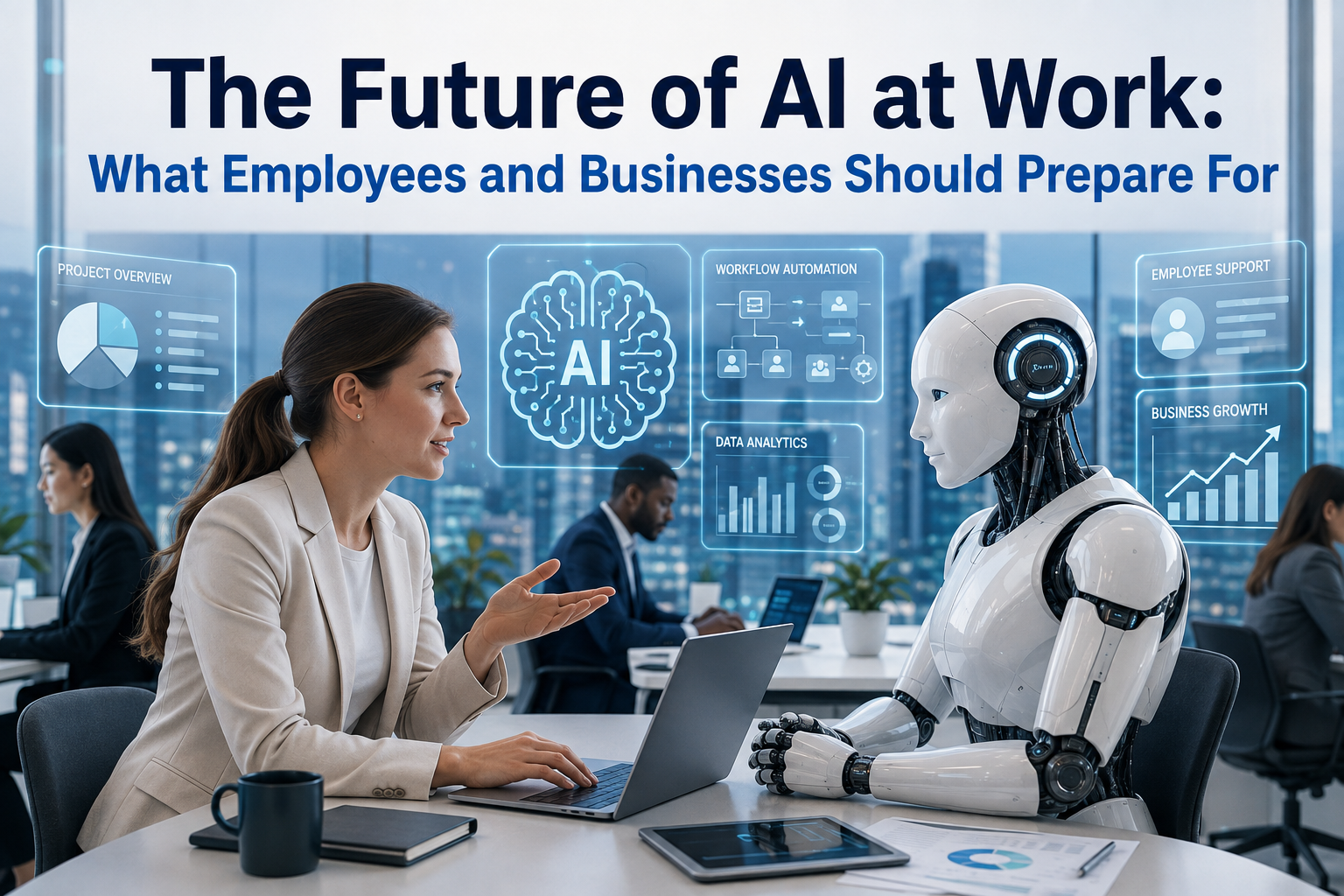
Artificial intelligence is rapidly changing the modern workplace. What once seemed like technology reserved for large technology companies is now becoming part of everyday work in marketing, finance, customer service, healthcare, software development, manufacturing, human resources, and many other industries. AI can analyze information, generate content, automate repetitive processes, assist with decision-making, and help employees complete tasks faster. As these capabilities improve, both employees and businesses need to understand how work is likely to change and how they can prepare for it.
The future of AI at work is not simply about replacing people with machines. In many cases, it is about changing how people perform their jobs. Research on the 2026 labor market suggests that AI is increasing the value of skills such as judgment, creativity, leadership, and adaptability while also creating stronger demand for AI-related capabilities. Employees who learn how to work effectively with AI may therefore have significant advantages as workplaces become increasingly technology-driven.
AI Will Become Part of Everyday Work
AI is likely to become a normal workplace tool in much the same way that email, spreadsheets, search engines, and cloud software became standard business technologies. Employees may use AI to summarize documents, research topics, analyze data, prepare reports, create presentations, communicate with customers, generate ideas, and organize information.
This shift is already happening. Research from the U.S. Chamber of Commerce Foundation reported in 2026 that half of small-business workers surveyed were already using AI at work, with productivity improvement being a major use case.
Platforms and resources such as https://evostai.com/ reflect the growing ecosystem surrounding artificial intelligence and its practical applications. As AI technology becomes easier to access, employees will not necessarily need to be programmers or data scientists to benefit from it. Instead, understanding how to communicate with AI systems, evaluate their output, and integrate them into existing workflows may become valuable abilities across many professions.
Jobs Will Change More Than They Disappear
One of the biggest concerns surrounding AI is job loss. Automation will undoubtedly affect certain tasks and occupations, particularly where work is repetitive, predictable, and highly standardized. However, the overall picture is more complicated than simply saying that AI will eliminate jobs.
SHRM research published in 2026 estimated that while 20% of U.S. employment had at least half of its tasks automated, only 5.1% was both at least half automated and without nontechnical barriers to displacement. This distinction matters because being technically capable of automating a task does not automatically mean that an entire position will disappear.
Many jobs may instead be redesigned. Administrative professionals could spend less time entering information and more time coordinating complex activities. Marketers could use AI for initial research and drafts while concentrating on strategy and brand positioning. Developers could use AI to generate routine code while spending more time reviewing architecture, security, and product requirements.
The important question for employees is therefore not only whether AI can perform part of their job, but what higher-value responsibilities they can take on when routine tasks become automated.
Human Skills Will Become More Valuable
As machines become better at generating information and completing standardized tasks, distinctly human abilities may become increasingly important. Critical thinking, communication, creativity, leadership, negotiation, emotional intelligence, and sound judgment are difficult to reduce to simple automated processes.
PwC’s 2026 AI Jobs Barometer found that AI-exposed junior positions were considerably more likely to demand skills traditionally associated with senior employees, including leadership and judgment. It also found that jobs requiring specific AI skills were growing much faster than the broader employment market.
Employees should therefore develop both technological and human capabilities. Knowing how to operate AI tools is useful, but knowing when AI is wrong, incomplete, inappropriate, or missing important context can be even more valuable.
Employees Need Continuous Learning
The traditional idea of learning a profession once and relying on the same knowledge for decades is becoming less practical. AI tools are developing quickly, and the skills required for AI-exposed jobs are changing faster than those required for less-exposed roles.
Employees should become comfortable with continuous learning. This does not necessarily mean earning another university degree. Practical learning may involve experimenting with AI tools, completing short professional courses, learning better data-analysis techniques, understanding automation systems, or developing stronger industry expertise.
Employees should also learn how to verify AI-generated information. AI systems can produce inaccurate or misleading responses, so human review remains important. Workers who combine AI efficiency with professional knowledge and careful verification are likely to provide greater value than those who depend on AI output without evaluating it.
Businesses Must Develop a Clear AI Strategy
For companies, purchasing AI software is not the same as successfully adopting AI. Businesses need to determine where AI can create meaningful improvements rather than implementing it simply because competitors are doing so.
Management should examine existing workflows and identify tasks that consume significant time but provide relatively little strategic value. AI can then be introduced where it can reduce repetitive work, improve analysis, accelerate customer service, or help employees make better decisions.
Businesses should also measure results. Productivity, accuracy, customer satisfaction, operating costs, employee workload, and revenue can help determine whether an AI implementation is actually delivering value. S&P Global reported that process efficiency and employee productivity were more common enterprise AI objectives than reducing headcount, illustrating how companies are often approaching AI as a productivity technology rather than purely a replacement strategy.
Training Employees Should Be a Priority
Companies that invest heavily in AI technology but ignore employee development may struggle to achieve the expected results. Workers need to understand what tools are available, what they are permitted to use them for, and where human approval is required.
Training should extend beyond basic instructions about writing prompts. Employees should understand data privacy, cybersecurity, fact-checking, intellectual property, responsible AI use, and the limitations of automated systems.
Organizations also need to prepare employees for future roles rather than only teaching them to use today’s tools. Research from The Conference Board in 2026 found that many organizations were concentrating on AI literacy and improving employees’ current roles while fewer were preparing workers for broader reskilling associated with future workforce changes.
Responsible AI Governance Will Matter
As AI becomes involved in hiring, performance evaluation, customer interactions, financial decisions, and internal operations, governance will become increasingly important. Businesses need clear rules describing what information can be entered into AI systems, which decisions require human review, and who is responsible when an automated system produces an incorrect result.
Privacy is another major consideration. Employees and customers should understand when AI systems are collecting, analyzing, or using their information. Companies that introduce AI without appropriate security and transparency may expose themselves to regulatory, reputational, and operational risks.
Human oversight should therefore remain central to important decisions. AI can provide recommendations and analysis, but organizations should avoid assuming that automated decisions are automatically objective or accurate.
The Workplace Will Become More Collaborative
The workplace of the future may involve collaboration not only between people but also between people and AI systems. Employees could increasingly manage AI assistants or specialized AI agents that perform research, organize information, monitor processes, and complete defined tasks.
This could significantly increase the amount of work that an individual or small team can accomplish. Instead of spending hours gathering basic information, employees may receive an AI-generated starting point and dedicate their time to analysis, decision-making, creativity, and execution.
The competitive advantage may therefore shift toward people and organizations that can effectively combine human expertise with machine speed.
Preparing for an AI-Powered Future
AI will continue to reshape jobs, skills, workflows, and business models. Employees should focus on learning how to use AI while strengthening the judgment, creativity, communication, and specialized expertise that allow them to use technology effectively. Businesses should focus on responsible adoption, employee training, measurable productivity improvements, strong governance, and thoughtful redesign of work.
The future workplace is unlikely to be entirely human or entirely automated. It will increasingly be a combination of both. Organizations that treat AI as a way to strengthen human capabilities rather than simply reduce labor costs may be better positioned to innovate and grow. Employees who remain adaptable and learn how to collaborate with intelligent systems will likewise be better prepared for new opportunities as the nature of work continues to evolve.