F1, 2025 São Paulo Grand Prix: Race analysis, key turns, and how Mostbet lines read it
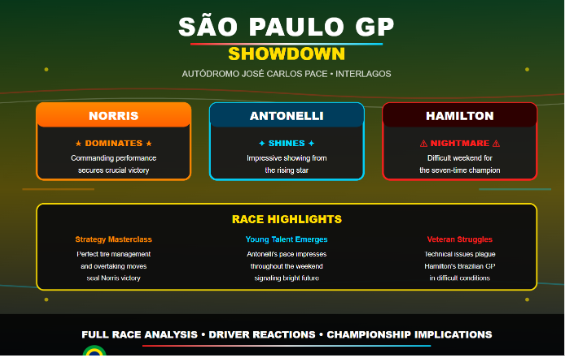
The São Paulo Grand Prix on November 9, 2025, turned out to be exactly how fans love Interlagos: tense, with a change of pace, numerous tactical dilemmas, and heroes in unexpected roles. The big news was that Lando Norris had a virtually flawless weekend and took victory, extending his lead in the drivers’ standings, while Mercedes junior Kimi Antonelli secured a career-best finish of P2, holding off a late-charging Max Verstappen, who had broken through to P3. Meanwhile, Lewis Hamilton’s harsh assessment of his debut season with Ferrari—”a nightmare”—was heard after yet another retirement, and it became a major media ripple on Sunday.
What happened on the track: chronology and meaning
Interlagos is a short, fast-paced track where laps fly by like sprints, and any fluctuation in tire temperature or pace translates into seconds over the course of the race. At the start, Norris maintained control and set the key rhythm early: a controlled pace, focused on tire degradation and “clean air.” In the middle phase of the race, pit stop windows became crucial: undercuts were used only sporadically—fresh tires didn’t always enter the operating window quickly, and every extra car in the “out-lap” could ruin the effect.
Nevertheless, McLaren played precisely the right game of chess, where the leader has track position priority, while rivals are forced to react. The result was a confident victory for Norris and an expanded lead in the championship. According to leading publications, Lando’s lead grew to more than twenty points, and he secured his seventh victory of the season, cementing his status as the favorite for the title.
Kimi Antonelli is a different story. The young Italian not only found the right tire and pace window, but also played coolly in key defensive moments when Verstappen, who had started from the pit lane and executed an impressive comeback, was bearing down on him. For Mercedes, Kimi achieved his second podium of the season and a personal best result of P2, especially on a track where mistakes are rarely forgiven.
Several important twists remained in the shadows of the overall narrative. First, Oscar Piastri. He was involved in contact and lost pace, and a penalty and forced tactical adjustment set him back—he finished only fifth, which, in the context of the championship intrigue, was more significant than the number suggests. Second, Red Bull: strategically focused and with workable speed over a long run—this is precisely what allowed Verstappen to turn a poor starting position into a podium finish. Finally, Ferrari had another overly nervous Sunday, culminating in Hamilton’s retirement after early contact. The final media picture from Ferrari is stormy, and this is where Lewis’s loud quote about the “nightmare” season came from.
The Key to Victory: Tempo vs. Degradation
The hallmark of Norris’s winning run was the balance between attacking and caring for the tires. Interlagos favors drivers who can coast where it doesn’t cut revs and jump out of slow transitions with more vigor. McLaren found the right pressures and temperatures, and the driver executed perfect out- and in-laps in the crucial windows, denying his rivals their “free tens.” Consequently, Mercedes had fewer pressure zones to disrupt the leader’s rhythm. Verstappen, on the other hand, spent most of his pace points on breaking through, and by the end, his attack options, given the condition of his tires and brake temperatures, had objectively shrunk.
Antonelli: Maturity at a High Pulse
Kimi exemplifies how micro-decisions on ERS and differential management add up to macro-results. The back-up radio repeatedly cued him to use lift-and-coast and carefully charge, allowing him to have a “package” to protect him at his most vulnerable points—at the exit of Junção and on the DRS-zone straight. And there was luck where it’s absolutely necessary: in one incident, Kimi admitted he escaped with only a minor scare, avoiding serious damage. But in sport, fortune favors those who are prepared.
Hamilton and Ferrari: a contrast between expectations and reality
The post-race media landscape was largely shaped by the phrase “It was a nightmare” in reference to Lewis’s rookie year at Ferrari. The retirement in Brazil only added to the drama, with the press converging on two narratives: the new team’s growing pains and a series of incidents that have disrupted his points tally. Hamilton himself, however, spoke of his belief in the project and his desire to “get up tomorrow and keep working,” but the tone of his statement was unusually harsh. It was both a media signal and an attempt to reset the context before the end of the season.
Why this race is important for the Norris-Piastri championship duel
São Paulo is one of those weekends where the dynamics of the title race really change. Before the start of the Brazilian round, the intrigue remained within a range of one or two races, but now Norris’s lead has become a zone of psychological superiority: Piastri is no longer simply “chasing within one victory,” but is forced to take risks every Saturday and Sunday—in qualifying, at the start, during pit stops—to make up not one or two points at a time, but in batches. Under these conditions, McLaren logically divides the risks: the leader adopts a more conservative strategy, while the pursuers take aggressive pit stops and respond earlier, “mirroring” their rivals’ moves. In the current configuration, every sprint is doubly valuable—it was the additional points on Saturday that strengthened Lando’s position in São Paulo.
A curious statistic from the weekend: Norris tied Piastri for the most wins this season (according to F1 data), but it was precisely due to his greater conversion rate to “fat” points-scoring days and the consistency of his Sunday finishes that Lando emerged ahead over the course of the season. This nuance explains why two drivers with the same number of wins sometimes have different title chances: the gray area of P2-P4 at the end of the season can be worth more than one additional win after a couple of disappointing finishes.
How the bookmakers read it: Mostbet’s perspective
Now, on to the most hyped question for those who enjoy comparing team strategy and odds movements. Mostbet India is an example of a bookmaker that offers not only classic win/podium odds for the Grand Prix, but also a comprehensive live lineup: leader’s lap, winning tire stint, safety car deployment, top-3/top-6/top-10 finishes, sprint outcomes, teammate duels, and even pit stop strategy markets (one or two, first pit lap range, etc.).
Before the start
Before the race, Mostbet’s lineup on the leaders would have looked conservatively balanced: Norris is the favorite based on form and pace over long runs (especially after a sprint victory), Piastri is a teammate but with a lower price tag due to his penalties and likely need for aggression, and Mercedes is a semi-outsider but a very attractive podium-finish option due to their starting positions and pace in the FP/sprint sections. In such situations, Mostbet’s logic typically follows this: the favorite shrinks toward the start (the odds drop), while the second-tier teams expand due to a mix of bets on the “obvious.” And if you prefer safety nets rather than outright victories, a “Top 3 Antonelli” or a “Antonelli vs. Russell” duel in favor of the Italian looks reasonable—as a bet on form and starting position.
Example of a bet construction (illustrative): “Antonelli Podium” + “Norris to Win” – an accumulator with average odds, typically slightly lower than the “dirty” outright on the second-favorite win, but higher than a single bet on Lando to win. This isn’t financial advice, but a demonstration of how Mostbet’s market combinations allow for proportional risk/reward without the hassle.
Live: Where Value Lives
Interlagos is an ideal track for live betting. The Mostbet online platform typically offers active markets during the race:
- The introduction of SC/VSC and the pit stop window. Any yellow phase shifts the lines to the undercuts and overcuts.
- Teammate duels near the pit windows. If one driver is seen to be in-lapping with traffic jams at the entrance/exit, while their teammate has “clear air,” the line can shift by 10-20% per lap.
- Tire composition at the finish. As soon as telemetry and pit boards indicate that the leader is holding out for one stop, the line for their victory tightens, while the “catch-up” (win/podium finish in the second tier) widens.
The strongest live action was the moment when it became clear that Verstappen was on comeback pace, and Antonelli was maintaining a steady pace and had ERS pools to protect. Here, Mostbet’s live “Antonelli podium” market should have sharply contracted—from the risky upside category to a still-undervalued mid-pack price (and this is where an attentive bettor would have found the perfect value—catching the “before the contraction” odds).
Norris’s live performance is practically textbook: as soon as it became clear that his degradation was under control and McLaren wouldn’t get caught in heavy traffic after the first stint, the victory market went negative (odds of 1.5→1.3→1.2 and below—illustrative dynamics). This is a classic “line runs ahead of the event” situation: Most bet quickly takes into account the speed at the “out-lap” after a pit stop and the distance to the nearest “undercut window” of the competitors.
Risks and bankroll discipline
These stages have their pitfalls. Firstly, overbought favorites: too low odds on the leader’s victory aren’t “free money” but a very short margin over the long run. Secondly, emotional betting after contacts and yellow flags: it seems that “now everything is clear,” but Interlagos has a knack for restoring the intrigue after 5–10 laps. And, of course, bankroll management: Mostbet supports a wide range of pre-match and live markets, but that’s precisely why it’s important to split the pot, avoid going all-in on one scenario, and use cash out when the line has generated the desired profit before the finish.