How AI Could Reshape the Entire U.S. Auto Insurance Industry
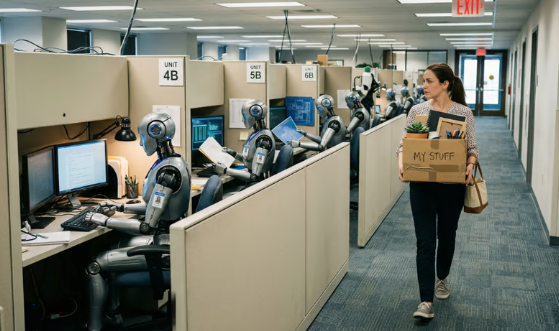
The insurance industry may be approaching one of the biggest transformations in its history. For decades, large companies like State Farm, GEICO, Allstate, and Progressive dominated the market because building an insurance company required enormous infrastructure: thousands of employees, massive call centers, regional offices, claims departments, underwriting teams, legal divisions, and huge advertising budgets.
Artificial intelligence could change that completely.
Over the next decade, AI may allow small digital insurance companies to operate with only a tiny fraction of the staff traditional insurers currently need. Instead of tens of thousands of employees, future insurers may operate with small teams supervising automated systems that handle quotes, customer service, billing, fraud detection, underwriting, and even parts of the claims process.
If that happens, the number of insurance companies could explode.
Why Large Insurance Companies Became So Powerful
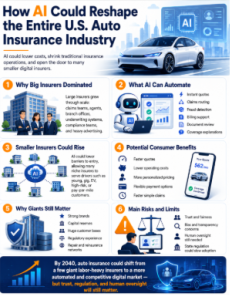
Historically, large insurers benefited from scale. Building a nationwide insurance company required:
- Huge customer service departments
- Thousands of licensed agents
- Massive claims teams
- Regional branch offices
- Complex underwriting systems
- Large legal and compliance departments
- Heavy television and advertising spending
Only very large companies could afford to maintain that infrastructure. This created enormous barriers to entry and made it difficult for small competitors to survive.
AI may reduce many of those barriers.
An AI Insurance Company Could Operate With Very Few Employees
A modern AI-driven insurer could automate many of the repetitive tasks that currently require thousands of workers.
For example, AI systems can already:
- Answer customer questions in real time
- Generate quotes instantly
- Review uploaded documents
- Analyze accident photos
- Detect fraud patterns
- Process billing requests
- Explain policy coverage
- Route claims automatically
- Predict repair costs
Instead of maintaining giant call centers with thousands of employees, a future insurer might operate mostly through AI voice assistants and chat systems available 24 hours a day.
This could reduce operating costs dramatically.
Could Traditional Insurance Giants Shrink by 90%?
It sounds extreme, but it is possible that many traditional insurance companies could eventually operate with far smaller workforces than they do today.
Large insurers currently employ tens of thousands of workers because most insurance operations are still heavily dependent on human labor. If AI systems become reliable enough to automate customer support, billing, underwriting, simple claims handling, and internal administration, many positions could disappear over time.
Some experts already compare the future of AI automation to the industrial revolution. Just as machines transformed manufacturing, AI could transform service industries.
A company that currently needs 50,000 employees might eventually operate with 5,000 or fewer if most repetitive tasks become automated.
That does not necessarily mean insurance companies would disappear entirely. More likely, they would become much smaller, leaner, and more technology focused.
Thousands of Small AI Insurers Could Appear
The most disruptive possibility is not simply that big insurers shrink. It is that thousands of small insurers could emerge at the same time.
Today, launching an insurance company is incredibly expensive. But if AI drastically lowers operating costs, smaller businesses may suddenly become capable of competing.
Future insurers might specialize in:
- Young drivers
- Pay-per-mile insurance
- Electric vehicles
- Gig economy drivers
- Low-income drivers
- High-risk drivers
- Subscription-based insurance
- Short-term policies
Instead of a few dominant giants controlling most of the market, the industry could become much more fragmented.
Profits that are currently concentrated inside a handful of giant corporations might eventually spread across thousands of smaller digital insurers.
Insurance Could Become Much More Competitive
If thousands of AI-assisted insurers begin competing aggressively, pricing pressure could increase significantly.
Companies with low overhead may be able to survive on thinner profit margins because they would not need massive office buildings, giant support teams, or expensive administrative structures.
Consumers could benefit from:
- Faster quotes
- Lower operating costs
- More personalized pricing
- Flexible payment structures
- Faster claims handling
- More transparent policy explanations
This kind of competition could also reshape how drivers compare policies, especially as new AI-driven insurers make it easier to understand types of auto insurance coverage before choosing a policy.
Big Insurance Companies Still Have Major Advantages
Even if AI changes the industry dramatically, large insurers will not disappear easily.
Companies like State Farm and GEICO still have:
- Massive financial reserves
- Strong brand recognition
- Huge customer bases
- Regulatory experience
- Existing data infrastructure
- Relationships with repair networks and reinsurers
These companies also have the money to invest heavily in AI themselves.
That means the future may not be a complete collapse of traditional insurers. Instead, large companies could adapt aggressively and automate large parts of their operations before smaller startups fully disrupt the market.
The Biggest Challenge Will Be Trust
Insurance is not only about technology. It is also about trust.
Drivers need confidence that claims will be paid fairly after accidents. A fully automated insurer that denies claims unfairly or provides confusing explanations could quickly lose customers.
This is why many experts believe humans will still remain involved in areas such as:
- Regulatory compliance
- Serious injury claims
- Fraud investigations
- Lawsuits
- Appeals and disputes
- AI auditing and supervision
The future is probably not a world with zero employees. It is a world where a small human team supervises extremely powerful automated systems.
Regulators Could Slow the Transition
Another major factor is regulation.
Insurance companies in the United States operate under strict state-level rules. Regulators may not allow fully automated systems to make important decisions without oversight.
States could require:
- Human review for denied claims
- Audits of AI pricing systems
- Transparency requirements
- Consumer appeal rights
- Proof that algorithms are not discriminatory
These rules could slow down how quickly fully AI-operated insurers expand.
The Insurance Industry Could Look Completely Different by 2040
By 2040, the insurance market could look very different from today.
Instead of a few giant companies employing hundreds of thousands of people collectively, the industry might consist of highly automated digital insurers operating with tiny teams and advanced AI systems.
Some traditional companies could survive by adapting early. Others may shrink dramatically or disappear if they fail to modernize quickly enough.
Consumers may eventually interact mostly with AI systems instead of human agents, especially for quotes, billing, policy adjustments, and simple claims.
The rise of AI may not destroy the insurance industry itself. But it could completely transform who controls it, how it operates, and how profits are distributed across the market.
References
- National Association of Insurance Commissioners (NAIC) guidance on artificial intelligence and insurer accountability.
- NAIC property and casualty insurance expense ratio reports.
- Reuters reporting on workforce automation and AI adoption in financial services industries.