How Do You Capture the Best Sunset Photos on a Catamaran?
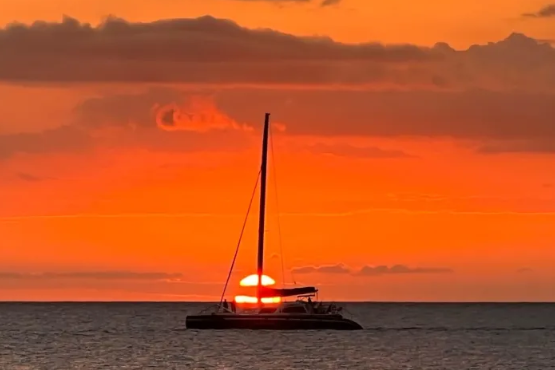
Taking sunset photos from a catamaran is different from anything you can accomplish standing on shore. You’re out on the water with a complete view in every direction, and nothing gets between you and that dramatic sky unfolding above the horizon.
Capturing Sunset Photos in O’ahu
O’ahu lies right in the middle of the Hawaiian Islands and gives you some of the most reliable and gorgeous sunset light you’ll find anywhere in the world. Known for its golden beaches and clear blue water, the island sits on the map, meaning you’re always facing west toward the setting sun.
When you book a catamaran tour, you get the best of both worlds: an incredible sunset and the chance to see incredible marine wildlife. If you’re planning whale watching near O’ahu, Hawaii, a catamaran tour will be the best choice.
Tips to Capture the Best Sunset Photos on a Catamaran
Here are the tips to capture the best sunset photos on a catamaran.
Get Your Equipment in Order
You need a camera that lets you adjust things manually so you can respond to the changing light as the sun moves down. DSLRs and mirrorless cameras will give you much better results than your phone, though honestly, a decent smartphone can work if that’s what you have. Bring a wide-angle lens that goes down to about 24 mm.
Understand Your Camera Settings
Getting the right balance between aperture, shutter speed, and ISO takes some thought when you’re working on a moving boat. Start with your camera set to an ISO between 100 and 400 so your photos stay clean and clear, even as you handle the boat’s constant, gentle movement.
Compose With Intention
Don’t put your horizon line right in the middle of your frame because that makes things feel flat and boring. Instead, place it on the upper third or the lower third so you’re emphasizing either the sky or the water, whichever part of the scene you find more interesting.
Master the Reflection Game
The water acts like a mirror when it’s calm and smooth. Look for moments when the water surface is quiet enough to reflect the colors clearly, and then frame your shot. Many actually point out that these mirror-like reflections give your images an extra dimension.
Work With the Light’s Transition
The light changes crazy fast during sunset, moving from golden orange to deep red to purple and pink all within a span of maybe ten or fifteen minutes. This means you should keep shooting even after the sun disappears below the horizon because the colors that come after often look even better than what you get during the main sunset.
Capture Silhouettes and Contrast
When you position something dark against that bright, glowing sky, you create instant visual drama that catches people’s attention immediately. Put people, boat equipment, birds, or distant islands in front of that sunset, and they become striking shapes that work incredibly well in photos.
Protect Your Equipment
The salt water that you don’t really think about on shore becomes an actual problem when you’re out on the water taking photos. Keep lens cloths handy because salt builds up on your lenses, and you need to wipe it off during the trip. Put your extra batteries and memory cards in waterproof cases.
Conclusion
Getting great sunset photos from a catamaran requires you to actually understand how your camera works and stay patient while the light keeps changing on you. Having the right equipment makes a real difference during whale watching in Hawaii, O’ahu. This is because you get sharper images and more options for creativity.
Key Takeaways
- Use manual camera controls with ISO 100-400
- Position your horizon on the upper or lower third of the frame.
- Capture water reflections by finding calm ocean surfaces
- Move around the boat continuously throughout the sunset
- Include foreground elements
- Shoot through the entire golden hour
- Apply moderate post-processing adjustments