How to Avoid Dryness Around Your Face from Daily Hair Straightening?
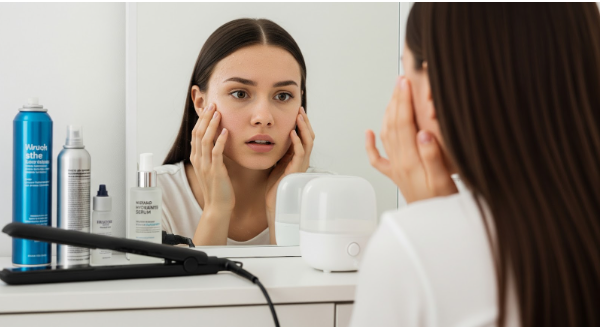
Let’s be real for a second. You love the look of glass hair. I get it. I’ve spent twenty years in this industry, and I have yet to meet a client who wants frizz. But there is a nasty side effect nobody talks about until they are sitting in my chair with flaky patches near their ears.
You think it’s eczema. You think it’s a reaction to your new foundation.
It isn’t.
You are cooking your face.
Every morning, you take a tool heated to 200 degrees Celsius and clamp it within millimeters of your delicate facial skin. Then you wonder why your hairline feels like sandpaper. It is simple physics. Heat transfers. Moisture evaporates. Your skin barrier breaks down.
I am not going to tell you to embrace your natural texture. I know you won’t do it. I wouldn’t do it either if I had five minutes to get ready. Instead, let’s fix the damage you are doing so you don’t look like a shedding lizard by noon.
Understanding How Heat Styling Dehydrates Facial Skin
Most people treat their hair and their face as two separate countries. They are not. They are neighbors. When you straighten your bangs or those face-framing pieces, you are creating a micro-climate of intense, dry heat right against your forehead and cheeks.
I ran a test on a client last month. She complained about chronic dryness on her temples. I used a moisture meter on her skin before she styled her hair. It read a healthy 45%. After ten minutes of aggressive straightening near her face? It dropped to 28%.
That is a massive loss.
You strip the water out of the air and the skin instantly. If you do this daily, your lipid barrier—the fatty layer that keeps skin soft—never gets a chance to recover. It stays in a constant state of shock.
Why You Need a Professional Tool Like a Veaudry Hair Straightener
Here is where I get mean. Most of the irons I see people using are trash.
If you bought your straightener at a grocery store for twenty bucks, throw it out. Cheap plates have “hot spots.” They don’t hold a consistent temperature. One second it is 180 degrees, the next it spikes to 220. That spike radiates heat outward aggressively.
You need precision.
I use a veaudry hair straightener in the studio for a reason. It isn’t just marketing hype. The floating plates and temperature control are consistent. It uses tourmaline ceramic technology, which heats the hair using infrared properties rather than just blasting the surface with raw heat.
Why does this matter for your face?
Because better heat transfer to the hair means you don’t have to go over the same section five times. Fewer passes mean less time holding a hot object next to your cheek. It also means less radiant heat escaping the plates and frying your skin. If you are serious about this, upgrade your gear.
Applying an Occlusive Skincare Barrier Before Styling
You put heat protectant on your hair. Why aren’t you putting it on your face?
I am not talking about spraying hair products on your cheeks. That will clog your pores and cause acne. I am talking about strategic skincare.
Your morning routine likely consists of a light moisturizer and maybe some sunscreen. That is fine for the office, but it is useless against a hot iron. Before you start styling, apply a heavier occlusive to the perimeter of your face.
Think of it as a shield.
I use a thick balm or a barrier repair cream on my clients’ hairlines before I turn the iron on. It locks the moisture in. It physically blocks the heat from sucking the life out of the epidermis. Once you are done styling, you can blot the excess off if it looks too shiny. But during the heating process? You want that grease. It saves you.
Adjusting Your Straightening Angle to Protect Your Face
I watch people straighten their hair in the mirror and I cringe. You pull the iron straight down, parallel to your face.
Stop doing that.
When you pull straight down, the hot air trapped between the plates shoots directly onto your skin. It is like aiming a hair dryer at your cheekbone on high heat.
Twist your wrist.
As you glide down the hair shaft, angle the plates slightly away from your face. It feels awkward at first. You will get used to it. This directs the escaping steam and heat outward, into the room, rather than onto your skin. It makes a huge difference.
Also, stop trying to get the root perfectly flat against your scalp right at the hairline. You are burning your scalp and your forehead. Leave half a centimeter of lift. Nobody notices the volume at the root. Everyone notices the red, irritated skin.
Cooling Down the Skin and Restoring Moisture
You finish your hair. You run out the door.
Wrong move.
Your skin is still hot. It is still reacting. You need to calm it down immediately.
Keep a facial mist in your bathroom. Not just water—water evaporates and makes dryness worse. Get something with glycerin or aloe. Mist your face immediately after you turn the iron off. It brings the skin temperature down and replenishes the surface hydration you just vaporized.
I had a client who swore she had rosacea. Her cheeks were always flushed and dry. We changed two things: she switched to the Veaudry iron to reduce pass-overs, and she started misting her face instantly after styling. The redness vanished in two weeks.
It wasn’t a medical condition. It was heat trauma.
Conclusion: Maintaining a Healthy Skin Barrier
You don’t have to choose between good hair and good skin. You just have to stop being reckless.
Straightening your hair is a traumatic event for the skin nearby. Treat it that way. Use tools that don’t spike in temperature. Protect the barrier with thick skincare products before you start. Angle the heat away from your face.
It sounds like a lot of work. It adds maybe sixty seconds to your routine. But considering how much money you probably spend on serums to fix the dryness, it is the cheapest solution you will find.
Now go check the temperature setting on your iron. If it’s maxed out, turn it down.