Human or AI? Simple Test to Know Instantly 2026
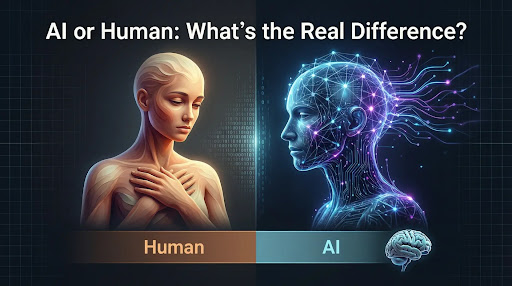
Human or AI is the question everyone is asking in 2026. With tools like ChatGPT, Gemini, and Claude generating billions of words every day, it has become harder than ever to tell who actually wrote something.
Teachers, editors, hiring managers, and everyday readers all need reliable ways to spot the difference. The gap between human writing and machine-generated content is closing fast. But the good news is that clear patterns still exist.
What Does “Human or AI” Actually Mean?
The question “human or AI” refers to identifying whether a piece of text, image, or other content was created by a real person or an artificial intelligence tool.
In 2026, this distinction matters more than ever. AI now produces essays, news articles, emails, social media posts, and even scientific papers that look almost identical to human work.
The challenge is growing because AI models keep improving. Spotting the difference requires knowing exactly what to look for.
Why It Matters to Know Human or AI in 2026
Schools and universities need to protect academic integrity. A student submitting AI-generated work as their own undermines the entire learning process.
Businesses need to verify that the content they publish reflects real human expertise. AI-generated content without oversight can spread false information and damage brand credibility.
Readers deserve to know whether the person behind an article actually has lived experience or whether it was generated in seconds by a machine.
The Core Science: How Human and AI Writing Differ
Two key metrics separate human writing from AI-generated text — perplexity and burstiness.
Perplexity measures how predictable the next word is. AI models tend to choose the most statistically expected word. Human writers are less predictable. They make surprising word choices that feel natural but are harder to guess.
Burstiness measures variation in sentence length. Humans naturally write short punchy sentences, then long complex ones. AI tends to write sentences of similar length back to back, creating a flat rhythm.
Human or AI: 10 Signs You Can Spot Without Any Tool
Sign 1 — Uniform Sentence Length
Count the words in several consecutive sentences. If most fall in the same 15-20 word range, that is a red flag.
Human writers speed up and slow down. AI keeps a steady, mechanical pace throughout.
Sign 2 — Overuse of Hedge Words
Watch for phrases like “it is worth noting,” “it is important to consider,” “furthermore,” and “moreover” appearing repeatedly.
One or two hedges in an article is normal. When nearly every claim is softened with qualifiers, that is a classic AI pattern.
Sign 3 — No Personal Stories or Specific Examples
AI gives vague, hypothetical examples. Humans draw from lived experience with real names, specific numbers, and personal observations.
An AI might say “a marketing team could improve results.” A human would say “our team cut production time by 40% after switching tools.”
Sign 4 — Repetitive Structure
AI-generated paragraphs often follow the same sentence pattern — subject, verb, object, repeat. It looks correct but feels robotic.
Human writers mix it up. They ask questions, use fragments for effect, and vary their tone throughout a piece.
Sign 5 — Overly Formal or Neutral Tone
AI is trained to be helpful and avoid controversy. So it often writes in a diplomatic, balanced tone that sounds like a textbook.
Human writing takes stances. It has personality, energy, and sometimes even typos. If a blog post reads like a policy document, check it for AI.
Sign 6 — Em Dash Overuse
AI models — especially ChatGPT — use em dashes far more frequently than human writers do in normal prose.
A couple of em dashes in a 1,000-word article is fine. Seeing them in nearly every other sentence is a strong signal worth combining with other signs.
Sign 7 — Vague Citations and Missing Sources
AI frequently invents citations or avoids naming specific sources altogether. It refers to “studies” and “experts” without naming them.
Human writers link to real research and name real people. When a text about a factual topic has no named sources, treat that as a warning sign.
Sign 8 — AI Hallucinations and Wrong Facts
AI sometimes confidently states false facts, invents nonexistent books, or gets dates wrong. This is called hallucination.
If you spot a claim that sounds authoritative but cannot be verified anywhere, the text may be AI-generated.
Sign 9 — Balanced “Both Sides” on Everything
AI is trained to present multiple perspectives on nearly every topic. It avoids taking sides even when a clear answer exists.
Human writers are willing to be wrong. They have opinions. If every paragraph ends with “on the other hand,” question who wrote it.
Sign 10 — Missing Knowledge of Recent Events
AI models have training cutoff dates. If an article about a recent topic seems to be missing information from the past 6 to 12 months, that absence can reveal AI authorship.
This sign is becoming less reliable as AI providers update their models more frequently. But for very recent events, it is still a useful check.
Human or AI: Quick Visual Test Table
| Writing Signal | More Likely Human | More Likely AI |
|---|---|---|
| Sentence length | Varies a lot | Uniform and consistent |
| Personal stories | Yes, specific and named | Vague or hypothetical |
| Tone | Opinionated or emotional | Neutral and formal |
| Hedge words | Occasional | Constant throughout |
| Em dash usage | Rare to moderate | Frequent |
| Named sources | Yes | Often missing or invented |
| Typos or errors | Occasional | Almost never |
| Recent events | Included | Often missing |
| Humor or sarcasm | Natural | Forced or absent |
| Paragraph rhythm | Varied | Flat and predictable |
Best Free Tools to Test Human or AI in 2026
You do not need to rely on manual checks alone. Several powerful free AI detector tools can give you an instant result.
GPTZero
GPTZero is one of the most accurate AI detectors available in 2026. It checks perplexity and burstiness at the sentence level and highlights exactly which parts of a text appear AI-generated.
It reports 99% accuracy on modern LLMs and is widely trusted by educators. It works best on longer documents of at least 500 words.
Grammarly AI Detector
Grammarly’s free AI detector checks for AI content from ChatGPT, Gemini, Claude, and other major tools. No sign-up is required.
It ranks as the top detector on the RAID independent benchmark. It also provides explanations for flagged phrases, not just a percentage score.
Copyleaks
Copyleaks analyzes frequency ratios, grammatical structure, syllable dispersion, and hyphen usage to flag AI content.
It boasts a false positive rate of just 0.03% — meaning it almost never incorrectly labels human writing as AI. That makes it one of the safest tools for high-stakes checks.
QuillBot AI Detector
QuillBot goes further by telling you not just whether text is AI but how AI was used. It distinguishes between fully AI-generated, AI-refined, and human-written content.
It supports over 20 languages and is a good option for non-English content checks.
Undetectable AI Detector
Undetectable AI runs your text through multiple leading detector models at once, including GPTZero, Turnitin, and Originality.ai. It is trusted by over 22 million users.
It gives you a combined view of how your text would score across different platforms — useful for students and content creators who need to pass multiple systems.
Free vs Paid AI Detector Tools: Comparison Table
| Tool | Free Version | Accuracy | Best For |
|---|---|---|---|
| GPTZero | Yes | 99% | Education, long documents |
| Grammarly Detector | Yes | 99% (RAID #1) | Writers, general use |
| Copyleaks | Yes (limited) | 99%+ | Business, publishing |
| QuillBot Detector | Yes | High | Multi-use, non-English |
| Undetectable AI | Yes | 95%+ | Students, content creators |
| Turnitin | No (institutional) | Very high | Academic institutions |
The Turing Test: The Original Human or AI Challenge
The Turing Test was created by mathematician Alan Turing in 1950. The test asks whether a machine can hold a conversation indistinguishable from a human.
In 2026, modern AI passes basic Turing tests with ease. That is exactly why more sophisticated methods are now needed to tell human or AI apart.
Interactive versions of the Turing Test are now available online. Sites like turingtest.live let you chat with a participant and guess whether they are human or AI. Average people guess correctly only 71% of the time.
How AI Detectors Actually Work
AI detectors are trained on massive datasets of both human and machine-generated text. They learn to recognize patterns that are statistically more likely to appear in AI output.
The main factors they measure include perplexity, burstiness, sentence structure, vocabulary diversity, and common AI phrase signatures.
Most modern detectors use large language models themselves to identify other large language models — essentially fighting fire with fire.
The Arms Race: Humanizers vs Detectors
A new category of tools called AI humanizers has emerged specifically to make AI text bypass detectors. These tools rewrite AI content to mimic human patterns.
This has created an ongoing arms race. As detectors improve, humanizers adapt. As humanizers improve, detectors update their models.
The result is that no single detector is 100% reliable. Experts recommend using at least two tools together and combining them with manual judgment.
Human or AI Detection in Different Industries
Education
Teachers and professors use AI detectors to check whether student essays were written by a real student or generated by ChatGPT.
The best approach is not to rely on the detector alone. A follow-up conversation with the student about their own work reveals genuine understanding instantly.
Journalism and Publishing
Newsrooms and publishers use AI checkers to verify that submitted articles contain real reporting and human editorial judgment.
AI-generated press releases and fake news can spread faster than fact-checkers can respond. Detection tools help slow that process down.
Hiring and HR
Recruiters are now running AI checks on cover letters and written assessments submitted during the hiring process.
The most reliable method is pairing the written submission with a structured interview on the same topics. The gap between the two reveals everything.
SEO and Content Marketing
Search engines are actively working to rank authentic, experience-based content over generic AI output. Content teams now check their own material before publishing.
Google’s Helpful Content guidelines specifically target AI-generated content that lacks expertise, authority, and trust signals.
Human or AI in Images: What About Visual Content

The human or AI question does not stop at text. AI-generated images are now widespread on social media, news sites, and marketing materials.
Studies show that average people identify AI images correctly only 71% of the time even when they feel certain. The newer image models are closing that gap further.
Signs of AI-generated images include unnatural hand structures, symmetrical faces with no unique features, inconsistent backgrounds, and strange text rendering inside the image.
Common Mistakes When Trying to Spot Human or AI
Mistake 1 — Relying on a single sign. No single pattern proves AI authorship. You need multiple signals pointing the same direction before drawing a conclusion.
Mistake 2 — Treating the detector result as final. AI detectors can produce false positives. Non-native English speakers and academic writers sometimes trigger AI flags unfairly.
Mistake 3 — Ignoring context. A formal technical document is supposed to sound formal. Do not flag every structured text as AI.
Mistake 4 — Not checking facts. The fastest way to expose AI content is often to verify one or two specific claims. AI hallucinations stand out quickly when you look them up.
How to Write More Like a Human (And Pass AI Checks)
If you use AI writing tools and want your final content to read as genuinely human, these steps help significantly.
Add real personal examples with specific numbers, names, and dates. Replace vague placeholders with actual data from your own experience.
Vary your sentence length deliberately. Write a long sentence, then a short one. Break the pattern AI naturally falls into.
Take a clear stance on your topic. Avoid hedging every point. Human writing has a voice and a point of view.
Human or AI: What the Data Shows in 2026
| Metric | 2024 | 2025 | 2026 |
|---|---|---|---|
| AI words generated daily (est.) | 3 billion | 6 billion | 10 billion+ |
| Average human accuracy detecting AI text | 73% | 72% | 71% |
| Average AI detector accuracy (best tools) | 95% | 97% | 99% |
| Percentage of online content estimated to be AI-assisted | 20% | 35% | 50%+ |
| Number of major AI detector tools available | 12 | 20+ | 30+ |
Red Flag Phrases That Almost Always Signal AI
Certain phrases appear so often in AI output that they have become widely recognized signals. Seeing them repeatedly in a single text is a clear warning.
| AI Red Flag Phrase | Why It Signals AI |
|---|---|
| “It is worth noting that” | Overused filler hedge phrase |
| “In today’s world” | Generic AI opener |
| “Delve into” | Overused by AI models especially Claude |
| “In conclusion” | Formulaic AI sign-off structure |
| “It is important to consider” | Diplomatic AI hedging language |
| “Furthermore” / “Moreover” | Transitional phrases AI overuses |
| “Underscoring the importance of” | AI favorite for adding fake depth |
| “As an AI language model” | Now suppressed but still appears |
| “This highlights the fact that” | Filler used to pad AI summaries |
| “Navigate the complexities of” | AI marketing language cliché |
The Gray Zone: Mixed Human and AI Writing
Many texts today fall in a gray zone — written partly by a human and partly assisted or edited by AI. GPTZero can detect mixed documents with 96.5% accuracy.
This gray zone is growing as writers use AI for first drafts, outlines, and editing. The final content is neither fully human nor fully machine.
The most honest approach is transparency. Disclose when AI was used as a tool in your writing process, just as you would disclose any other source or assistant.
Frequently Asked Questions (FAQs)
What is the fastest way to test human or AI text?
Paste the text into a free tool like GPTZero or Grammarly’s AI detector. You get a result with an AI probability score in a few seconds.
Can you tell human or AI apart without a tool?
Yes. Look for uniform sentence length, excessive hedge words, no personal examples, and overused transitional phrases. These manual signs are reliable when combined.
How accurate are AI detectors in 2026?
The best tools like GPTZero, Grammarly, and Copyleaks report accuracy rates between 99% and 99.98% when tested on modern AI models.
Do AI detectors give false positives?
Yes. Non-native English speakers and academic writers can sometimes be incorrectly flagged. Copyleaks reports a false positive rate of just 0.03%, which is the industry low.
Can paraphrased AI content fool detectors?
Some humanizer tools attempt this. Most leading detectors are now trained to identify rewritten and paraphrased AI content, though it is an ongoing arms race.
Is it cheating to use AI for writing?
Context determines the answer. Using AI as a drafting or editing tool with human oversight is generally accepted. Submitting fully AI-generated work as your own without disclosure is dishonest in most educational and professional settings.
Why does AI writing sound so flat?
AI models are trained to predict the most statistically likely next word. This makes the output grammatically correct but emotionally flat, lacking the personality that comes from real lived experience.
What is burstiness in AI detection?
Burstiness measures how much sentence length varies across a text. Humans write with natural bursts — short sentences followed by long ones. AI output tends to be uniformly consistent, which is a detectable pattern.
Which free AI detector is best in 2026?
GPTZero and Grammarly’s detector are both ranked at the top for accuracy. Both are free for basic use and require no sign-up to get started.
Can AI-generated images be detected the same way?
Similar principles apply but different tools are needed. AI image detectors look for unnatural patterns in hands, faces, backgrounds, and text. Human accuracy for detecting AI images sits around 71% in 2026 even without tools.
Conclusion
The human or AI question is one of the defining challenges of 2026. As AI tools generate more content than ever before, the ability to spot the difference between machine text and genuine human writing has become an essential skill.
The good news is that clear patterns still exist — in sentence rhythm, word choice, source quality, and emotional tone. Free tools like GPTZero, Grammarly, and Copyleaks make the test instant and accessible to everyone.
But no detector should be your only method. Combine tool results with your own judgment, look for multiple signs together, and always consider the context.
Whether you are an educator, editor, employer, or just a curious reader, knowing human or AI instantly gives you a real advantage in a world where the lines keep getting blurred.