Blog
Improve Design Accuracy Using an AI 3D Model Generator for Precise Reconstruction
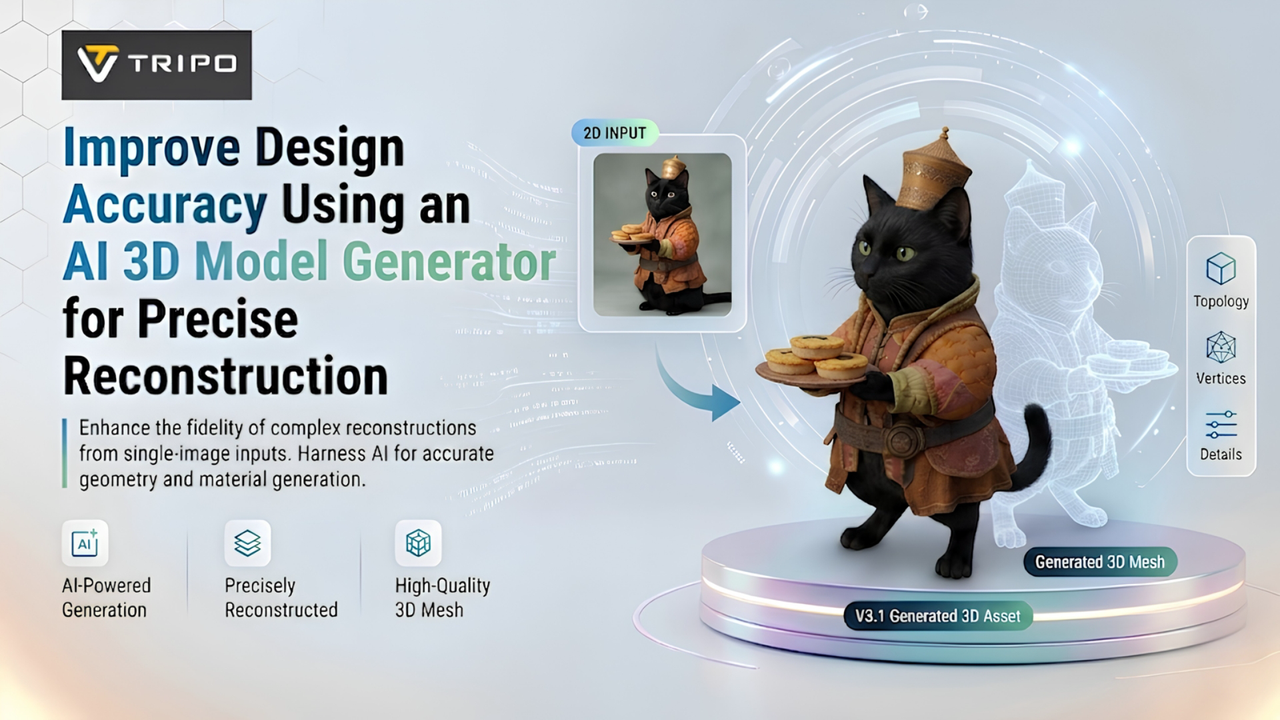
Design accuracy is a key factor that supports modern digital production pipelines. Accurate 3D reconstruction supports reliable models for use in games, films, and manufacturing. Geometric errors and inconsistencies can be introduced in the recreation process when using manual workflows. AI-powered tools have helped address many of these limitations through automated workflows. Tripo 3D is a platform designed for accurate and high-fidelity reconstruction. It helps maintain structural integrity, speed, and consistency in modeling tasks.
Understanding Precision Reconstruction in 3D Modeling
Precision reconstruction is a reconstruction of a digital 3D model with a high degree of geometric precision from references. It will focus on shape fidelity and on proportions and spatial relations. When reconstructed accurately, the visual output closely reflects the original design intent. Structural elements are crucial for realism and usability. Clean topology can also aid in editing, animating, and rendering. Tripo 3D improves reconstruction results through mesh flow and geometric regularization. This process supports production pipelines that require consistency and reliability across design stages.
How AI 3D Model Generator Enhances Design Accuracy
AI systems analyze visual data and interpret spatial structure to improve modeling accuracy. They reduce the risk of human error during manual modeling and help maintain consistent output quality. The geometry is created accurately by analyzing shapes, edges, and depth relationships using an AI 3d model generator. It helps align generated meshes with reference inputs for improved fidelity. Tripo 3D applies structured reconstruction logic and adaptive mesh optimization. This approach maintains proportional balance while reducing approximation errors in complex models. The system also maintains consistency in textures and surface details. This contributes to improved accuracy of assets used across different industries.

Image-to-3D Reconstruction for Detailed Results
Image-based reconstruction converts static images into 3D models with realistic depth. The system interprets lighting, perspective, and structure from images. This process significantly reduces manual modeling effort while supporting more consistent results. The image to 3d workflow with Tripo 3D supports both single-view and multi-view reconstruction. It predicts spatial relationships to reconstruct hidden geometry. This enables more detail in structure and surface features to be preserved. Depth estimation algorithms help create natural proportions and realistic depth. The resulting model closely reflects the original visual references with minimal deviation.
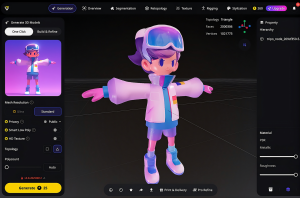
Steps to replace manual sculpting steps using an AI 3d model generator for faster creation
Step 1: Start with Image or Text References
- First, you need to access Tripo 3D and signup. Next, go to the “Model” tab present in the vertical left menu bar.
- Under the menu, click on the “HD Model”. You can generate the model either using the text prompt or through image upload.
- You can drag and drop to upload the image, or you can also upload the image from a specific location of your device using the “Upload” tab.
- If you don’t have an image, click on the “Text to model” tab to generate the model using a descriptive text prompt.
Step 2: Speed Up Model Generation
- Under the “General settings” tab, you can either allow the AI to completely generate on its own by switching “AI complete”. Or you can turn on texture and select the custom “Texture Quality” like 2K, 4K, or 8K.
- You can also turn on “PBR” for accurate material reflective properties.
- For better topology characteristics, select either “Quad” or “Triangle” topology.
- You can also set the custom polycount.
- Later choose the model from the list, including v3.1 best quality, v3.0 fast and balanced, or v2.5 legacy.
- If you are a member, then you can choose “Generate in Parts”, “8K Texture”, and “Privacy” options.
- Finally, click on the “Generate Model” to begin generation.
Step 3: Finalize and Save the Model
- Tripo 3D allows you to completely view your model in the style you want. Key styles include “Solid View”, “Cartoon Style”, “Sketch Style”, “Hologram Style”, and “Unlit” form. You can also “Refine” your design right through the bottom menu.
- You can also edit the “Environment Settings” and camera settings through “Reset Camera”.
- You can 3D print the design you want, or you can share it directly by clicking “3D Print”.
- In the end, click on the “Export” tab from the bottom menu. Next, choose the resolution, format, and file name, and click again on “Export” to save the design to your local device.
Factors Contributing to Reconstruction Precision
Several technical factors contribute to high-quality reconstruction results. AI’s ability to interpret structure and detail depends largely on input quality. Proper alignment reduces deviation from the intended design, while clean meshes support easier editing. Detailed shape preservation helps retain key object features for realistic modeling. Topology consistency helps maintain stability and support animation pipelines. Advanced texture application improves surface realism and appearance. AI refinement applies iterative adjustments to improve accuracy further.
- The input alignment will be more accurate, the closer the reference design structure is to the truth.
- Organized geometry generation generates organized mesh structures that are able to be edited.
- Detailed shape preservation (maintaining important visual and functional attributes).
- Improved topology consistency is beneficial for stability and production compatibility
- Advanced application of textures, giving reality and depth to surfaces.
- AI-assisted iterative refinement can further improve model quality and accuracy.
Tripo 3D Capabilities for Accurate Design Recreation
Tripo 3D provides features for high-precision modeling and reconstruction processes. It combines geometry processing, texture, and material systems for consistent output. The platform supports high-fidelity reconstruction from inputs such as images and sketches. The text to 3d model feature converts descriptive prompts into structured 3D models with detailed geometry. Tripo 3D provides clean topology and meshes suitable for downstream applications. It also has a variety of export options that can be used with the most popular 3D software. These capabilities support industries that require reliable and efficient asset creation pipelines.
Practical Considerations for Precision-Oriented Workflows
When working with precision-focused workflows, input selection and generation settings are important considerations. Higher-resolution reference images reduce ambiguity and improve reconstruction quality. Texture and topology settings help achieve cleaner output structures. Checking model dimensions helps maintain proportional accuracy through design stages. Iterative refinement can help correct small geometric inconsistencies. Tripo 3D’s editing tools and real-time preview options support these adjustments. Regular evaluation throughout the generation process helps maintain quality and supports professional use cases.
Future Innovations in AI Reconstruction Technology
In many aspects, AI reconstruction is still moving towards more intelligent and accurate structures. Future systems are expected to improve multi-view integration for broader spatial understanding. Geometry prediction is expected to improve, reducing the need for manual corrections. Improved learning models may better interpret complex and organic forms. Game, architecture, and manufacturing industries are expected to see broader applications. As algorithms continue to evolve, Tripo 3D may incorporate these advancements. These innovations may influence future digital modeling processes.
Conclusion
AI-powered reconstruction improves accuracy, efficiency, and consistency in 3D modeling workflows. It reduces processing time while maintaining structural and visual fidelity. Tripo 3D incorporates geometry generation and refinement tools into the workflow. It supports various industries that rely on digital asset creation. Continued AI development is expected to improve reconstruction accuracy and efficiency further.