Kick Stats Explained: Accuracy, Distance & Records 2026

Kick stats are the core metrics used to evaluate the performance of NFL placekickers, covering everything from field goal percentage and extra point accuracy to average kick distance and long-range records.
Whether you follow the game for fantasy football, sports betting, or pure love of the sport, understanding kick stats helps you measure a kicker’s true value to a team.
Modern kick stats have become increasingly detailed, tracking distance by range, conversion rates by game situation, and performance under pressure.
This complete guide breaks down every major kick stat category, explains the key records, profiles the top kickers, and shows you how to read the data like a pro analyst in 2026.
Quick Facts Table
| Stat | Detail |
|---|---|
| Keyword Focus | Kick Stats |
| Most Accurate Kicker All Time | Justin Tucker (89.1% career FG%) |
| Current NFL Record Longest FG | 68 yards — Cam Little, Jacksonville Jaguars (Nov 2, 2025) |
| Previous Record | 66 yards — Justin Tucker, Baltimore Ravens (Sept 26, 2021) |
| NCAA Record Longest FG | 69 yards — Ove Johansson, Abilene Christian (1976) |
| Average NFL FG Distance (2025) | 37 to 39 yards |
| Average FG Percentage (NFL) | 88 to 91% from under 40 yards |
| Average FG Percentage 50+ Yards | 65 to 70% league average |
| Extra Point Percentage (League Avg) | 93 to 95% |
| Key Kick Stat Categories | FGM, FGA, FG%, XP%, Long, Avg Distance, Pts |
| Top Fantasy Kicker Metric | Field Goal Attempts Per Game |
| Best Season FG% (Min 20 Att) | 94.4% — Cody Parkey (2013) |
| Most FGs in a Season | 44 — David Akers (2011) |
| Most Career FGs | Adam Vinatieri (599) |
| Scoring from Kicking Only | 3 pts (FG), 1 pt (PAT), 2 pts (blocked XP return) |
| Dynamic Kickoff Rule | Introduced 2024 NFL season |
| Key Platforms for Kick Stats | Pro-Football-Reference, ESPN, NFL.com, CBS Sports |
What Are Kick Stats
Kick stats is the umbrella term for all statistical metrics that track a placekicker’s performance across field goals, extra points, kickoffs, and touchbacks in football. They are a core part of NFL special teams analysis.
At the most basic level, kick stats tell you how many times a kicker attempted and made field goals in a game or season, and at what percentage. These numbers determine how valuable a kicker is to their team in scoring situations.
In modern football analysis, kick stats have expanded well beyond simple makes and misses. Today’s metrics include average attempt distance, conversion rates by range bracket, kickoff hang time, touchback rates, and performance in pressure situations like the fourth quarter and overtime.
Field Goal Made and Field Goal Attempted
The two foundational kick stats are field goals made (FGM) and field goals attempted (FGA). These numbers form the basis of every kicker evaluation at every level of football.
FGM tells you how many three-point kicks a kicker successfully converted during a game or season. FGA tells you the total number of times the kicker was sent onto the field for a field goal try, regardless of the outcome.
The ratio between these two numbers produces the field goal percentage, which is the single most referenced kick stat when evaluating kicker quality. A kicker with 30 FGM from 33 FGA holds an FG percentage of 90.9%, which is elite by any measure.
Field Goal Percentage Explained
Field goal percentage (FG%) is calculated by dividing field goals made by field goals attempted and multiplying by 100. It is the most widely used kick stat for measuring accuracy.
The league-wide average field goal percentage in the NFL has climbed significantly over the decades. In the early 2000s, a kicker making 80% of their attempts was considered solid. Today, the league average sits above 88%, and elite kickers routinely post 90% or higher.
Justin Tucker of the Baltimore Ravens has maintained over a 90% career field goal percentage, making him the most accurate kicker in NFL history. This standard has redefined what fans and teams expect from the position.

FG Percentage by Distance Range
One of the most important breakdowns in kick stats is field goal percentage split by distance range. Not all kicks are equal and tracking accuracy by range reveals a kicker’s true strengths and limitations.
The standard distance brackets used across most NFL stat platforms are under 20 yards, 20 to 29 yards, 30 to 39 yards, 40 to 49 yards, 50 to 59 yards, and 60 or more yards. Each bracket tells a different story about a kicker’s range and reliability.
At the shorter distances, league-wide success rates are extremely high. From 20 to 29 yards, NFL kickers make over 97% of attempts. From 30 to 39 yards, conversion rates stay above 92%. From 40 to 49 yards, the number drops to around 85%. From 50 to 59 yards, the average falls to around 70%, and from 60 or more yards, only a handful of kicks in NFL history have been successful.
How Kicker Accuracy Has Improved Over Time
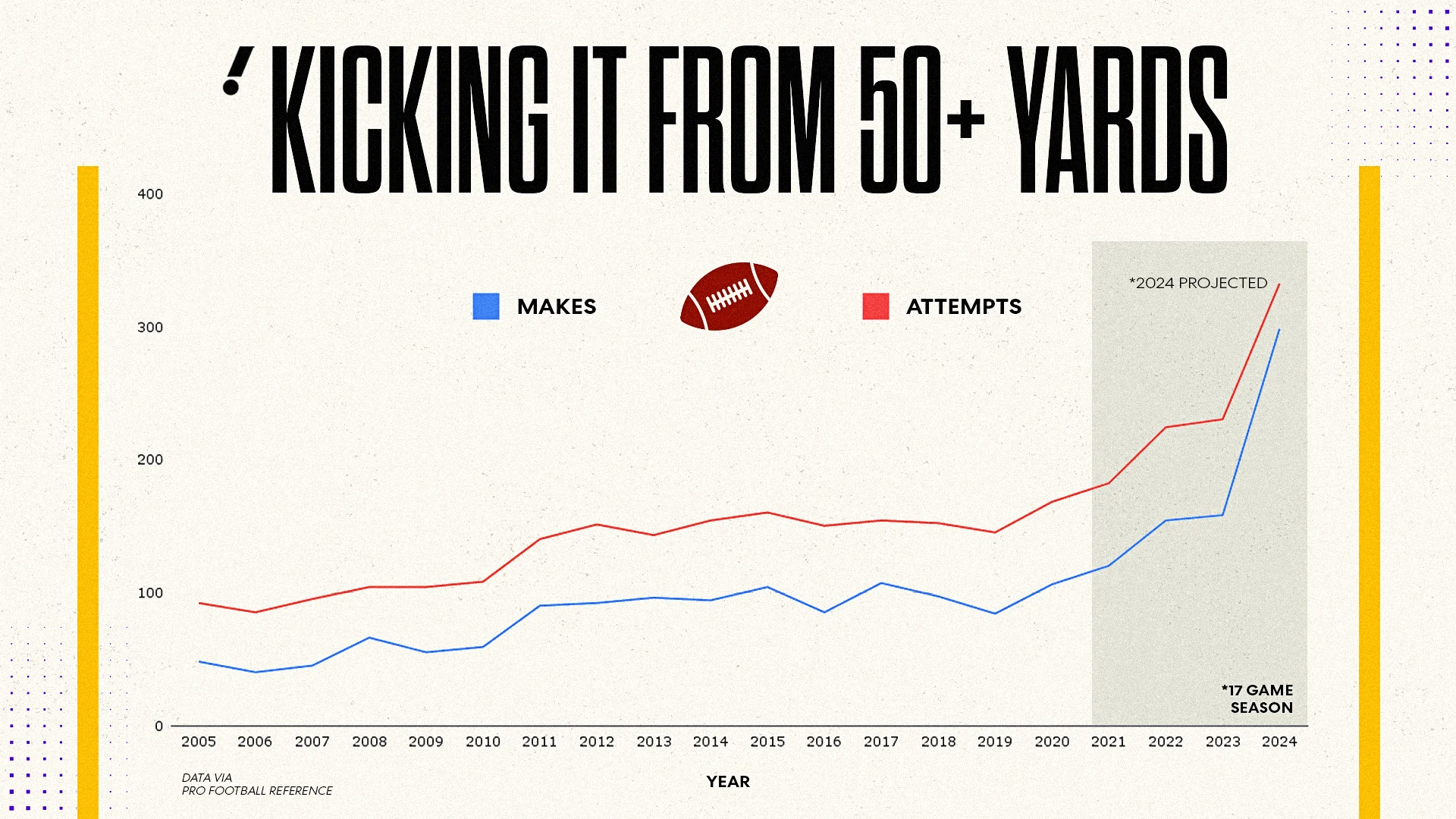
NFL kickers have become significantly more accurate at every distance since 1999. Kickers in 2024 were 12 percentage points more accurate on kicks of 30 to 34 yards, 10 percentage points better from 40 to 44 yards, and a massive 20 percentage points more accurate from 50 to 54 yards compared to the 1999 to 2003 era.
The biggest accuracy gains have come at long range. Kickers in 2024 were 40 percentage points more accurate on kicks of 55 to 59 yards than their counterparts in the early 2000s. This improvement has meaningfully changed game strategy.
These improvements come from better training methods, improved footwear and ball technology, and a larger pool of specialized kicking talent entering the NFL through college programs with dedicated special teams coaching.
Extra Point Percentage
Extra point percentage (XP%) is the kick stat that measures how often a kicker converts the one-point point-after-touchdown attempt. After the NFL moved the extra point distance to the 15-yard line in 2015, this kick became less automatic but still sits above 93% league-wide.
Before the rule change, extra point conversion rates exceeded 99% consistently. The increased distance introduced meaningful variance and gave extra points real game-stakes tension that did not exist before.
Elite kickers maintain XP% above 96%. This number feeds directly into total kicking points, making it just as important as field goal accuracy when evaluating a kicker’s overall seasonal contribution and fantasy football value.
Average Kick Distance
Average kick distance is the mean yardage of all field goal attempts by a kicker in a given season. It reveals whether a kicker is being asked to attempt longer or shorter kicks relative to their peers.
A higher average attempt distance suggests a team trusts the kicker from greater range and is willing to push the limits of their range in game situations. Matt Prater, for example, posted average distances consistently above 39 yards during his peak years.
The league average attempt distance has increased over recent seasons as teams gain confidence in their kickers and as offensive strategies evolve. More teams are now attempting 50-plus yard kicks rather than automatically punting when drives stall past the 35-yard line.
Long Field Goal Kick Stat
The long (LNG) kick stat records the longest successful field goal a kicker made during a game or season. It is one of the most watched individual kick stats because it showcases the pure leg power and technique of an elite kicker.
A kicker with a long of 55 or more yards in a season is demonstrating elite range. Any kicker who connects from 60 or more yards is entering record-book territory that only a handful of players in NFL history have reached.
The long kick stat is especially useful in fantasy football, where kicks from 50-plus yards score bonus points on most platforms. Kickers with a demonstrated ability to connect from long range carry significantly higher fantasy ceiling values than those limited to short and medium attempts.
The Current NFL Record for Longest Field Goal
On November 2, 2025, Cam Little of the Jacksonville Jaguars hit a 68-yard field goal during their Week 9 game against the Las Vegas Raiders, breaking the previous NFL record.
The previous record was held by Justin Tucker, who kicked a 66-yard game-winning field goal for the Baltimore Ravens in a Week 3 victory over the Detroit Lions in 2021. That kick was historic not just for the distance but because it was a game-winner with no time remaining.
The NCAA record for longest field goal stands at 69 yards, set by Ove Johansson of Abilene Christian on October 16, 1976, against East Texas State. The NFL record now sits just one yard short of that mark.
Justin Tucker and His Record-Breaking Kick
Justin Tucker held the NFL record for longest field goal for over four years with his 66-yard game-winner at Ford Field in Detroit on September 26, 2021. The kick remains one of the most dramatic moments in NFL kicking history.
To generate the extra power needed, Tucker adjusted his technique for the record attempt, taking extra steps back and approaching the kick more like a kickoff than a standard field goal attempt. The ball struck the crossbar and bounced through to complete the 19 to 17 Ravens victory.
From 2016 through 2023, Tucker converted 78% of his field goals from over 50 yards, an extraordinary rate at that distance. He also set a record by making at least 85% of his kicks in eight consecutive seasons from 2016 through 2023.
Cam Little and the New NFL Record in 2025
Jacksonville Jaguars kicker Cam Little nailed a 70-yard field goal in the first week of the 2025 preseason against the Pittsburgh Steelers, previewing the kind of range that would eventually break the NFL in-game record in Week 9.
His 68-yard record-setting kick in the regular season against the Las Vegas Raiders confirmed Little as one of the most powerful legs in the modern NFL. At just over 68 yards, the kick surpassed Tucker’s celebrated record by two full yards.
The new record marks a significant shift in how teams and fans think about extreme-range kicking. What was once considered impossible from beyond 60 yards is now treated as rare but achievable by elite specialists.
Touchback Percentage as a Kick Stat
Touchback percentage is a kickoff-specific kick stat that measures how often a kicker’s kickoffs result in a touchback, meaning the receiving team elects to start at the 25-yard line rather than returning the kick.
Higher touchback rates were historically considered good for the kicking team because they prevented long returns. However, the new Dynamic Kickoff rule introduced in 2024 changed how kickoffs work and how touchback rates are calculated and interpreted.
Under the Dynamic Kickoff rules, kickers now aim for precision placement rather than pure distance. Touchback rates and return rates are being recalibrated across the league as coaches and special teams coordinators experiment with new kick placement strategies.
Dynamic Kickoff Rule and Its Impact on Kick Stats
The NFL introduced the Dynamic Kickoff rule in 2024, fundamentally changing the kickoff play and how kickoff-related kick stats are tracked. The old model of kickers simply booting the ball as deep as possible is no longer the primary strategy.
Under the new rule, the kicking team lines up closer to the receiving team, changing how blockers and returners interact. Kickers now have to think about placement, hang time, and directional accuracy rather than just raw distance.
Justin Tucker described the new kickoff format as similar to golf, noting he had developed between eight and nine different kickoff strategies to use throughout a season depending on the game situation. This complexity adds entirely new dimensions to kickoff-related kick stats.
Kicking Points as a Composite Kick Stat
Total kicking points (PTS) is the composite kick stat that adds together all points a kicker scored through field goals and extra points in a given season. It is the most comprehensive single-number summary of a kicker’s offensive contribution.
For context, a kicker who makes 30 field goals and 35 extra points in a season produces 125 total kicking points. Elite kickers in high-volume offenses can exceed 140 to 150 points in a strong season.
Adam Vinatieri holds the NFL record for most career field goals made with 599, making him the all-time leader in career kicking production by volume. His combination of longevity and consistency across two decades set standards that still influence how total kicking points are evaluated today.
Fantasy Football Kick Stats
In fantasy football, kick stats determine weekly scoring and season-long value. The key metrics for fantasy kicker evaluation are field goal attempts per game, field goal percentage, average distance, and total kicking points.
For fantasy football purposes, field goal attempts per game is the most important kick stat to evaluate because volume correlates directly with fantasy points. A kicker on a high-scoring offense that also stalls near the red zone generates the most attempt opportunities.
Efficiency matters too but volume comes first. A kicker with 0.9 attempts per game at 88% accuracy outscores a kicker with 0.6 attempts per game at 95% accuracy in nearly every scenario. Smart fantasy managers prioritize opportunity when setting lineups.
How to Read a Kicker Stat Line
A standard NFL kicker stat line includes these abbreviations: FGM (field goals made), FGA (field goals attempted), FG% (field goal percentage), LNG (longest made field goal), XP (extra points made), XPA (extra point attempts), XP% (extra point percentage), and PTS (total kicking points).
Advanced stat lines add distance-range breakdowns showing makes and attempts from each 10-yard bracket. These range stats let analysts see not just overall accuracy but which distances a kicker excels or struggles at.
Reading a kicker’s split stats over home versus away games, or dome versus outdoor stadiums, adds another layer of understanding. Weather, altitude, and surface all affect kick performance in ways that raw season totals sometimes hide.
Key Kick Stats to Track Each Week
For weekly tracking in both real football analysis and fantasy football, the most important kick stats to monitor are field goal attempts, field goal percentage on attempts of 40 or more yards, and total kicking points.
Watch for schedule factors that affect kick stats. Cold weather games in outdoor stadiums reduce range and accuracy. Wind conditions at certain stadiums like Soldier Field in Chicago or Highmark Stadium in Buffalo are notoriously difficult for kickers.
Injury reports are also essential. A kicker nursing a groin or leg injury will see their long-range accuracy and kickoff power drop significantly even if they remain active. These subtle health factors often show up in kick stats before they show up in media reports.
Top NFL Kickers to Watch in 2025 and 2026
Several kickers have established themselves as the most productive and reliable in the current NFL era. Their kick stats consistently rank at or near the top of every major category.
Harrison Butker of the Kansas City Chiefs is one of the most decorated kickers in the game. Butker has recorded over 90 field goals made over three consecutive seasons and maintains a field goal percentage just under 90%. His consistency on one of the NFL’s most dominant offenses makes his kick stats among the most reliable in the league.
Brandon Aubrey of the Dallas Cowboys has emerged as one of the most exciting long-range kickers in football. He connected from 65 yards in a 2024 regular season game, the second-longest made field goal in NFL history at the time. His kick stats suggest elite range and strong accuracy from beyond 50 yards.

Harrison Butker Career Kick Stats
Harrison Butker has been the Kansas City Chiefs’ placekicker since 2017 after being drafted in the seventh round out of Georgia Tech. His career kick stats place him among the best of his generation.
Butker has won multiple Super Bowls with the Chiefs and his performance in high-pressure playoff games has cemented his reputation as a clutch performer. His kick stats in postseason games reflect the same accuracy and range he shows in the regular season.
His 2025 season FG% of 84.6% ranked 25th in the league, a down year by his own standards. His longest kick of the 2025 season reached 59 yards and he totaled 95 kicking points despite the below-average accuracy rate.
Cam Little Rising Star Kick Stats
Cam Little of the Jacksonville Jaguars announced himself to the national audience with his record-breaking 68-yard field goal in the 2025 regular season. His emergence represents the next generation of extreme-range kickers in the NFL.
His preseason 70-yard field goal had already demonstrated elite raw leg power, but converting from 68 yards in a regular season game against a professional NFL defense confirmed that his range is genuine and repeatable in competitive conditions.
Little’s kick stats going forward will be among the most watched in the league as analysts determine whether he can combine the distance he has shown with the consistency required to be considered among the all-time great kickers.
Kick Stats Glossary
Understanding kick stats fully requires familiarity with the standard abbreviations and terms used across all major platforms. Here is the complete glossary of kick stat terminology.
FGM means field goals made. FGA means field goals attempted. FG% means field goal percentage. LNG means longest successful field goal in the period. XP means extra points made. XPA means extra points attempted. XP% means extra point conversion percentage. PTS means total kicking points scored. AVG means average field goal attempt distance. TB means touchbacks on kickoffs. TB% means touchback percentage on kickoffs. KO means kickoffs. KOYds means total kickoff yardage. 1 to 19, 20 to 29, 30 to 39, 40 to 49, 50 to 59, and 60-plus are the distance-range breakdown columns used for FGM and FGA splits.
Where to Find Official Kick Stats
The most reliable sources for official kick stats are Pro-Football-Reference.com, ESPN.com, NFL.com, CBS Sports, and Fox Sports. Each platform offers slightly different data presentations and filter options.
Pro-Football-Reference is the gold standard for historical depth. You can filter by season, by player, by range, and by game situation going back to the earliest decades of NFL history. It is the best tool for comparing kick stats across eras.
ESPN and NFL.com offer cleaner real-time leaderboards for the current season. They update live during games and show weekly leaders alongside season totals. Fox Sports and CBS Sports both provide solid tables with sortable columns that make quick comparisons easy.
Kick Stats in College Football
Kick stats in college football follow the same basic structure as the NFL but with different benchmarks for what constitutes elite performance. College kickers face less pressure but more varied playing conditions.
The NCAA record for longest field goal of 69 yards, set in 1976, still stands and has not been broken despite the advances in kicking technique over the past five decades. This reflects how truly exceptional long-range kicking remains even at the highest level.
ESPN tracks college kick stats by conference and nationally for every season. The stats use the same FGM, FGA, FG%, and distance-range format as the NFL, making it easy to compare college and professional kicker performance when scouting draft prospects.
Advanced Kick Stats and Analytics
The field of advanced kick stats has grown significantly with the rise of player-tracking technology and air-yards data. Modern analytics go far beyond traditional box score numbers.
Expected Points Added (EPA) per kick is one of the most powerful advanced kick stats. It measures how much a kicker’s performance increased or decreased a team’s expected scoring relative to a league-average kicker in the same situation. Positive EPA means the kicker outperformed expectations.
Win Probability Added (WPA) is another advanced kick stat that measures how much a specific kick changed the probability of a team winning the game. Tucker’s 66-yard game-winner in Detroit in 2021 had one of the highest WPA values ever recorded for a kicking play.
Kick Stats and Weather
Weather has a measurable and documented effect on kick stats. Cold temperatures reduce ball elasticity and air density, which shortens carry distance and reduces accuracy on longer attempts.
Wind is the most significant weather factor affecting kick stats. A direct headwind can reduce field goal range by 10 to 15 yards. Crosswinds make directional accuracy extremely difficult. Studies of NFL kick stats show that kickers in cold-weather outdoor stadiums post lower FG% from 50-plus yards compared to dome kickers.
Altitude is a positive factor. Kicks at Mile High Stadium in Denver, where the air is thinner, travel farther than the same kick at sea level. Matt Prater’s 64-yard record in Denver in 2013 benefited from the altitude, while Tucker’s 66-yard record came indoors at Ford Field in Detroit.
Kick Stats for Punters vs Placekickers
While kick stats most commonly refers to placekicker metrics, punting is a separate category of kick statistics tracked independently. The two are covered under the broader umbrella of special teams stats.
Punting kick stats include gross average yards per punt, net average yards after return, touchback rate, punts inside the 20-yard line, and hang time. These metrics measure a punter’s ability to flip field position and pin the opposing offense deep.
The best punters in NFL history have combined long average distance with excellent directional control to keep the ball out of the end zone and inside the 20-yard line consistently. Both punting and placekicking kick stats feed into overall special teams grade ratings used by analysts and coaches.
Kick Stats Records Worth Knowing
Beyond the longest field goal records, several other kick stats records define the history of the position and set the benchmarks modern kickers chase.
Most field goals made in a single season: 44 by David Akers with the San Francisco 49ers in 2011. Most career field goals made: 599 by Adam Vinatieri across 24 seasons. Most consecutive extra points made: 499 by Mike Vanderjagt from 1999 to 2007. Best career field goal percentage: Justin Tucker at 89.1%. Most game-winning field goals with no time remaining: 7 by Justin Tucker. Most FG% in a single season by a kicker with 20 or more attempts: 94.4% by Cody Parkey in 2013. Most 50-plus yard field goals in a season: 10 by Justin Tucker in 2016.
Frequently Asked Questions
What are kick stats in football?
Kick stats are the statistical metrics used to track a placekicker’s performance, including field goals made and attempted, field goal percentage, extra point accuracy, average distance, and total kicking points scored.
What is the most important kick stat?
Field goal percentage (FG%) is the single most important kick stat for evaluating accuracy. For fantasy football, field goal attempts per game is the top metric because it measures how many scoring opportunities a kicker receives.
Who has the best kick stats in NFL history?
Justin Tucker of the Baltimore Ravens holds the best career field goal percentage in NFL history at 89.1%. Adam Vinatieri holds the record for most career field goals made with 599.
What is the current NFL record for the longest field goal?
The current NFL record for the longest field goal is 68 yards, set by Cam Little of the Jacksonville Jaguars on November 2, 2025, during a Week 9 game against the Las Vegas Raiders.
What does FG% mean in kick stats?
FG% stands for field goal percentage. It is calculated by dividing the number of field goals made by the number of field goals attempted and multiplying by 100 to get a percentage.
How do kick stats affect fantasy football scoring?
Kick stats directly determine fantasy points. Standard fantasy scoring awards 3 points for field goals under 40 yards, 4 points from 40 to 49 yards, and 5 points from 50 or more yards, plus 1 point per extra point made.
What is the average field goal percentage in the NFL?
The league-wide average field goal percentage in the NFL is approximately 88 to 90%, with elite kickers posting above 91% and most quality starters sitting between 84% and 92% in a typical season.
Where can I find live kick stats during NFL games?
Live kick stats are available on NFL.com, ESPN, CBS Sports, Fox Sports, and Pro-Football-Reference. NFL.com and ESPN update in real time during games and show field goal range and distance for each attempt.
What is a good FG% from 50-plus yards?
Any field goal percentage above 70% from 50 or more yards is considered very good. Elite kickers can sustain 75 to 80% accuracy at that distance. The league average from that range is approximately 65 to 70%.
How has the Dynamic Kickoff rule changed kick stats?
The Dynamic Kickoff rule introduced in 2024 changed kickoff strategy from pure distance kicking to placement and directional precision. Traditional touchback percentage stats are now less relevant and new metrics around kick placement accuracy and return rates have emerged.
Conclusion
Kick stats are far more than just field goals made and missed. From field goal percentage broken down by distance range to career accuracy records and the physics of game-winning 68-yard booms, kick stats tell the complete story of one of football’s most specialized and underappreciated positions.
The evolution of kicker performance over the past 25 years has been remarkable, with accuracy improving at every distance and extreme-range records falling in real game situations.
Whether you are building a fantasy lineup, analyzing special teams tendencies, or simply appreciating the artistry of elite kicking, understanding kick stats in 2026 gives you the edge to see the game more clearly.