Ml in a Quart: A Comprehensive Guide to Converting Quarts to Milliliters
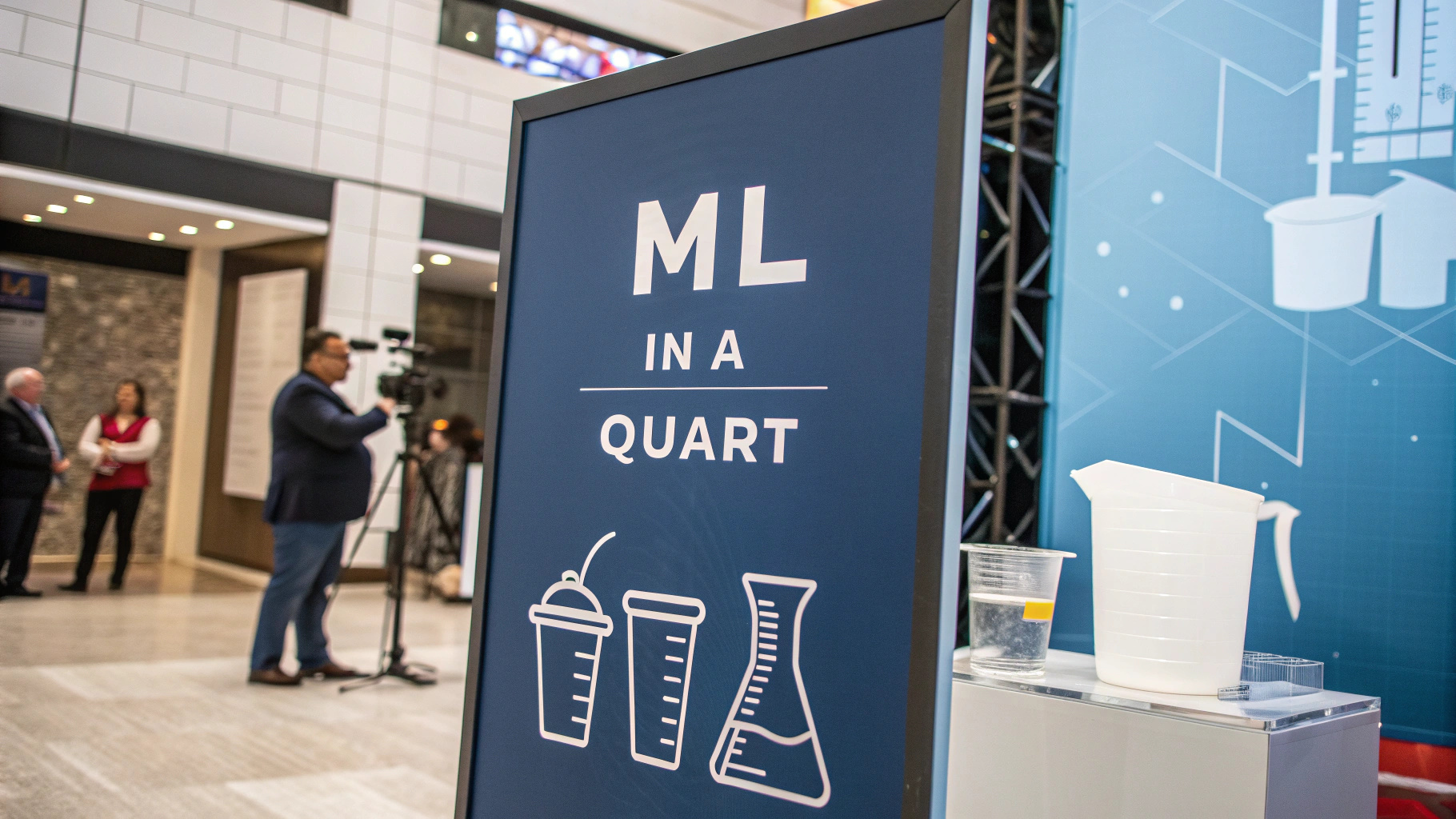
Ml in a Quart is a critical conversion for anyone working with liquid measurements in cooking, science, or daily tasks. In the US customary system, one quart equals exactly 946.352946 milliliters, a precise figure essential for accurate measurements.
This conversion is vital when bridging the US system with the metric system, used globally in most countries. Understanding how many ml in a quart ensures precision in recipes, experiments, or any scenario requiring liquid volumes.
Understanding the Quart as a Unit of Measurement
A quart is a volume unit primarily used in the United States, derived from the Latin “quartus,” meaning one-fourth, as it represents a quarter of a gallon. In the US system, 1 liquid quart is exactly 946.352946 ml, calculated from the fact that 1 US gallon equals 3.785411784 liters, and 4 quarts make a gallon. Dividing the gallon’s liter value by 4 and converting to milliliters (1 liter = 1000 ml) gives the precise milliliters in one quart.

The ml in US quart refers specifically to the US liquid quart, distinct from the US dry quart (used for dry goods like grains) and the imperial quart (used in the UK). The imperial quart is larger, equating to 1136.5225 ml, which can cause confusion in international contexts. For most practical purposes, especially in cooking, the focus is on the liquid quart to ml, making this conversion a cornerstone for accurate measurements.
Why Convert Quarts to Milliliters?
Converting 1 quart equals how many ml is necessary when working with metric-based tools or recipes. The metric system, with liters and milliliters, is the global standard for scientific research, international trade, and most national measurement systems outside the US. Knowing ml in a quart allows seamless transitions between these systems. For example, a recipe calling for 1 quart of broth translates to 946.35 ml, enabling use of a metric measuring cup.
In cooking measurement quart to ml, this conversion ensures consistency in dishes like soups or sauces, where liquid ratios are critical. Beyond the kitchen, convert quart into ml is useful in fields like chemistry, where precise liquid volumes are needed, or in everyday tasks like filling water bottles or mixing cleaning solutions. The ml equivalent of a quart eliminates guesswork, ensuring accuracy across diverse applications.
US vs. Imperial Quarts: Key Differences
The quart to ml conversion hinges on whether you’re using the US or imperial system. A US liquid quart is 946.352946 ml, while an imperial quart, used in the UK and some Commonwealth countries, is 1136.5225 ml. This 190 ml difference can significantly impact outcomes, especially in cooking measurement quart to ml. For instance, using a US quart value for an imperial quart recipe could result in less liquid, altering a dish’s texture or flavor.
The US dry quart, used for measuring dry ingredients like flour, is approximately 1101.22 ml, further complicating conversions if not specified. For clarity, this guide focuses on the liquid quart to ml, as it’s the most common in recipes and liquid-based tasks. Always verify the measurement system to ensure the correct ml in a quart.
Practical Applications of Quart to Milliliter Conversion
Knowing how many ml in a quart has wide-ranging applications. In the kitchen, cooking measurement quart to ml is essential for recipes requiring large liquid volumes, such as stocks or beverages. For example, 1 quart of milk for a dessert recipe is 946.35 ml, allowing precise measurement with metric tools. This is especially helpful when scaling recipes for larger gatherings or professional kitchens.
Outside cooking, milliliters in one quart is useful in gardening (measuring water or fertilizer), home brewing (calculating wort volumes), or automotive tasks (measuring fluids like oil). In scientific experiments, convert quart into ml ensures alignment with metric standards, critical for accurate results. Even in daily life, like filling a 1-quart water bottle, knowing ml equivalent of a quart helps match container capacities.
How to Perform the Quart to Milliliter Conversion
To convert quart into ml, multiply the number of quarts by 946.352946 for US liquid quarts. For 1 quart, this yields 946.35 ml (rounded for practicality). For multiple quarts, multiply accordingly: 2 quarts × 946.352946 = 1892.71 ml, 3 quarts × 946.352946 = 2839.06 ml, and so on. For imperial quarts, multiply by 1136.5225.
Without a calculator, approximate 1 US quart as just under 1 liter (1000 ml) for quick estimates, subtracting about 50 ml to get roughly 950 ml. While less precise, this method works for casual tasks. For fractional quarts, like 0.5 quarts, multiply 0.5 × 946.352946 = 473.18 ml. To convert milliliters back to quarts, divide by 946.352946. A quart to milliliters chart can simplify repetitive conversions, listing values like 1 qt = 946.35 ml, 2 qt = 1892.71 ml, etc.
Tools for Accurate Quart to Milliliter Conversion
For precise quart to ml conversion, use tools designed for liquid measurements. A metric measuring cup, marked in milliliters, is ideal for kitchen use. A 1-liter pitcher (1000 ml) can approximate 1 quart, with slight adjustments for the 53.65 ml difference. Digital kitchen scales with liquid conversion functions can calculate ml in a quart by weight, especially for water (1 ml = 1 gram).

Conversion apps or quart to milliliters chart printed for kitchen use streamline repetitive tasks. In professional settings, graduated cylinders or beakers ensure accuracy for liquid quart to ml measurements. Always confirm tools are metric-calibrated to avoid errors in ml in US quart calculations.
Common Mistakes to Avoid in Quart to Milliliter Conversion
Errors in how many ml in a quart often arise from mixing US and imperial quarts. Using 1136.5225 ml (imperial) instead of 946.352946 ml (US) can throw off recipes or experiments. Another mistake is applying the dry quart value (1101.22 ml) for liquid measurements, which skews results. Always clarify the quart type before converting.
Rounding too aggressively, like using 900 ml instead of 946.35 ml, can lead to inaccuracies in precise tasks like baking. Misreading measuring tools, such as using a dry measuring cup for liquids, is another pitfall. Double-check calculations and tools to ensure the correct ml equivalent of a quart.
FAQs About ml in a quart
How many milliliters are in a US liquid quart?
One US liquid quart equals 946.352946 ml, often rounded to 946.35 ml for simplicity.
Is the ml in a quart different for imperial quarts?
Yes, an imperial quart is 1136.5225 ml, about 190 ml more than the ml in US quart (946.35 ml).
Why is quart to ml conversion important for cooking?
Cooking measurement quart to ml ensures accurate liquid measurements for recipes, especially when using metric tools or international recipes.
How do I convert 1 quart to ml without a calculator?
Approximate 1 US quart as 950 ml (just under 1 liter) for quick estimates, or use 946.35 ml for precision.
Does the dry quart affect ml in a quart conversion?
Yes, a US dry quart is about 1101.22 ml, compared to 946.35 ml for a liquid quart to ml. Confirm the quart type.
What tools help with convert quart into ml?
Metric measuring cups, digital scales, or a quart to milliliters chart ensure accurate quart to ml conversion.
How many milliliters are in half a quart?
Half a US liquid quart (0.5 qt) is 473.18 ml, calculated as 0.5 × 946.352946.
Conclusion on Ml in a Quart
Understanding ml in a quart—946.352946 ml for a US liquid quart—is a valuable skill for anyone handling liquid measurements. Whether cooking, conducting experiments, or performing daily tasks, quart to ml conversion ensures precision across diverse contexts.
By using reliable tools, distinguishing between US and imperial quarts, and avoiding common errors, you can master convert quart into ml. This knowledge simplifies cooking measurement quart to ml, making your measurements accurate and your projects successful.