Adapting to the Age of Intelligent Operations
Introduction: Beyond Routine Automation
Businesses today face challenges that are less about executing repetitive tasks and more about responding quickly to change, managing complexity, and sustaining innovation. While robotic process automation (RPA) laid the groundwork for digitized operations, the new frontier is intelligent automation—where software agents operate not only with speed but also with context, purpose, and flexibility.
The Rise of Digital Collaboration
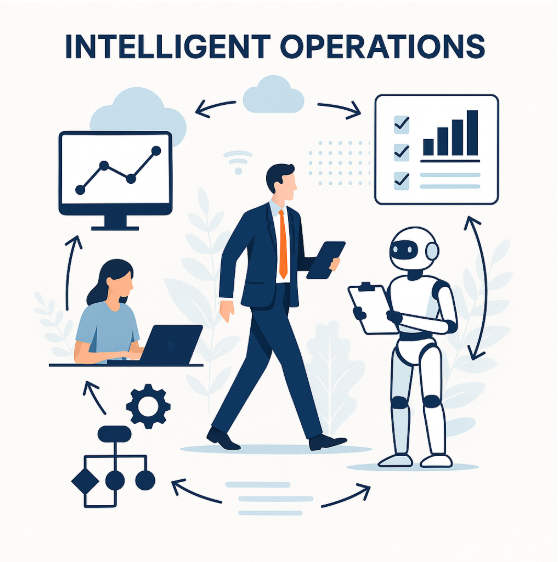
Modern enterprises are built on interconnected systems, teams, and workflows. However, these networks often suffer from bottlenecks due to rigid automation or siloed tools that don’t communicate. In contrast, businesses moving toward a more fluid model—where both human and digital agents work in unison—are seeing transformative gains.
In this hybrid future, the key isn’t just automation, but how different automated systems coordinate with one another and with people. This coordination is what empowers organizations to move from reaction to anticipation, from control to collaboration.
Enabling Adaptive Decision-Making at Scale
To remain competitive, companies must build workflows that adjust in real-time to shifting conditions—be it a spike in demand, a supply chain hiccup, or a compliance change. This is where agentic orchestration comes into play. Rather than scripting step-by-step processes, organizations deploy software agents that act autonomously within a structured ecosystem. These agents dynamically allocate work, escalate issues, and collaborate with humans and other bots to achieve defined business outcomes.
The value of agentic orchestration lies in how it removes the bottlenecks of traditional automation. Instead of a linear workflow, tasks are dynamically assigned and executed based on agent capabilities, workload, and changing priorities—much like a smart team that reassigns roles on the fly to meet a deadline.
Bridging the Gap Between Strategy and Execution
Too often, strategic objectives get lost in translation when passed down through layers of manual processes. But when digital agents are orchestrated intelligently, every layer of the organization can remain aligned to high-level goals. This seamless coordination allows enterprises to scale operational agility without adding managerial overhead.
It’s no longer enough to have dashboards that report what happened. Businesses need systems that respond to what’s happening now. Orchestrated digital agents are the missing link—translating insights into action across systems and departments in real time.
Real-World Impact Across Industries
Industries like finance, healthcare, and manufacturing are already leveraging intelligent orchestration to boost service delivery. In financial services, for example, digital agents manage loan applications from intake to decisioning by collaborating across fraud detection, credit scoring, and compliance modules. In healthcare, these agents facilitate faster patient onboarding, scheduling, and billing coordination across disparate platforms.
One global logistics company recently implemented orchestrated digital agents to reroute deliveries based on traffic data, inventory levels, and client urgency. The result was not just cost savings, but a significant increase in customer satisfaction and staff productivity.
Empowering People, Not Replacing Them
A common misconception is that advanced automation aims to replace people. In reality, orchestrated automation enhances the value of human talent. When mundane tasks are handled autonomously, teams gain bandwidth to focus on analysis, innovation, and complex decision-making.
Digital agents can, for example, handle initial customer inquiries and triage issues to the right department. This ensures that human agents are only brought in where emotional intelligence or nuanced judgment is truly needed—raising both employee engagement and service quality.
Building a Resilient Enterprise Architecture
Resilience in business isn’t just about surviving disruption—it’s about thriving through it. Organizations embracing orchestration aren’t just automating tasks—they’re cultivating systems that can learn, adapt, and evolve.
By designing enterprise architectures that integrate orchestrated agents at the core, companies future-proof their operations. These systems become self-regulating and scalable, offering long-term efficiency without constant reconfiguration.
Looking Ahead: A Culture of Autonomy and Trust
As digital agents take on more responsibility, companies must build a culture of trust—among systems and people. Governance frameworks, transparent decision trees, and real-time feedback loops will be essential. When people understand how automation decisions are made and how agents align with strategic intent, they are more likely to collaborate with and trust those systems.
Moreover, the next step is not merely increasing automation but fostering environments where both humans and machines can learn from each other. By doing so, companies unlock the full potential of agentic orchestration to drive innovation and resilience in tandem.
Conclusion: Reimagining the Workplace
The future of work is no longer just digital—it’s adaptive, orchestrated, and deeply human at its core. By embracing technologies that facilitate coordination between autonomous digital agents and human talent, organizations can do more than scale. They can thrive in complexity, act with speed, and operate with purpose.
As the lines blur between automated systems and strategic operations, agentic orchestration becomes the silent conductor—ensuring that every process, every agent, and every decision is part of a harmonious and high-performing whole.