World Sport and the Environment: Who Has Switched to Green Stadiums?
In March 2025, the fans of Barcelona did not sing during halftime; they gazed. The scrolling along the jumbotrons at Estadi Olímpic Lluís Companys was not an advertisement, but an energy dashboard in real-time: the amount of kilowatts recovered, liters of reclaimed water, and emission reductions. Does a football stadium demonstrate climate data? Neither is that a gimmick. It is the future.
In athletics around the world, and football in particular, environmental stewardship is ceasing to be a peripheral PR activity and is becoming a core infrastructure. Stadiums that used to be meant to draw visual attention are now rated based on the amount of carbon produced, water usage, and transportation plan. It is no longer about being modern, but it is about being responsible.
The Money Behind Green
Green stadiums are no longer just feel-good projects. They’re economically sound. Clubs installing solar panels or water-reuse systems are slashing costs while future-proofing against tightening UEFA and national standards.
This financial logic is now being reflected across parallel digital environments as well. Notably, several digital services—including those offering casino online real money experiences—are highlighting partnerships with eco-aware clubs mid-season, positioning sustainability as a positive driver for brand loyalty. As clubs improve climate credentials, adjacent platforms are riding the wave to connect with the same conscious demographic.
What Does Sustainability Actually Look Like?
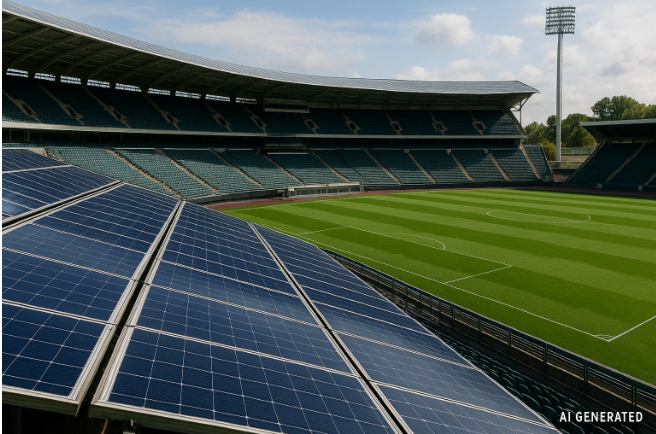
The scope of “green” stadium practices goes far past installing LED bulbs and placing recycling bins around the venue. We consider regenerative infrastructure such as roofs incorporated with solar panels, designated areas for composting, and EV-powered grid storage.
As of 2015, Johan Cruijff Arena has been carbon neutral, operating with 4,200 solar panels which store excess energy in second-life Nissan Leaf batteries located underneath the stadium. Watering the pitch involves collecting rainwater exclusively from the stadium’s roof.
In the UK, Forest Green Rovers are currently building Eco Park, which will be the first stadium made entirely out of certified timber. Estimated to open by 2026, it will serve vegan meals, be off-grid, and incorporate zones for biodiversity into its footprint. This is an operating model rather than an experiment.
Digital Culture and Environmental Loyalty
Every progression in hardware technology unlocks new opportunities for storytelling. Marketing campaigns concerning sustainability have long achieved broad online engagement in climate action. Clubs have seamlessly adapted to this fact.
This is true to a greater extent in developing areas where football fandom merges with lifestyle media. For instance, Melbet Instagram India‘s promotion of solar-powered academies and recycling competitions eclipses ordinary advertising by appealing to local fan culture. Embracing sustainable practices has evolved from optional to essential as a measure of fandom engagement.
In early 2025, Kerala Blasters launched a digital series documenting climate action initiatives featuring renovations inside the club aimed at sustainability. The impact was beyond what anyone anticipated, dominating content shares for 1.5 years, surpassing even player reveal videos.
The Most Sustainable Stadiums in World Football
To understand how sustainability is implemented at the top level, it’s helpful to look at the stadiums currently leading the field. These venues combine practical innovation with verified climate certifications, setting the pace for others to follow.
| Stadium | Club | Key Green Features | Certification |
| Johan Cruijff Arena | Ajax (Netherlands) | Solar power, battery grid, rainwater use | Carbon Neutral since 2015 |
| Tottenham Hotspur Stadium | Tottenham Hotspur (UK) | Zero landfill, composting, smart energy tracking | UN Sport Positive #1 |
| Allianz Arena | Bayern Munich (Germany) | District heating, LED lighting, compostable concessions | ISO 14001 Certified |
| Mercedes-Benz Stadium | Atlanta United (USA) | Solar roof, water reclamation, LEED Platinum structure | LEED Platinum |
| Eco Park (opens 2026) | Forest Green Rovers | Timber build, vegan-only, off-grid power | BREEAM Outstanding (target) |
Each of these clubs isn’t just reducing harm. They’re defining blueprints. UEFA has already hinted that future Champions League venues may require minimum sustainability metrics—energy disclosure, transit planning, and waste tracking.
Fans Are Pushing the Standard
Supporters are also driving smaller-scale innovations that are adding up across leagues. Beyond club-wide policies, fans themselves are creating a measurable impact through community-led ideas and pressure campaigns.
5 fan-led sustainability initiatives:
- “Bring Your Cup” scheme to reduce plastic waste in German Bundesliga matches.
- Curva Sud’s tifo is made entirely from recycled materials (AS Roma, April 2025)
- Green travel coordination apps developed by supporters of Celtic and Rangers
- Fan audits of matchday waste and transport (Union Berlin supporters group)
- Petition-led phaseouts of diesel team buses (France Ligue 2 supporters)
Supporters have become watchdogs. Roma’s ultras now rate away grounds on waste and water performance. In Berlin, Union fans deliver feedback to the club on public transport options. Glasgow-based Green 90 runs independent audits of Scottish stadiums.
UEFA responded. In late 2024, it announced that by 2027, any club hosting a UCL semifinal or final must submit verified sustainability reports, or be barred.
Top 5 stadium actions with measurable impact:
- Solar energy covers 50–70% of electricity needs
- Integrated public transport ticketing
- On-site composting and waste sorting
- Greywater systems linked to pitch irrigation
- In-stadium dashboards showing real-time energy data
These five strategies are no longer considered experimental or elite—they’re becoming a baseline for clubs aiming to meet modern environmental expectations. Clubs that have implemented them consistently report not only reduced emissions but improved fan experience and operating efficiency. Whether it’s shorter wait times due to smarter waste systems or quieter concourses powered by renewables, the shift is being felt in ways both subtle and significant.
Barcelona, Forest Green, and UEFA Lead the Shift
In the last year and a half, football has responded to climate pressures and has made significant steps in some initiatives within the sustainability movement.
As part of their “Green Matchday” initiative, FC Barcelona started displaying climate dashboards that track energy consumption and transport emissions during home games at Estadi Olímpic Lluís Companys. The pilot program is supported by Catalan regional subsidies and has citywide planning repercussions. Additionally, the club reported an 89% drop in single-use plastic consumption during the trial phase in April 2025.
Simultaneously, Forest Green Rovers began construction on the Eco Park timber structure in February 2024. Under the guidance of climate activist Dale Vince, the club adopted a zero-emission policy and vowed to fully electrify matchday operations. They intend to be the first stadium to operate without fossil fuels. Current construction projections target a soft opening in mid-2026.
This marks the most aggressive move UEFA has made to date. It was reported in December 2024 that UEFA has implemented its Sustainability Mandate for Clubs, which includes a sharp ultimatum: by 2027, all stadiums hosting the knockout phases of the Champions League need to meet climate waste management certification, renewable energy disclosure, and low-emission transport plans. If clubs do not meet the conditions, hosting rights will be stripped.
Barcelona’s Temporary Stadium: A Climate Prototype
As FC Barcelona works on redeveloping Camp Nou, they have used the temporary home as a test site. Between March and June 2025, they trialed a plastic-free concession policy, metro-linked ticketing, and visible climate metrics.
The club confirmed these results will directly shape the final build of Camp Nou, which is set to reopen in 2026 as Europe’s most sustainable mega-venue. Expected results show matchday transport emissions will decrease by 37% compared to 2023.
This isn’t a trend. It’s a complete reset. Stadiums that do not continue with the sustainability efforts will lose access to the future of the sport.