Deal or No Deal: Rules, Tips & Winning Strategies 2026
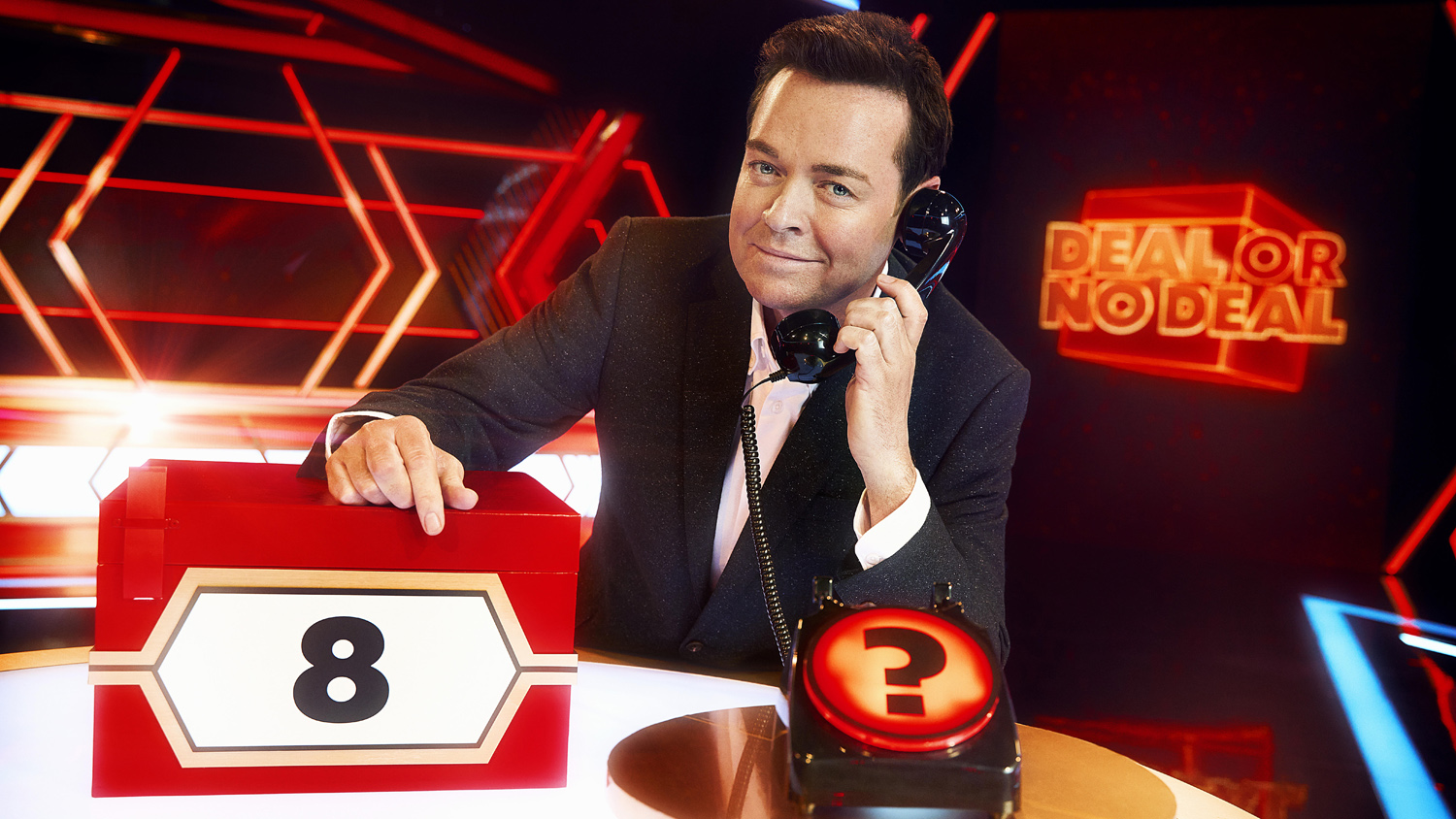
Deal or No Deal is one of the most iconic game shows in television history, built entirely on one simple but nerve-wracking question.
First airing in the US on December 19, 2005, hosted by Howie Mandel on NBC, it turned everyday people into potential millionaires through nothing but luck, guts, and timing.
The format is deceptively simple: pick a briefcase, eliminate others, and decide whether to accept the Banker’s cash offer or keep playing.
With 26 briefcases hiding values from $0.01 to $1,000,000, every round brings tension, drama, and high-stakes decision-making.
What Is Deal or No Deal?
Deal or No Deal is a global television game show format originally created by Dutch production company Endemol. The Dutch version, called Miljoenenjacht (Hunt for Millions), premiered first before the format was exported to over 80 countries worldwide.
The premise requires no trivia knowledge, no skill challenges, and no physical competition. A contestant picks one briefcase from a set of numbered cases, each hiding a different cash amount. They then eliminate other cases round by round while the mysterious Banker calls with increasingly strategic cash offers.
The only decision the contestant must ever make is whether to say “Deal” and take the money or “No Deal” and keep playing. That single repeated choice is what made the show a global phenomenon.
Deal or No Deal History and Origin
The Dutch Beginning
Deal or No Deal started as Miljoenenjacht in the Netherlands in 2002. The original Dutch format included a preliminary quiz to whittle down 200 studio audience members to one final contestant, who then played the briefcase game for a top prize of 5 million guilders.
The concept of the briefcase game itself was so compelling that Endemol separated it from the trivia format entirely. The pure luck-and-decision format was then sold to broadcasters around the world.
US Premiere: December 19, 2005
The American version of Deal or No Deal premiered on NBC on December 19, 2005, hosted by Howie Mandel. The five-episode Christmas week stunt was an immediate ratings smash, with all five episodes landing in Nielsen’s Top 15 for the week.
Mandel, who was planning to quit television at the time, became one of TV’s most recognizable hosts overnight. The show ran for four main seasons from 2005 to 2010 and was revived on CNBC in 2018 for a fifth season before ending in August 2019.
UK Version: October 31, 2005
The British version of Deal or No Deal debuted on Channel 4 on October 31, 2005, hosted by Noel Edmonds. It used 22 sealed boxes instead of 26 briefcases, with prizes ranging from 1p to £250,000.
The UK format had a unique setup where all 22 boxes were held by the 22 potential contestants themselves. Each day, one of them was randomly selected to play, creating an emotional group dynamic unlike any other game show on television.
Deal or No Deal Island (2024–2025)
In February 2024, NBC launched Deal or No Deal Island, a reality competition spin-off that blended the briefcase game with Survivor-style island gameplay. Hosted by Joe Manganiello and executive-produced by Howie Mandel, contestants competed in physical challenges to retrieve briefcases across a tropical island.
The show ran for two seasons. In Season 2, Australian Survivor legend David Genat won $5.8 million, the largest prize in reality TV history at the time. The show was cancelled in December 2025 after two seasons.
Deal or No Deal Rules: Complete Step-by-Step Guide
Understanding the rules of Deal or No Deal is essential before developing any strategy. Here is a complete breakdown of how the game works in its US format.
Step 1: Choosing the Briefcase
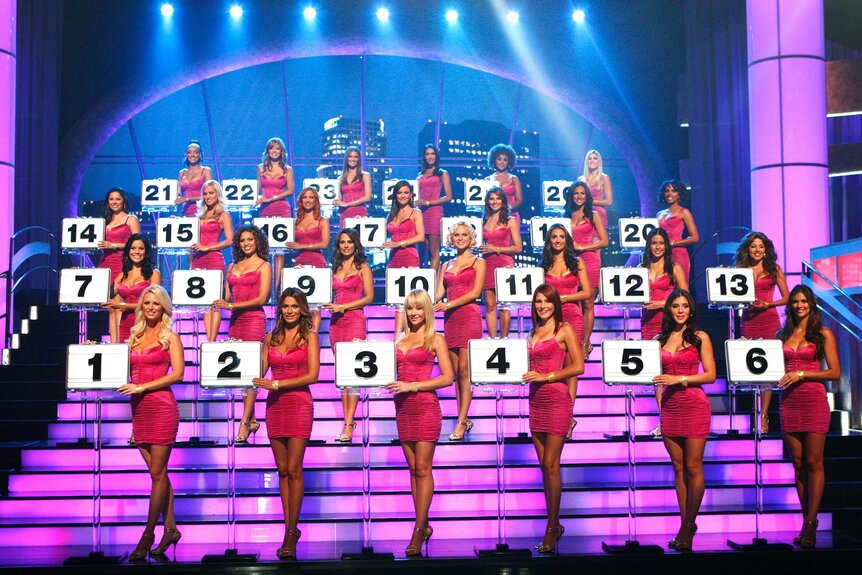
At the start of the game, 26 briefcases are presented, each held by an identically dressed model. Each briefcase contains a different cash value, randomly assigned before the game by an independent adjudicator.
The contestant selects one briefcase, which is brought to the podium and placed before them. This is their case for the entire game. They do not open it immediately.
Step 2: The Money Board
The money board displays all 26 cash values currently in play. As cases are opened and their amounts revealed, those values are removed from the board.
The board is typically split into lower values (shown in blue or on the left) and higher values (shown in red or on the right). Watching the high-value amounts disappear is the primary source of tension throughout the game.
Step 3: Opening Cases by Round
The game is divided into rounds. In each round, the contestant selects a number of cases to open. Here is the standard US round structure.
| Round | Cases Opened |
|---|---|
| Round 1 | 6 cases |
| Round 2 | 5 cases |
| Round 3 | 4 cases |
| Round 4 | 3 cases |
| Round 5 | 2 cases |
| Round 6 onward | 1 case per round |
Each time a case is opened, its cash value is revealed and removed from the board. If the opened case contained a high value, the money board weakens and the Banker’s offer typically drops. If low values are eliminated, the remaining board stays strong and the Banker’s offers increase.
Step 4: The Banker’s Offer
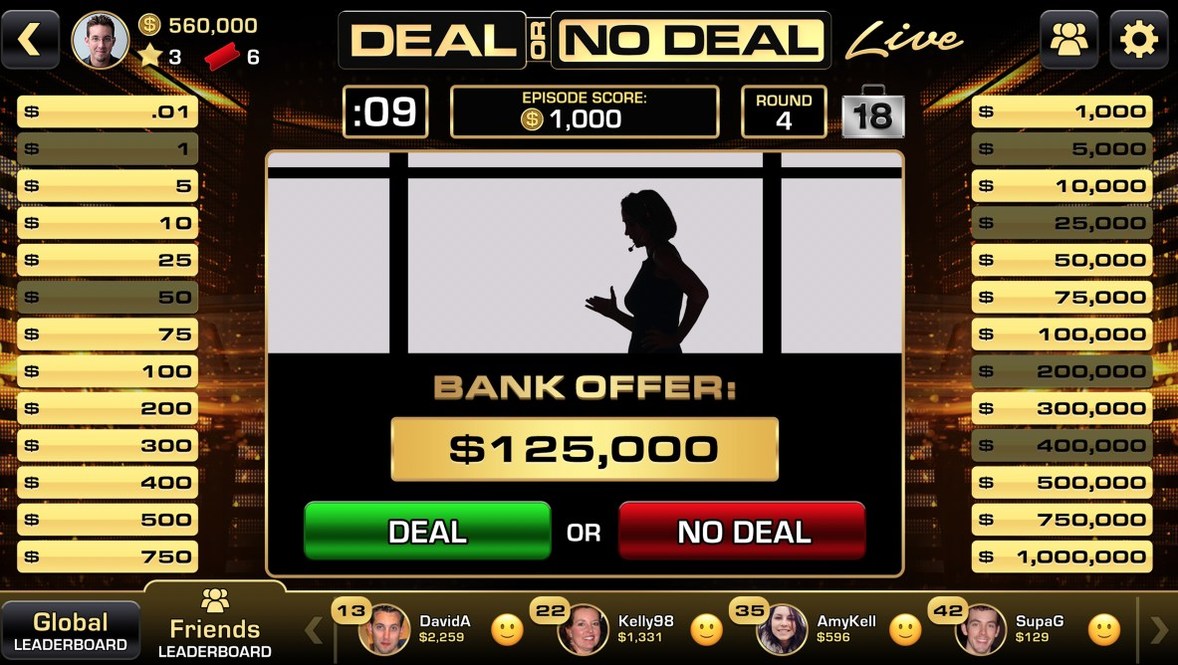
After each round of case openings, a telephone rings on the host’s podium. The host answers and speaks with “The Banker,” a mysterious figure visible only as a silhouette in a skybox overlooking the studio.
The Banker makes a cash offer to buy the contestant’s chosen briefcase. This offer is calculated based on the average expected value of the remaining cases on the board, but is almost always less than that average — especially in early rounds.
The host then asks the defining question of every game: “Deal or No Deal?”
Step 5: Deal or No Deal Decision
If the contestant says “Deal,” they accept the Banker’s offer, the game ends, and they receive that cash amount. Their original briefcase is then opened to reveal what was inside.
If the contestant says “No Deal,” the game continues to the next round. More cases are opened, the board changes, and the Banker makes a new revised offer at the end of that round.
Step 6: The Final Decision
If the contestant reaches the final two cases without taking a deal, they are presented with one last offer from the Banker. If they decline this final offer, they may choose to either keep their original case or swap it for the one remaining case on stage.
Whatever cash value is inside their final chosen case is what they win.
Deal or No Deal Prize Amounts: All 26 Briefcase Values
These are the standard US briefcase values used across the main NBC run of Deal or No Deal.
| Lower Values | Higher Values |
|---|---|
| $0.01 | $75,000 |
| $1 | $100,000 |
| $5 | $200,000 |
| $10 | $300,000 |
| $25 | $400,000 |
| $50 | $500,000 |
| $75 | $750,000 |
| $100 | $1,000,000 |
| $200 | — |
| $300 | — |
| $400 | — |
| $500 | — |
| $750 | — |
| $1,000 | — |
| $5,000 | — |
| $10,000 | — |
| $25,000 | — |
| $50,000 | — |
The starting expected value (average of all 26 cases) is approximately $131,477. This number is the theoretical baseline for evaluating every Banker’s offer throughout the game.
Who Is the Banker on Deal or No Deal?
The Banker is one of the most memorable elements of Deal or No Deal. In the US version, the Banker is never named or shown in full, appearing only as a silhouette in a skybox while communicating via phone with the host.
The Banker’s objective is to close the game as cheaply as possible. They calculate offers based on the remaining case values but deliberately underbid, especially early in the game, to maximize entertainment and protect against paying out large sums.
In the 2018 CNBC revival, the Banker was portrayed as a female voice, adding a fresh dynamic. Occasional celebrity Bankers appeared throughout the show’s run, including Donald Trump and Darth Vader for themed episodes.
In Deal or No Deal Island Season 1, the Banker was revealed in the finale to be Howie Mandel himself — the original host of the main show.
How the Banker Calculates Offers
The Banker’s offer is never purely mathematical. It blends game theory, psychological strategy, and entertainment pacing to influence contestants to accept deals at the right moment for the show.
In early rounds, offers are typically only 20–40% of the expected value of remaining cases. By the middle rounds (around Round 5–6), offers rise to roughly 70% of expected value. In the final rounds, offers often approach or even exceed 100% of the average remaining value.
This escalation is intentional. The low early offers encourage contestants to keep playing, which creates better television. The high late offers put real pressure on contestants who have managed to keep large values alive on the board.
Deal or No Deal Winning Strategies: What the Math Says
Deal or No Deal is fundamentally a game of probability and psychology, not skill. However, mathematical analysis has revealed several evidence-backed strategies that can improve expected outcomes.
Strategy 1: Do Not Accept Offers Before Round 6
Analysis of over 100 Deal or No Deal episodes consistently shows that offers in Rounds 1 through 5 are significantly below the average expected value of remaining cases. Accepting before Round 6 almost always means accepting a bad deal relative to what is statistically still available on the board.
By Round 6, four to five cases remain, and the offer percentage rises to approximately 70% of expected value. This is the first point where the offer becomes meaningful enough to seriously consider.
Strategy 2: Calculate the Expected Value Before Each Decision
Before responding to any Banker’s offer, mentally calculate the average value of all remaining cases (including your own). Add up the visible board values and divide by the number of remaining cases.
If the Banker’s offer is higher than this average, it is mathematically a favorable deal. If it is lower, declining is the statistically correct move — though not always the emotionally right one.
Strategy 3: Set a Personal Minimum Before the Game Starts
Research on Deal or No Deal contestants shows that those with a pre-determined minimum acceptable prize perform better than those who make purely emotional decisions in the moment.
Decide before the game what amount would be truly life-changing for you. If the Banker’s offer reaches that amount, take the deal. This prevents the emotional pressure of the studio audience, family members, and the Banker from clouding your judgment.
Strategy 4: Do Not Let Supporters Override Your Instinct
One of the most common patterns on Deal or No Deal is contestants being talked into declining strong offers by over-enthusiastic family members and friends. In multiple documented cases, this led to contestants accepting much lower offers later or winning very little.
Your supporters are not losing anything if you walk away with less. The decision is entirely yours, and it should be made based on logic rather than crowd energy.
Strategy 5: The Final Case Swap Decision
When two cases remain and you have declined the final offer, you face one more choice: keep your original case or swap it for the remaining one.
Unlike the famous Monty Hall problem (where switching always improves your odds), in Deal or No Deal the host has not knowingly eliminated a low-value case for you. Both remaining cases have a 50/50 probability of containing either value. The swap decision has no mathematical advantage either way at this stage.
Strategy 6: Understand the Banker’s Psychology
The Banker’s offers are designed to manipulate your emotional state, not to offer you fair value. Early low offers are meant to make you feel like you are negotiating upward. High late offers create fear of walking away empty-handed.
Recognizing this psychological architecture is the most important strategic tool a contestant can have. The Banker is not your advisor. The Banker is your opponent.
Famous Deal or No Deal Moments and Big Winners
Jessica Robinson: First $1 Million Winner (US)
Jessica Rodriguez became the first US contestant to win $1,000,000 on Deal or No Deal. To achieve this, she had to pick the case containing the $1,000,000 at the start and decline every single Banker’s offer throughout the game — including a final offer of $561,000.
The odds of selecting the $1,000,000 case at the start are 1 in 26, approximately 3.8%.
Richie Bell: The Most Famous “No Deal” Mistake (2008)
On October 22, 2008, contestant Richie Bell of Karns City, Pennsylvania became one of the most discussed contestants in Deal or No Deal history. He declined multiple Banker offers exceeding $400,000 and turned down a final offer of $416,000.
His original briefcase (Case #15) contained $1. He won a consolation prize of $10,001. The episode became an internet meme and is still referenced today as a cautionary tale about when “No Deal” goes wrong.
Michelle Falco: $750,000 in Her Case (2006)
On September 22, 2006, Michelle Falco kept both $750,000 and $1,000,000 in play all the way to the end. She turned down the biggest offer in US Deal or No Deal history at the time — $880,000.
Her case contained $750,000. She would have won $1,000,000 had she switched cases, making her another famous near-miss in the show’s history.
David Genat: $5.8 Million (Deal or No Deal Island, 2025)
In the Season 2 finale of Deal or No Deal Island, Australian Survivor legend David Genat won $5.8 million — the largest prize ever awarded in reality TV history. The prize was accumulated through the season’s group pot mechanic and final Banker’s game.
Deal or No Deal International Versions
Deal or No Deal has been adapted in over 80 countries. Here is a comparison of some of the most prominent global versions.
| Country | Host (Notable) | Cases | Top Prize | Unique Feature |
|---|---|---|---|---|
| USA (NBC) | Howie Mandel | 26 | $1,000,000 | Models hold briefcases |
| UK (Channel 4) | Noel Edmonds / Stephen Mulhern | 22 | £250,000 (original) / £100,000 (2023 revival) | Contestants hold their own boxes |
| Netherlands | Various | 26 | €5,000,000 | Included trivia preliminary round |
| Australia | Andrew O’Keefe | 26 | AUD $200,000 | Audience elimination rounds |
| Philippines (ABS-CBN) | Kris Aquino / Luis Manzano | 26 (later 20) | ₱1,000,000–₱4,000,000 | Returning for Season 6 in 2026 |
| India | Shah Rukh Khan | 26 | ₹1,00,00,000 | Hosted by Bollywood megastar |
| Spain | Various | 26 | €300,000 | Strong audience participation |
The UK version had the longest run of any international version, airing from 2005 to 2016 and reviving again in 2023 with ITV host Stephen Mulhern and a reduced top prize of £100,000.
Deal or No Deal Game Theory: What Economists Say
Deal or No Deal has been studied extensively by mathematicians, economists, and behavioral scientists. The show is considered one of the cleanest real-world tests of decision-making under risk ever produced.
Expected Value vs. Utility Theory
The standard economic advice is to maximize expected value: take the deal if the offer exceeds the average of remaining cases, decline if it is below. In practice, this strategy would result in almost no deals being taken, since the Banker rarely exceeds expected value early in the game.
In reality, contestants make decisions based on utility theory — the diminishing value of additional money. A $400,000 guaranteed offer often provides more personal utility than a 50% chance of $800,000, even though both have the same mathematical expected value.
This explains why most contestants accept deals well below the mathematical optimum. The psychological certainty of a life-changing sum outweighs the logical case for continuing.
Risk Tolerance and the “Minimum Acceptable Prize” Concept
Research using Deal or No Deal as a testing ground found that contestants implicitly carry a minimum acceptable prize in their minds throughout the game. As long as the board still contains multiple values above that threshold, they continue playing.
Once the board gets “dangerous” — meaning one bad case opening could drop the offer below their minimum — they become more likely to accept the current offer. This is an emotionally rational, if not purely mathematically optimal, strategy.
The Banker as a Strategic Player
The Banker is not a passive calculator. The Banker is an active strategic player whose goal is to minimize the expected payout per hour of airtime — not per game.
An offer that keeps an entertaining contestant playing for another 30 minutes while eventually paying out $150,000 is more valuable to the show than an offer that ends the game quickly at $100,000. This is why the Banker’s early offers are deliberately low: they are designed to extend the game, not to reflect fair value.
Deal or No Deal Board Game and Home Versions
Deal or No Deal was adapted into an extremely popular board game for home play. The home version uses the same format as the TV show, with one player acting as the host/banker and another as the contestant.
In the home game, briefcases contain value cards rather than actual cash. Players take turns being host and contestant, and the player who accumulates the most money across multiple games wins.
The game was also adapted into video games for Nintendo DS, various gaming consoles, and Macromedia Flash online games. Several cruise lines, including Princess Cruises and Carnival Cruises, run live Deal or No Deal games for passengers where prizes include free cruises and cash.
Deal or No Deal Online: Casino Adaptations
The Deal or No Deal format has been widely adapted for online casinos and gaming platforms. These adaptations maintain the core briefcase mechanic but replace the Banker with an automated system and add bonus rounds for additional engagement.
Players can participate in Deal or No Deal-style games on multiple licensed online gaming platforms. These versions are popular because the core game mechanic — progressive risk and reward — translates naturally to the gambling entertainment experience.
Some versions include live dealer formats where a real host conducts the game over a video feed, creating a TV-like atmosphere for online players.
Tips for Deal or No Deal: How to Think Like a Winner
Beyond raw strategy, there are practical mindset tips that separate contestants who leave happy from those who leave with regret.
- Know your number before you play. Decide what amount would genuinely change your life, and commit to accepting it when offered.
- Ignore the audience. The crowd will always want you to keep playing because it is more entertaining for them. Their enthusiasm costs them nothing.
- Do not anchor to the top prize. Mentally anchoring on $1,000,000 distorts your perception of every offer. A $200,000 offer is an excellent outcome even if it is not the maximum possible.
- Watch the board, not the host. The host’s job is to entertain and extend drama. Track the mathematical situation on the board independent of what the host says or implies.
- Understand variance. The higher the variance between remaining cases, the riskier it is to keep playing. Two remaining cases of $1 and $1,000,000 is maximum variance. Two cases of $400,000 and $500,000 is near-zero variance — keep playing in that scenario.
- Treat each Banker’s offer independently. Do not think about what you rejected in previous rounds. The only relevant question is: is this offer good relative to what is left on the board right now?
- Use the swap option wisely. At the final two cases, the swap has no mathematical advantage. Make the emotional choice that you can live with regardless of the outcome.
- Play the long game on early rounds. Eliminating cases quickly in early rounds without taking the poor early offers builds your statistical position for the rounds when offers become meaningful.
- Recognize when the board has turned. If you have eliminated several high-value cases in a row, the board has weakened significantly. A strong offer now may not come again.
- Trust your preparation over your emotion. The decisions made in the calm before the show are more reliable than the ones made under studio lights with an audience screaming and family members in tears.
Deal or No Deal in Pop Culture
Deal or No Deal became one of the most referenced game shows in pop culture history. The phrase “Deal or No Deal” entered common language as shorthand for any high-stakes binary choice.
Meghan Markle, before becoming the Duchess of Sussex, spent a season as a briefcase model on the US version, holding case number 24. Chrissy Teigen also briefly held case 12. The show launched or boosted the profiles of numerous models who appeared in it regularly.
Howie Mandel credits Deal or No Deal with changing how game shows were produced. He argues the show prioritized humanity over gameplay, leading to a wave of comedian-hosted formats including Are You Smarter Than a 5th Grader with Jeff Foxworthy and Family Feud with Steve Harvey.
Deal or No Deal 2026: What Is Current
As of 2026, the original US version of Deal or No Deal is not in active production. Deal or No Deal Island was cancelled in December 2025 after two seasons.
The UK revival with Stephen Mulhern on ITV, which started in November 2023, has continued to air. The Philippine version (Kapamilya, Deal or No Deal) returned on April 18, 2026, with Luis Manzano as host for its sixth season.
Howie Mandel remains active in entertainment, serving as a judge on America’s Got Talent and is set to host a Canadian primetime version of The Price Is Right. He has stated in interviews that the legacy of Deal or No Deal continues to influence the entertainment industry in 2026.
Frequently Asked Questions (FAQs)
Q1. What is Deal or No Deal and how does it work?
Deal or No Deal is a TV game show where a contestant picks one of 26 briefcases containing cash values from $0.01 to $1,000,000, then eliminates other cases round by round while deciding whether to accept the Banker’s cash offers or keep playing for a potentially higher prize.
Q2. Who hosts Deal or No Deal?
The original US version was hosted by Howie Mandel on NBC from 2005 to 2019. The Deal or No Deal Island spin-off was hosted by Joe Manganiello, while the UK revival on ITV is hosted by Stephen Mulhern.
Q3. How many briefcases are in Deal or No Deal?
The US version uses 26 briefcases with values ranging from $0.01 to $1,000,000. The UK version uses 22 boxes, and the Philippine version has varied between 20 and 26 cases across its seasons.
Q4. What is the best strategy for Deal or No Deal?
The strongest evidence-based strategy is to avoid accepting offers before Round 6, calculate the expected value of remaining cases before each decision, and set a personal minimum acceptable prize before the game begins rather than deciding emotionally under studio pressure.
Q5. Who has won $1 million on Deal or No Deal?
Jessica Rodriguez was the first US contestant to win $1,000,000 on Deal or No Deal. Only a handful of contestants across all international versions have ever won the top prize, as it requires picking the right case initially and refusing every single Banker’s offer throughout the game.
Q6. What is the starting average value of all Deal or No Deal cases?
With all 26 US briefcases in play, the average expected value at the start of the game is approximately $131,477. Any Banker’s offer below this number is, in mathematical terms, a bad deal.
Q7. Can you swap cases at the end of Deal or No Deal?
Yes, when two cases remain and the contestant has declined the final Banker’s offer, they may choose to keep their original case or swap it for the remaining one. Unlike the Monty Hall problem, this swap has no mathematical advantage — both cases have a 50/50 chance of containing either value.
Q8. What happened to Deal or No Deal Island?
Deal or No Deal Island aired on NBC for two seasons (2024–2025). In Season 2, David Genat won $5.8 million, the largest prize in reality TV history. The show was cancelled in December 2025 and will not return for a third season.
Q9. Is Deal or No Deal still on TV in 2026?
The original US version is not currently in production. The UK revival on ITV with Stephen Mulhern is still airing, and the Philippine version (Kapamilya, Deal or No Deal) returned for Season 6 on April 18, 2026, with host Luis Manzano.
Q10. How does the Banker decide what to offer on Deal or No Deal?
The Banker calculates offers based on the average expected value of all remaining cases but deliberately bids below that average — especially in early rounds — to keep contestants playing and to protect against paying out large sums. Offers rise as the game progresses, often reaching or exceeding the expected value in the final rounds.
Conclusion
Deal or No Deal is far more than a simple game show. It is a live psychological experiment broadcast to millions, testing human behavior under financial pressure with no preparation, no trivia, and no safety net beyond your own judgment.
Since its 2005 premiere, it has given away hundreds of millions of dollars, produced some of the most memorable moments in television history, and changed the way game shows are produced worldwide.
Whether you are watching it on ITV, playing the board game at home, encountering it in an online casino format, or simply trying to understand the math behind the Banker’s offers, Deal or No Deal rewards those who understand its mechanics and think clearly under pressure.
In 2026, the format lives on in revivals, spin-offs, and pop culture references that prove the show’s four-word question still resonates: Deal or No Deal?