How Asset Tokenization Is Transforming Digital Ownership
Introduction
Asset tokenization is changing how ownership can be recorded, divided, transferred, and managed. Instead of relying only on paper records or separate databases, businesses can represent rights to physical or financial assets as digital tokens on a blockchain. This does not mean every tokenized asset automatically becomes liquid or legally enforceable. Legal structure, custody, regulation, investor rights, and the underlying asset still matter. However, programmable ledgers can combine ownership records, transaction rules, and automated processes. The IMF notes that tokenization can allow asset transfers and payments to occur together through shared digital infrastructure. For businesses, assets that are difficult to divide or transfer may become easier to administer, while investors may gain smaller ownership units and clearer records.
Asset Tokenization and the Evolution of Digital Ownership
Asset tokenization means representing ownership rights or claims to an asset through blockchain-based digital tokens. The asset may be physical, such as property or gold, or financial and intangible, such as securities, fund interests, or intellectual property.
Traditional ownership commonly relies on records maintained by separate institutions. A tokenized model can place a verifiable representation of ownership on a shared ledger and process transactions according to predefined rules. This differs from simple digitization. A scanned deed or electronic spreadsheet is digital, but it is not necessarily programmable or transferable through a blockchain. Tokenization can add smart-contract automation, fractional units, traceable transfers, and programmable restrictions.
The BIS says token arrangements can support processes across the life cycle of financial assets, while stressing the importance of governance and risk management.
What Is an Asset Tokenization Platform?
It is software infrastructure used to create, issue, distribute, manage, and sometimes facilitate the transfer of tokens linked to real-world or financial assets.
Typical functions include:
- Asset onboarding and digitization
- Token and smart-contract creation
- KYC/AML and investor verification
- Ownership and transaction records
- Transfer restrictions and compliance rules
- Wallet, custody, payment, and reporting integrations
The technology does not replace legal ownership documents or regulatory duties; it connects token records with the asset’s legal and operational framework.
How Asset Tokenization Works
Asset Selection and Legal Structuring
First, the issuer identifies the asset and defines what the token represents. A real-estate token, for example, might represent an interest in a property-holding entity rather than direct title to the building. The structure must reflect applicable securities, property, tax, and investor-protection rules.
Token Creation and Smart Contracts
Digital tokens are then created on a suitable blockchain or distributed ledger. Smart contracts can define token supply, ownership rules, transfer conditions, distributions, voting rights, or other functions. For regulated assets, transfer rules may restrict participation to verified or eligible investors.
Ownership Distribution
Tokens are issued to approved holders. Fractionalization divides a high-value asset into smaller units, potentially lowering the amount needed to participate.
The rights attached to each token depend on the underlying agreements.
Trading and Asset Management
Tokens may later be transferred through approved marketplaces or private systems, subject to applicable laws. Smart contracts can also automate distributions, reporting, redemptions, or other asset-management tasks.
Blockchain can improve traceability, but it does not guarantee liquidity. A secondary market still requires willing buyers, compliant trading infrastructure, and sufficient demand.
Key Benefits of Asset Tokenization
When implemented correctly, tokenization can offer several benefits:
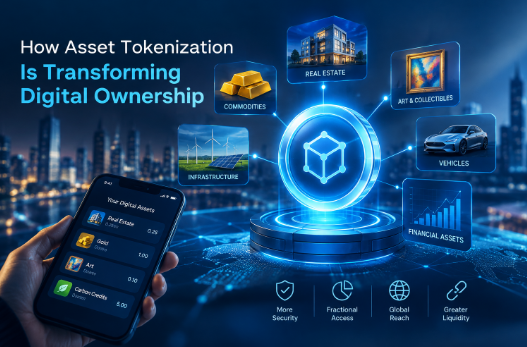
- Fractional ownership: Large assets can be divided into smaller economic interests.
- Improved liquidity: Some traditionally illiquid assets may become easier to transfer, although market demand remains essential.
- Faster transactions: Shared ledgers can reduce reconciliation and settlement steps.
- Greater transparency: Authorized participants can view consistent ownership and transaction records.
- Automated processes: Smart contracts can execute predefined transfers, payments, checks, or distributions.
- Global accessibility: Digital systems can support wider participation, subject to local laws.
The World Economic Forum identifies shared records, programmability, fractional ownership, flexible custody, and composability as important features, while noting that regulation, interoperability, and liquidity remain adoption challenges.
Asset Tokenization Across Different Market Sectors
Real Estate
Property can be divided into interests representing equity, revenue rights, debt, or shares in a special-purpose entity. Legal title and compliance still matter.
Financial Services
Banks, asset managers, and market infrastructure providers are exploring tokenized securities, deposits, funds, and settlement models. The IMF highlights programmable assets, atomic settlement, and embedded compliance as areas of development.
Art and Collectibles
Tokens can represent fractional economic interests in artworks or collectibles. Blockchain records may support provenance tracking, although authenticity still depends on reliable off-chain verification.
Commodities
Gold and other stored commodities can be represented by tokens linked to defined quantities held by a custodian. Reserve audits and clear redemption rights are important.
Private Equity
Tokenization may simplify investor administration, distributions, ownership records, and permitted secondary transfers, while existing private-market and securities rules continue to apply.
Intellectual Property
Patents, music, media, and other intellectual property may be structured so tokens represent defined revenue or licensing interests. Smart contracts can automate payment allocation where agreements permit it.
The Future of Digital Ownership
Digital ownership is likely to develop through greater integration between blockchain networks and existing financial infrastructure rather than an immediate replacement of traditional systems.
Wider adoption will depend on legal certainty, interoperability, secure custody, digital identity, cybersecurity, and scalable compliance. As institutions experiment with tokenized securities, deposits, funds, and other assets, businesses will need systems that can connect programmable technology with real-world legal rights.
Conclusion
Asset tokenization is reshaping ownership by linking real-world rights with programmable digital records. Its potential includes fractional participation, more efficient administration, transparent transaction histories, and automated asset processes.
Successful implementation requires more than issuing a token. Technology must align with legal rights, security, compliance, custody, governance, and market access.
Organizations evaluating a tokenization project can speak with MXICoders, a Blockchain Development Company, about smart-contract architecture, investor workflows, compliance integrations, and scalable platform design.