How Businesses Can Use AI and Cloud Infrastructure to Build Smarter Digital Operations
The Two-Speed Business Reality
A coffee shop owner tracks inventory with a notebook. Across the street, her competitor uses a tablet that predicts tomorrow’s demand based on today’s weather. Both sell the same latte at the same price.
The second owner goes home earlier. She wastes less milk. She knows exactly how many croissants to bake.
That gap between them isn’t talent or luck. It’s infrastructure.
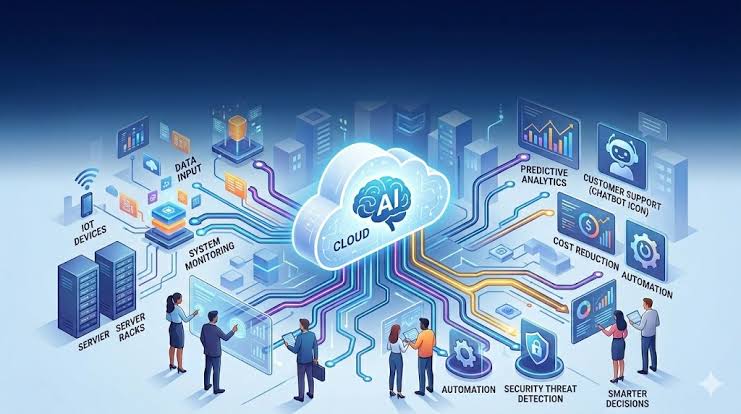
What powers that gap has shifted dramatically. AI and cloud computing used to require PhD-level expertise and a six-figure budget. Now they show up as monthly subscriptions with drag-and-drop interfaces.
The barrier to entry collapsed. What remains is knowing where to point these tools so they actually move the needle.
Why the Cloud Alone Isn’t Enough Anymore
Cloud infrastructure solved storage and access. Your files live on someone else’s computer, available from anywhere. That part is dead simple. Dropbox, Google Drive, and Microsoft OneDrive gave every business a digital filing cabinet by 2015.
But a filing cabinet doesn’t tell you what to do.
A typical small business now generates more data in a week than a 1990s enterprise saw in a year. Customer emails. Purchase histories.
Support tickets. Website clicks.
Appointment times. The cloud stores it all beautifully and cheaply. Pricing varies by provider, and the cost of Azure Backup illustrates how competitive storage costs have become across major platforms.
The bottleneck shifted from storage to sense-making. That’s where AI slides in.
Where AI Actually Changes the Game
I watched a dental practice implement an AI scheduling system last year. Their no-show rate dropped from 18% to 4% in three months. The AI didn’t just send reminders. It analyzed which appointment times historically produced cancellations and nudged patients toward slots with higher adherence rates.
That’s not futuristic. That’s a $200 monthly subscription paying for itself eight times over.
Three practical AI entry points that produce results quickly:
- Customer communication triage. AI reads incoming emails and messages, routes them to the right person, and drafts responses that a human approves before sending.
- Demand forecasting. Past sales data plus external factors like weather, holidays, and local events generate surprisingly accurate inventory predictions.
- Process automation for repetitive decisions. Invoice matching, delivery scheduling, and stock reordering follow patterns that AI recognizes faster than any employee can maintain.
None of these require building custom models. Most best AI chatbot builders now package visual workflow tools alongside their natural language features, which means you build conversation flows the same way you’d build a simple flowchart.
The Integration Trap Nobody Mentions
Tools that don’t talk to each other create more work than they eliminate. A shiny AI chatbot that can’t see a customer’s order history provides a charming conversation followed by an angry support call.
This is where cloud infrastructure earns its keep. When your CRM, payment processor, and inventory system all sit on the same cloud backbone, data flows between them without manual CSV exports or copy-paste marathons. The AI layer then pulls from a unified source rather than six fragmented databases.
A counterargument surfaces here: small businesses should stick to simple tools until they hit a certain revenue threshold. There’s something to that. Adding complexity before you need it wastes money and attention.
But the threshold is lower than most owners assume. A five-person ecommerce operation hitting 50 orders per day will drown in manual processes within six months.
The infrastructure scales faster than the team ever could.
What Smart Implementation Looks Like
Start with one process that hurts. Not five. Not a digital transformation roadmap. One recurring task that everyone dreads.
Maybe it’s reconciling payments at month-end. Maybe it’s responding to the same “where’s my order” emails. Give that single process to an AI tool connected to your cloud data for 90 days.
Measure the time saved. Then expand to the next pain point.
The businesses winning right now aren’t the ones with the most advanced tech stacks. They’re the ones who connected their existing tools and pointed AI at their messiest spreadsheets. The tools are no longer the differentiator. The decision to actually use them is.
That coffee shop owner with the tablet isn’t smarter than her competitor. She just stopped treating technology as something she’d get around to someday.