What is Less Than or Equal To in Math? Simple Guide 2026
Less than or equal to is one of the most important inequality symbols used in mathematics. Written as ≤, it tells us that a value is either smaller than or exactly the same as another value.
You will find this symbol in basic arithmetic, algebra, number lines, and even real-life situations like speed limits and shopping budgets.
What Does Less Than or Equal To Mean?
The phrase “less than or equal to” describes two possibilities at once. A value can either be smaller than another value, or it can be exactly equal to it.
For example, if x ≤ 5, then x can be 5, 4, 3, 2, 1, 0, or any negative number. All of these satisfy the condition because they are either less than 5 or equal to 5.
It is the opposite of “greater than or equal to” (≥), which means a value is either bigger than or the same as another value.
The Less Than or Equal To Symbol (≤)
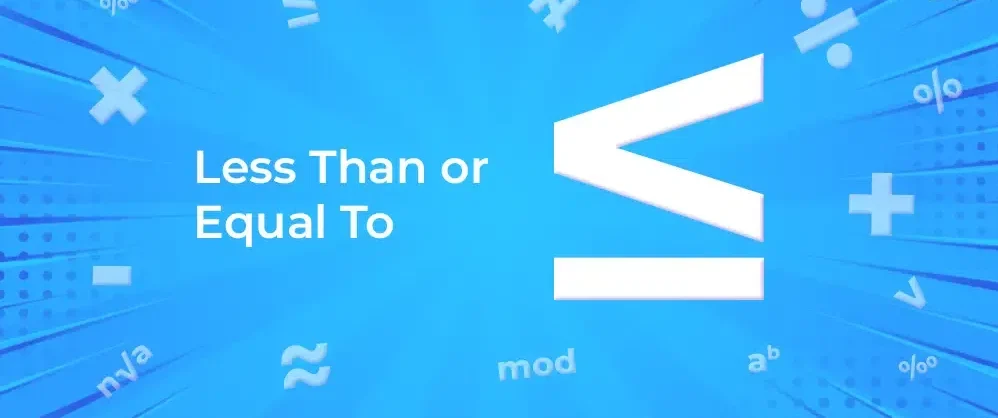
The symbol for less than or equal to is ≤. It is formed by combining the less than sign (<) with a horizontal line underneath it, representing the equal sign.
Think of it this way: the bottom line means “could also be equal.” Without the bottom line, it is just less than (<). With the bottom line, it becomes less than or equal to (≤).
| Symbol | Name | Meaning |
|---|---|---|
| < | Less than | Strictly smaller, not equal |
| ≤ | Less than or equal to | Smaller than or exactly equal |
| > | Greater than | Strictly larger, not equal |
| ≥ | Greater than or equal to | Larger than or exactly equal |
| = | Equal to | Exactly the same value |
| ≠ | Not equal to | Any value except equal |
Less Than or Equal To vs Less Than: Key Difference
Many students confuse < and ≤. The difference is simple but very important.
The strict inequality < means the value must be only smaller. For example, x < 5 means x can be 4.9, 4, 3, 2 — but not 5 itself.
The non-strict inequality ≤ means the value can be smaller or equal. So x ≤ 5 includes 5 as a valid answer, along with everything less than 5.
This distinction changes the solution set completely, which is why choosing the right symbol matters in every math problem.
Other Ways to Say Less Than or Equal To
In word problems, “less than or equal to” appears in many different phrases. Recognizing these phrases helps you translate sentences into math symbols quickly.
| Phrase | Math Symbol |
|---|---|
| At most | ≤ |
| No more than | ≤ |
| Maximum of | ≤ |
| Not exceeding | ≤ |
| Up to | ≤ |
| Does not exceed | ≤ |
| A limit of | ≤ |
Whenever you see “at most 10” in a word problem, write it as ≤ 10. This is one of the most tested concepts in school mathematics.
How to Read the ≤ Symbol
Reading the ≤ symbol is straightforward once you learn the direction rule. Always read from left to right.
If you see x ≤ 7, read it as: “x is less than or equal to 7.”
If you see 3 ≤ y, read it as: “3 is less than or equal to y” — or flip it to say “y is greater than or equal to 3.”
The symbol always points toward the smaller value. The open end (wider side) faces the larger value, just like the alligator method for remembering inequality signs.
Less Than or Equal To on a Number Line
Representing less than or equal to on a number line uses a specific rule that is different from strict inequalities.
For ≤ and ≥, always use a closed (filled) circle at the endpoint. This filled circle signals that the endpoint value is included in the solution.
For < and >, use an open (empty) circle because the endpoint is not part of the solution.
Steps to graph x ≤ 5 on a number line:
- Draw a horizontal number line with numbers marked.
- Locate the value 5 on the number line.
- Place a filled (closed) circle at 5, because 5 is included.
- Draw an arrow going to the left, covering all values smaller than 5.
The arrow continues left toward negative infinity, showing all valid values.
| Inequality | Circle Type | Arrow Direction |
|---|---|---|
| x < 5 | Open circle at 5 | Arrow to the left |
| x ≤ 5 | Closed circle at 5 | Arrow to the left |
| x > 5 | Open circle at 5 | Arrow to the right |
| x ≥ 5 | Closed circle at 5 | Arrow to the right |
Less Than or Equal To in Interval Notation
Interval notation is another way to express the solution to an inequality. It is widely used in algebra and higher math courses.
For x ≤ 5, the interval notation is (−∞, 5]. The square bracket ] is used at 5 because 5 is included. The parenthesis at −∞ is always used because infinity is never a fixed value — it cannot be included.
For x < 5, the notation is (−∞, 5). Both sides use parentheses because neither −∞ nor 5 itself is included.
The rule is simple: square bracket = included value, parenthesis = excluded value.
Real-Life Examples of Less Than or Equal To
The ≤ symbol appears constantly in everyday situations. Recognizing it in real life makes the concept much easier to understand and remember.
- Luggage weight limit: An airline says your bag must not exceed 20 kg. This means: weight ≤ 20.
- Speed limit: A road sign says the speed limit is 60 km/h. This means: speed ≤ 60.
- Budget limit: You have ₹500 to spend at a store. This means: spending ≤ 500.
- Age restriction: A website says users must be 18 years or younger. This means: age ≤ 18.
- Classroom capacity: A classroom can hold at most 30 students. This means: students ≤ 30.
Each of these real-world situations is naturally expressed using the less than or equal to symbol.
How to Solve a Less Than or Equal To Inequality
Solving a ≤ inequality follows the same basic steps as solving a regular equation. The only special rule to remember is about negative numbers.
Example 1: Solve 3x − 5 ≤ 10
Step 1: Add 5 to both sides → 3x ≤ 15
Step 2: Divide both sides by 3 → x ≤ 5
Solution: x ≤ 5 (all values up to and including 5)
Example 2: Solve −2x + 7 ≤ 1
Step 1: Subtract 7 from both sides → −2x ≤ −6
Step 2: Divide both sides by −2 → flip the inequality sign → x ≥ 3
Solution: x ≥ 3
The most important rule: when you multiply or divide both sides of an inequality by a negative number, you must flip the inequality sign.
The Negative Number Rule Explained
This is the rule that most students forget and lose marks over. It applies to all inequality symbols, including ≤.
When both sides of an inequality are divided or multiplied by a positive number, the sign stays the same. When divided or multiplied by a negative number, the sign reverses.
Why? Because multiplying by a negative number reverses the order of numbers on the number line. 2 < 4, but if you multiply both sides by −1, you get −2 > −4. The relationship flips.
This rule does not apply to addition or subtraction — you can add or subtract any number (positive or negative) without flipping the sign.
Less Than or Equal To in Algebra Word Problems
Word problems involving less than or equal to are very common in school exams. The key skill is translating the English sentence into a math inequality.
Problem: A student wants to score at most 80 marks in total across two tests. She scored 35 in the first test. What can she score in the second test?
Step 1: Let the second test score = y.
Step 2: Write the inequality: 35 + y ≤ 80
Step 3: Solve: y ≤ 80 − 35 → y ≤ 45
Answer: She can score up to and including 45 marks in the second test.
Always look for the phrases “at most,” “maximum,” “no more than,” and “not exceeding” as your signal to use the ≤ symbol.
Compound Inequalities with Less Than or Equal To
A compound inequality combines two inequalities together, showing a range of values. The ≤ symbol is commonly used in compound inequalities.
Example: −3 ≤ x < 5
This means x is greater than or equal to −3 AND less than 5. So x can be −3, −2, −1, 0, 1, 2, 3, 4, but not 5 itself.
On a number line, this is shown with a closed circle at −3 (included) and an open circle at 5 (excluded), with a line connecting them.
Compound inequalities describe a range — a set of numbers between two boundaries. They appear frequently in algebra and data analysis.
Comparing ≤ and ≥ Side by Side
Students often need to work with both symbols at the same time. Here is a clear comparison table:
| Feature | Less Than or Equal To (≤) | Greater Than or Equal To (≥) |
|---|---|---|
| Symbol | ≤ | ≥ |
| Meaning | Value is smaller or equal | Value is larger or equal |
| Number line arrow | Points left | Points right |
| Circle type | Closed (filled) | Closed (filled) |
| Example | x ≤ 8 | x ≥ 2 |
| Interval notation | (−∞, 8] | [2, +∞) |
| Real-life use | Maximum limit | Minimum requirement |
Both symbols use a closed circle because both include the endpoint value. That is what distinguishes them from their strict counterparts < and >.
Less Than or Equal To in Programming and Logic
The ≤ symbol is not just used in pure math. It appears in computer science and programming as a logical comparison operator.
In most programming languages, less than or equal to is written as <= because the ≤ character is not on standard keyboards. For example, in Python: if x <= 10: checks whether x is less than or equal to 10.
In logic and Boolean expressions, x ≤ y returns True if x is smaller than or equal to y, and False if x is larger.
This makes the ≤ concept essential for students learning coding, data science, algorithms, and competitive programming in 2026.
How to Type the ≤ Symbol
If you need to type the less than or equal to symbol in documents or assignments, here are the quickest ways:
| Method | How to Type ≤ |
|---|---|
| Windows keyboard shortcut | Hold Alt, type 8804 on numpad |
| Mac keyboard shortcut | Option + , (comma) |
| HTML code | ≤ |
| LaTeX code | \leq |
| Unicode code point | U+2264 |
| Microsoft Word | Insert → Symbol → ≤ |
| Copy-paste | ≤ |
For math assignments using LaTeX (common in universities), the command is \leq and it renders as the standard ≤ symbol.
Less Than or Equal To in Linear Programming

Linear programming is a branch of math that finds the best solution within a set of constraints. Almost all constraints in linear programming are expressed using ≤ or ≥.
For example, if a factory can produce at most 200 units per day, the constraint is: units produced ≤ 200.
The entire feasible region of a linear programming problem — the set of all valid solutions — is defined by these inequality constraints. Understanding ≤ is therefore essential for optimization problems in business, economics, and engineering.
Common Mistakes Students Make with ≤
Knowing what to avoid is just as important as knowing the right answers. Here are the most frequent errors:
Mistake 1: Using open circle instead of closed circle on a number line. For ≤, always use a filled/closed circle. Open circles are only for < and >.
Mistake 2: Forgetting to flip the sign when dividing by a negative number. This is the most common algebraic error with inequalities.
Mistake 3: Confusing “at most” with “at least.” “At most” means ≤ (maximum). “At least” means ≥ (minimum). They are opposites.
Mistake 4: Writing ≤ when the problem says strictly less than. If a problem says “less than 10” without including 10, use <, not ≤.
Mistake 5: Reversing the direction of the number line arrow. For ≤, the arrow always goes to the left (toward smaller values).
Practice Examples: Less Than or Equal To
Working through examples is the fastest way to build confidence with this topic.
Example A: Write “a number n is at most 12” as an inequality. Answer: n ≤ 12
Example B: Solve 5x + 3 ≤ 18. 5x ≤ 15 → x ≤ 3
Example C: Graph x ≤ −2 on a number line. Place a filled circle at −2. Draw an arrow to the left.
Example D: Write the interval notation for x ≤ 7. Answer: (−∞, 7]
Example E: Is x = 4 a solution of x ≤ 4? Yes, because 4 ≤ 4 is true (the values are equal, and equal is allowed).
Example F: Solve −3x ≤ 9. Divide by −3 and flip the sign → x ≥ −3
Less Than or Equal To in Sets and Set Builder Notation
In set theory, less than or equal to is used to describe sets with a condition or range.
The set of all real numbers less than or equal to 10 is written in set builder notation as: {x ∈ ℝ | x ≤ 10}.
This reads as “the set of all x that belong to the real numbers, such that x is less than or equal to 10.”
Set builder notation is commonly used in higher math, university-level algebra, and discrete mathematics courses.
Strict vs Non-Strict Inequalities: A Complete Breakdown
Mathematicians classify inequalities into two main categories, and knowing the difference is essential for accuracy.
Strict inequalities use < and >. They exclude the endpoint. The word “strictly” means the two values can never be equal.
Non-strict inequalities (also called inclusive or weak inequalities) use ≤ and ≥. They include the endpoint. The two values are allowed to be equal.
Less than or equal to (≤) is always a non-strict or inclusive inequality. This means the boundary value is a valid part of the solution set.
In formal mathematics, this distinction affects proofs, function domains, and optimization problems significantly.
Why Less Than or Equal To Matters in Real Math
The ≤ symbol appears in virtually every branch of mathematics beyond basic arithmetic.
In calculus, it defines domains of functions and conditions for continuity. In statistics, it is used to define cumulative probabilities. In linear algebra, it defines feasible regions and constraint systems. In computer science, it drives loops, conditional logic, and algorithm efficiency bounds.
Understanding less than or equal to deeply — not just as a symbol to copy — gives students a foundation that carries through to the most advanced levels of mathematics and science.
Quick Reference Summary Table
| Concept | Detail |
|---|---|
| Symbol | ≤ |
| Reads as | “Less than or equal to” |
| Also means | At most, no more than, maximum, not exceeding |
| Number line | Closed (filled) circle, arrow to the left |
| Interval notation | (−∞, value] |
| Opposite symbol | ≥ (greater than or equal to) |
| Type of inequality | Non-strict / inclusive |
| Key rule | Flip sign when multiplying or dividing by a negative number |
| Programming equivalent | <= |
| LaTeX command | \leq |
Frequently Asked Questions (FAQs)
What is less than or equal to in math?
Less than or equal to (≤) is an inequality symbol meaning a value is either smaller than or exactly the same as another value. It includes both possibilities in one expression.
What is the symbol for less than or equal to?
The symbol is ≤ — a less than sign (<) with a horizontal line underneath it representing equality. In programming it is written as <=.
What is the difference between < and ≤?
The symbol < means strictly less than and does not include the boundary value. The symbol ≤ means less than or equal to and includes the boundary value as a valid solution.
How do you graph less than or equal to on a number line?
Use a closed (filled) circle at the boundary value to show it is included, then draw an arrow pointing to the left to represent all smaller values.
What does “at most” mean in math?
“At most” means less than or equal to (≤). For example, “at most 10 students” is written as students ≤ 10.
When do you flip the inequality sign?
You flip the inequality sign only when you multiply or divide both sides of the inequality by a negative number. Addition and subtraction never require flipping.
What is the interval notation for x ≤ 5?
The interval notation is (−∞, 5]. The square bracket at 5 shows that 5 is included in the solution set.
What is the difference between less than or equal to and greater than or equal to?
Less than or equal to (≤) means the value is at most a given limit. Greater than or equal to (≥) means the value is at least a given limit. They are opposite directions on the number line.
Is less than or equal to a strict inequality?
No. Less than or equal to (≤) is a non-strict or inclusive inequality because it includes the case where the two values are equal. Strict inequalities (< and >) never include equality.
How is less than or equal to used in programming?
In most programming languages, less than or equal to is written as <=. It is used as a comparison operator in conditions, loops, and logical statements to check if one value is at most equal to another.
Conclusion
Less than or equal to is one of the foundational building blocks of mathematics. The symbol ≤ appears in everything from simple number comparisons and algebra problems to linear programming, calculus, computer science, and real-world constraints like speed limits and budgets.
Understanding what it means, how to graph it, how to solve inequalities with it, and how to spot it in word problems gives students a powerful tool that works across every level of math.
Remember the three key points: the closed circle on a number line shows the endpoint is included, flip the sign only when dividing by a negative number, and “at most” always means ≤. With these rules firmly in mind, less than or equal to becomes one of the simplest and most useful concepts in all of mathematics.