Halo Stats: Player Rankings, Kills & Leaderboard Update 2026
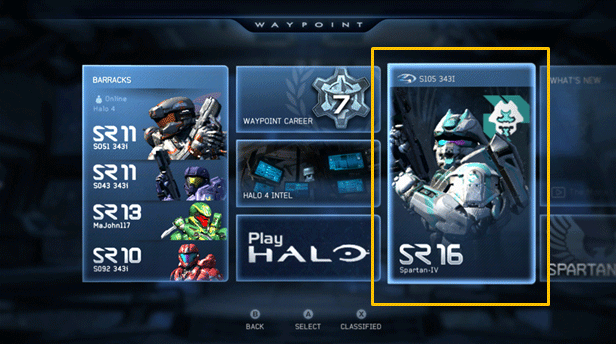
Halo stats are the backbone of competitive Halo Infinite — every kill, every death, every assist, every CSR point tells the story of your Spartan’s progress.
Whether you are chasing the Onyx leaderboard, trying to understand your K/D ratio, or simply curious about where you stand in the global player rankings, having a complete understanding of how Halo stats work in 2026 is essential.
What Are Halo Stats?
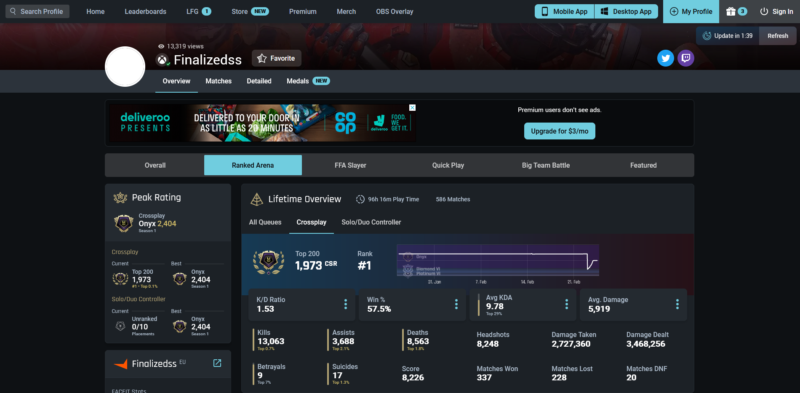
Halo stats — short for statistics — refer to the comprehensive set of performance metrics that track everything a player does in Halo Infinite multiplayer. These numbers paint a complete picture of how effective, consistent, and skilled a player is across all playlists and game modes.
Understanding your Halo stats is the first step toward improving them. Every metric is tracked automatically by 343 Industries’ systems and stored in your service record, accessible through Halo Waypoint and third-party tools like Halo Tracker.
The most important Halo stats categories that define player performance are kills, deaths, assists, K/D ratio, accuracy, win rate, and CSR (Competitive Skill Rank).
The Core Halo Stats Categories Explained
Every player’s service record is built around a set of core Halo stats that measure different aspects of performance.
Kills
Kills are the most fundamental of all Halo stats. A kill is recorded every time your Spartan lands the final blow on an enemy player. The kills leaderboard is one of the most searched and tracked stats in the entire Halo community.
Top players on the Halo Kills leaderboard — accessible through HaloTracker.com — have accumulated hundreds of thousands of career kills. The most prolific slayers on the global leaderboard tend to have played thousands of hours across multiple seasons.
Kills per game is a more useful metric for evaluating individual match performance. Elite players typically average 12 to 18 kills per match in Slayer, while top-tier Onyx players often push beyond 20 kills per match in competitive play.
Deaths
Deaths are tracked alongside kills to calculate K/D ratio. Every time your Spartan is eliminated by an opponent, a death is recorded in your Halo stats service record.
The deaths stat alone is less meaningful than in combination with kills — a player with 10,000 deaths but 20,000 kills has a K/D of 2.0, which is significantly above average. Deaths only become a problem when the ratio tips below 1.0 consistently.
K/D Ratio — Kill/Death Ratio
The K/D ratio is the most widely referenced individual Halo stat in competitive communities. It is calculated simply — total kills divided by total deaths.
A K/D above 1.0 means you are killing more than you die. The average Halo Infinite player sits somewhere between 0.9 and 1.1 K/D across all modes. Reaching 1.5 K/D puts you in the top quarter of players. A 2.0 K/D or above places you among the upper tier of Onyx-level competitors.
The Halo Tracker leaderboard allows you to filter K/D ratios globally, regionally, and by platform — giving players a way to benchmark their ratio against millions of other Spartans.
KDA — Kill/Death/Assist Ratio
KDA expands on K/D by incorporating assists into the calculation. Halo Infinite defines an assist as dealing significant damage to an enemy without landing the final kill blow.
KDA matters because it rewards team-oriented play. A player who always gets 5 assists per game in addition to 10 kills is far more valuable to a team than their raw K/D might suggest. In HCS competitive play, high KDA players are often the most sought-after teammates.
Accuracy
Accuracy is the percentage of shots fired that connect with enemy targets. It is one of the most telling Halo stats for evaluating true shooting skill — independent of how many kills a player gets.
The average Halo Infinite player across all skill levels sits at around 40-45% accuracy. Platinum players typically average 45-50%. Diamond players average 50-55%. Elite Onyx players often achieve 60% accuracy or above consistently.
Headshot accuracy is a separate metric tracked within Halo Infinite stats. This measures what percentage of your shots hit the head — a critical factor in landing precision kills with the Battle Rifle and Sniper Rifle.
Win Rate
Win rate is the percentage of matches a player finishes on the winning team. It is a team-outcome stat that reflects both individual contribution and the quality of team coordination.
A 50% win rate is baseline — you are winning exactly as many games as you lose. Competitive Platinum players typically hover around 50-54%. Diamond players average 54-60%. Onyx players who are actively climbing tend to maintain 55-65% win rates. The very best HCS-caliber players sustain win rates above 65%.
Medals
Medals are special recognition milestones within Halo Infinite’s stats system. They are awarded for exceptional in-match performance moments — multi-kills, killjoys, flag captures, Sniper headshots, and more.
The most prestigious medals in the Halo stats ecosystem include Killtastrophe (5 kills rapidly), Overkill (4 rapid kills), Running Riot (15 kills without dying), and the legendary Perfection (going an entire match without dying while winning).
Medal counts are tracked in the service record and contribute to your overall career stats profile.
The Complete Halo Infinite Ranking System
The Halo stats ranking system — formally called the Competitive Skill Rank or CSR system — is the backbone of competitive Halo Infinite. Understanding how it works is essential for any player who wants to climb the leaderboard.
How the CSR System Works
CSR stands for Competitive Skill Rank — the ranking that players see in the game. While it is closely tied to MMR, CSR is not directly used in the matchmaking process. It is a reflection of your performances in a ranked playlist throughout the season.
Behind the visible CSR sits a hidden number called MMR (Matchmaking Rating). The two systems work in parallel — CSR is what you see, MMR is what the game actually uses to find balanced matches. Winning against higher MMR opponents gives bigger CSR gains. Losing to lower MMR opponents causes steeper drops.
To earn your first rank, every player must complete 10 placement matches. Performance during those placement matches — combined with any historical MMR from previous seasons — determines your starting CSR.
All Halo Infinite Ranks in Order
There are six main CSR tiers in Halo Infinite, each divided into six sub-ranks (Tiers 1 through 6), except for Onyx which uses a raw numerical CSR score.
| Rank | Sub-Ranks | CSR Range | Player % |
|---|---|---|---|
| Bronze | Bronze 1 – Bronze 6 | Lowest tier | ~3% |
| Silver | Silver 1 – Silver 6 | Below average | ~8% |
| Gold | Gold 1 – Gold 6 | Developing skill | ~14% |
| Platinum | Platinum 1 – Platinum 6 | Average | ~36.66% |
| Diamond | Diamond 1 – Diamond 6 | Above average | ~31% |
| Onyx | No sub-ranks (1500+ CSR) | Elite | ~7.25% |
Platinum is the most common rank in Halo Infinite, occupied by 36.66% of players. Onyx is the rarest, held by only 7.25% of players.
The top 0.1% (Onyx 2000+) consists of roughly 8,000 to 10,000 players worldwide. This is the level at which most semi-professional and amateur HCS players compete.
Bronze — Where Every Journey Begins
Bronze is the entry level of Halo Infinite ranked play. Players in Bronze are still learning map layouts, weapon spawn timings, and the fundamentals of positioning. The focus at this level should be on surviving engagements rather than winning them.
Around 3% of the ranked population sits in Bronze. This represents players who are genuinely new to the game or returning after long absences. The matchmaking system places new accounts here initially based on their first few placement matches.
Silver — Building Foundations
Silver players have mastered the basics of staying alive and understand objective play at a surface level. Accuracy typically sits around 38-42% at this tier. The biggest improvement between Bronze and Silver is map awareness — knowing where the snipers and power weapons spawn.
The jump from Silver to Gold requires consistent accuracy improvements and the development of shot discipline — knowing when to push and when to hold position.
Gold — The Competitive Heartland
Gold players have solid mechanics but need to work on advanced strategies, callouts, and situational awareness.
Gold is where dedicated casual players typically plateau without deliberate practice. Accuracy at Gold level averages 42-47%. Players here understand the game modes well but struggle with high-pressure clutch situations.
Improving from Gold to Platinum requires working on consistency — performing your best in every match rather than only in comfortable situations.
Platinum — The Most Populated Rank
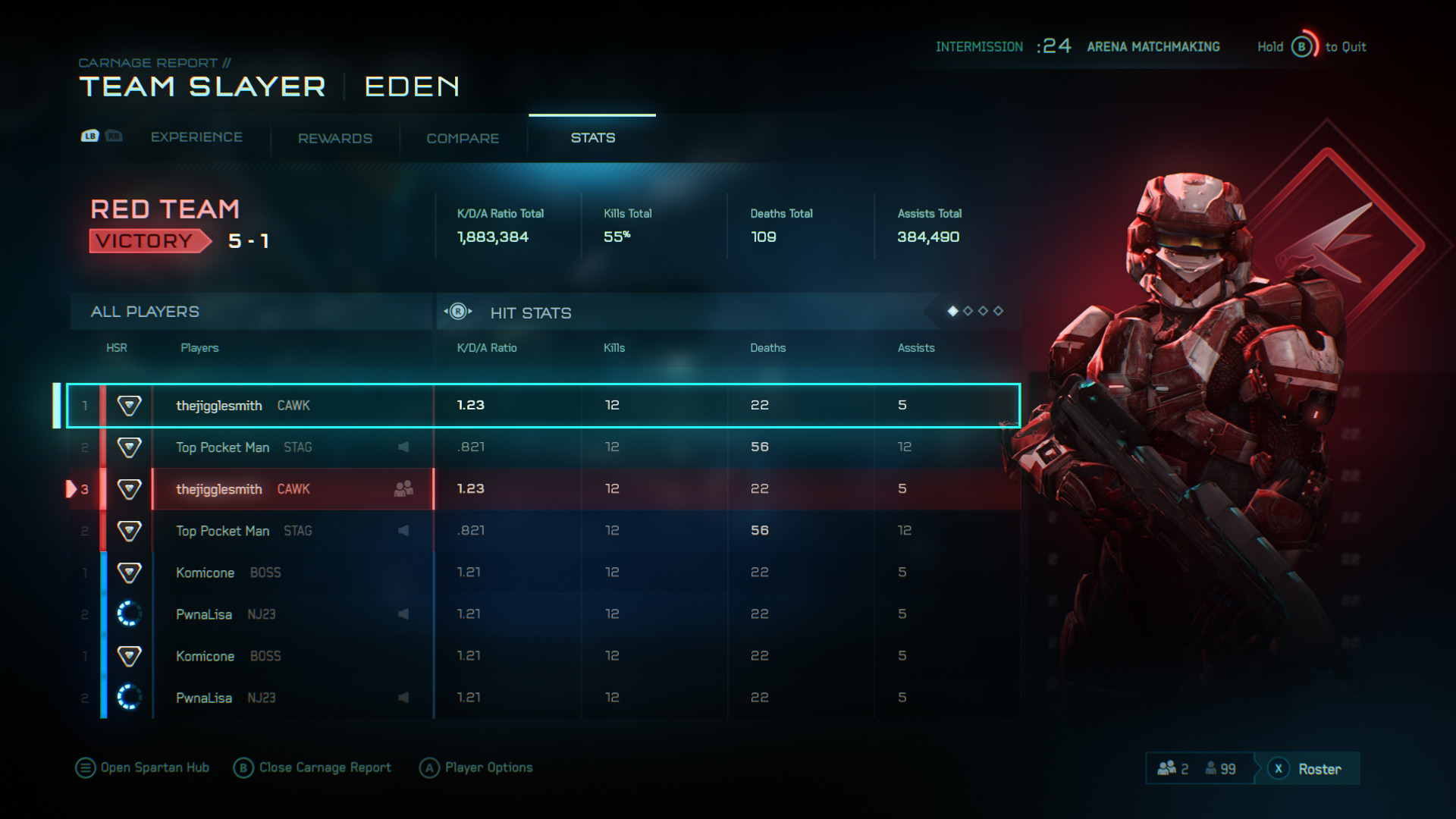
Platinum is the median rank in Halo Infinite — the place where most active ranked players spend the majority of their time. With 36.66% of all ranked players in Platinum, it is the most competitive tier by sheer volume.
If you are in Diamond 1 or above, you rank higher than the average Halo Infinite ranked player.
Platinum players understand power positions, make callouts, and work with their teams effectively. The difference between low Platinum and high Platinum is largely about consistency and decision-making speed.
Diamond — The Gateway to Elite
Diamond is where individual skill meets elite teamwork. Every mistake is punished. Players here closely follow the meta shifts from recent updates and pro play. The competition is fierce and every CSR point matters.
Diamond 1 is notable for having the highest single sub-rank population spike in the game — Diamond 1 is the sub-rank with the highest percentage of players at 7.77% — because it is the highest possible starting rank after placement matches for most players.
Diamond 5 and 6 are where you start encountering low-Onyx players in lobbies. Accuracy at Diamond level typically exceeds 52%. The emphasis at this tier shifts from individual mechanics to game-reading and strategic adaptation.
Onyx — The Pinnacle of Halo Stats Rankings
Onyx is the highest CSR rank in Halo Infinite. Onyx players are shown a numeric CSR rating, starting at 1500. There is no hard cap on this rank.
The Onyx leaderboard is where the most dedicated competitive Halo players compete. CSR milestones within Onyx carry significant prestige:
| Onyx CSR Tier | Significance |
|---|---|
| 1500 – 1600 | Entry-level Onyx |
| 1600 – 1800 | Mid Onyx — solid competitive level |
| 1800 – 2000 | High Onyx — semi-pro range |
| 2000 – 2200 | Elite Onyx — HCS Open qualifier level |
| 2200+ | Top 0.1% — pro-circuit competitive level |
Top Onyx players (1800+) often compete in semi-pro circuits. Reaching HCS-level 2000+ CSR requires near-perfect play, deep strategic understanding, and constant adaptation.
How to Check Your Halo Stats
There are two primary platforms for checking Halo stats in 2026 — Halo Waypoint (the official 343 Industries platform) and Halo Tracker (the leading third-party stat tracking site).
Halo Waypoint — Official Stats Hub
The Player Stats page has two tabs at the top of the page: Summary and Game History. Under the Summary tab you will find data about player performance, including career rank (introduced in Season 4), ranked level, multiplayer stats, and medals. Clicking the Game History tab displays specific information from games you have played.
To access your Halo stats on Halo Waypoint, navigate to halowaypoint.com, sign in with your Microsoft account, go to your service record, and use the Community dropdown to access the Leaderboards and Stats sections.
Halo Tracker — The Community Leaderboard Standard
Halo Tracker provides stats for Halo Infinite. Use the Halo Stats Tracker to see who is the best in global and regional leaderboards for players around the world. Check Halo Infinite stats and ranks for multiplayer, and view indepth leaderboards for every Halo Infinite stat.
Halo Tracker at halotracker.com is the most-used third-party Halo stats platform. You can look up any player by their Gamertag, compare your stats to friends, and view granular leaderboards filtered by kills, K/D, accuracy, wins, and more.
The platform also breaks down your weapon-specific stats — so you can see exactly how many kills you have with the Battle Rifle versus the Sniper Rifle versus the Plasma Pistol.
Halo Data Hive — The Esports Stats Platform
Halo Data Hive is home to all Halo Infinite esports HCS results and stats for LAN, tournament, and scrim series. Find pro player series results with statistic breakdowns, including Halo arena and custom game stats.
For competitive HCS tracking, Halo Data Hive is the go-to resource. It tracks pro player performance across LAN events, online qualifiers, and scrim matches — giving fans and analysts a comprehensive view of elite-level Halo stats.
Halo Stats Leaderboard Categories
The Halo Infinite leaderboard system is broken down into multiple categories, each rewarding a different type of player excellence.
| Leaderboard Category | What It Measures | Best For |
|---|---|---|
| CSR Rating | Competitive rank score | Ranked climbers |
| Total Kills | Career kill count | High-volume slayers |
| K/D Ratio | Kill efficiency | Precise, clean players |
| Accuracy % | Shot connection rate | Technical aimers |
| Win Rate % | Match win frequency | Team-oriented players |
| Assists | Team-play contributions | Support players |
| Medals | Special achievement count | Highlight players |
| Headshots | Precision shots on target | Sniper and BR specialists |
| HCS Points | Competitive circuit points | Pro-level competitors |
| Career Rank EXP | Total progression XP | Long-term grinders |
Each leaderboard tells a different story. A player who tops the K/D leaderboard may be playing conservatively in non-Slayer modes. A player who tops the Kills leaderboard may have a lower K/D because they are aggressive and push engagements constantly.
The most meaningful Halo stat for competitive purposes is CSR — because it is adjusted for opponent quality and reflects true skill more accurately than raw kill counts.
Understanding TrueSkill2 — The Engine Behind Halo Stats
TrueSkill2 is the underlying system used to understand as accurately and quickly as possible how skilled each player is relative to the population of players. TrueSkill2 uses a variety of data about each player’s performance in multiplayer matches including wins, losses, kills, deaths, and more to build this understanding model and determine each player’s skill.
TrueSkill2 is the hidden engine that powers every Halo stats ranking calculation. It updates after every match, adjusting a player’s hidden skill rating based on how they performed relative to everyone else in the lobby — not just whether they won or lost.
This means a player can lose a match and still see their MMR increase — if they massively outperformed what the system expected from them. It also means winning a match against much weaker opponents contributes very little to CSR progress.
TrueSkill2 considers party composition as well. When a group of players joins a Fireteam together, the skill system adjusts their skills upwards slightly to account for the advantage of being in a coordinated group.
Ranked Arena Game Modes and Their Impact on Halo Stats
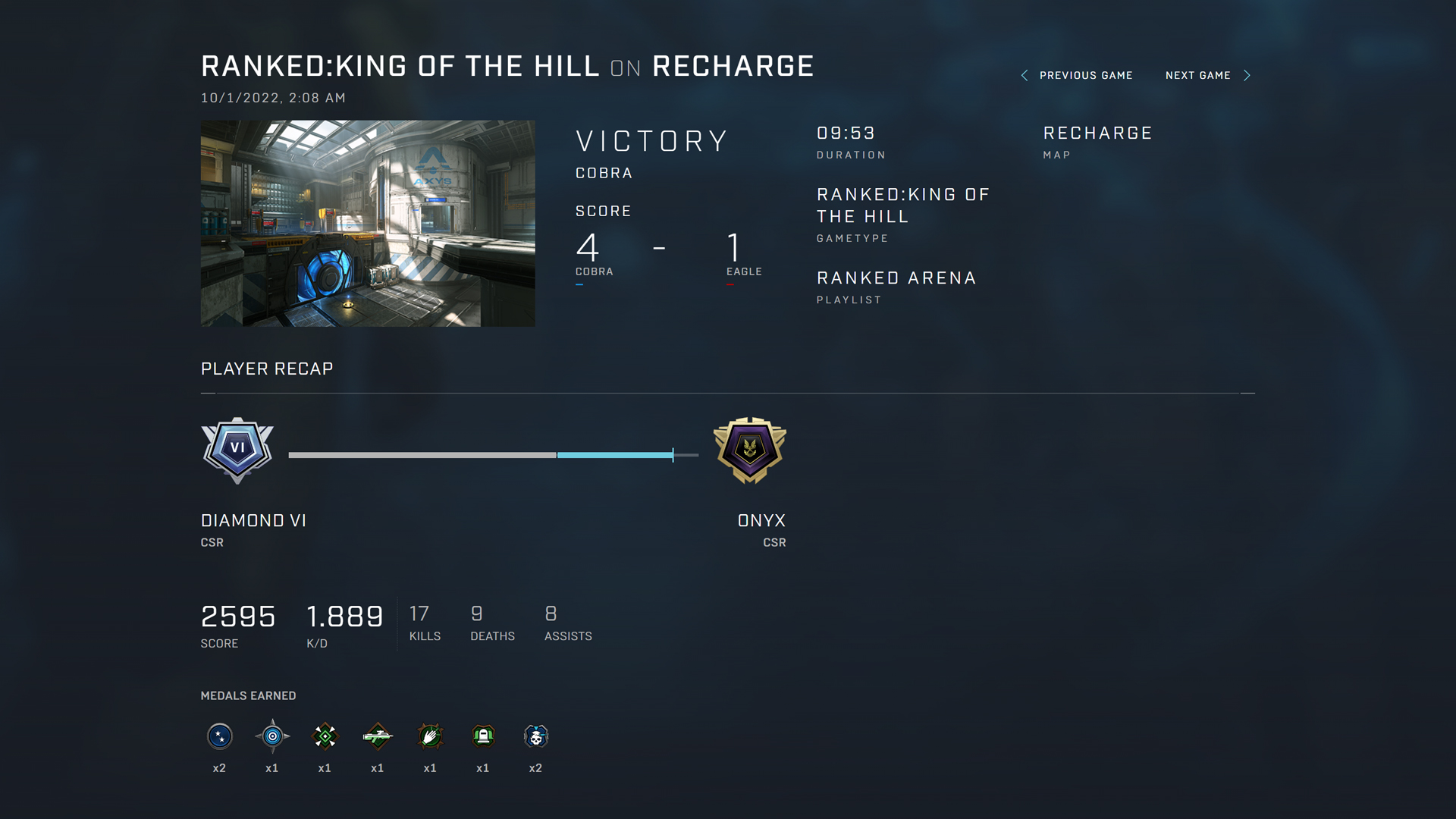
All Halo Infinite ranked playlist stats are generated through four rotating game modes. Each mode rewards different stat profiles.
Slayer
Slayer is a pure kill-based mode — first team to reach the kill limit wins. It is the most straightforward of all ranked modes and the one where individual kill stats accumulate fastest. K/D improvement is most directly tied to Slayer performance.
Capture the Flag (CTF)
CTF rewards objective play. Players who focus purely on kills in CTF often find their win rate suffers. The best CTF players balance flag carries, flag defenses, and kill support — making assists and objective stats more relevant than raw kill counts in this mode.
Oddball
Oddball requires holding a skull for the longest cumulative time. The stats that matter most here are skull hold time, kills near the skull, and team coordination. Players with high Oddball win rates tend to excel at positional play and callouts.
Strongholds
Strongholds rewards zone capture and defense. Like Oddball, raw kills are less important than game-sense. High Strongholds win rate is a strong indicator of map intelligence and rotational decision-making.
| Mode | Primary Stat Driver | Key Skill |
|---|---|---|
| Slayer | Kills, K/D | Individual mechanical skill |
| CTF | Assists, Objective | Team coordination |
| Oddball | Positioning, Win rate | Map control |
| Strongholds | Win rate, Positioning | Rotational IQ |
HCS Pro Player Halo Stats — The Competitive Scene in 2026
The Halo Championship Series (HCS) represents the highest level of organized competitive Halo Infinite. Pro player Halo stats from HCS events are tracked on platforms like Halo Data Hive and Liquipedia’s Halo statistics portal.
The top HCS earners and most accomplished competitive players have amassed significant prize money through the circuit. According to Liquipedia’s statistics portal, the Halo esports prize pool has distributed over $21.8 million in offline tournament winnings since 2002 — the vast majority of which has come in the Halo Infinite era.
Top HCS players consistently operate at Onyx 2000+ CSR in ranked Arena. Their kill stats, accuracy figures, and K/D ratios dwarf those of even high-Diamond ranked players. In HCS LAN events, kill differentials, series win rates, and head-to-head stats are the primary metrics used to evaluate pro performance.
How Halo Stats Impact Your Rank Climb
Understanding the relationship between your individual Halo stats and your CSR climb helps you prioritize what to improve.
Accuracy is the single most impactful mechanical stat for ranking up. A consistent 5% improvement in accuracy — say from 45% to 50% — will produce a measurable positive impact on your K/D and your win rate almost immediately.
A consistent 120+ FPS provides a tangible input lag reduction over 60 FPS. PC players with high-refresh monitors and optimized settings have a measurable reaction time advantage. However, the matchmaking system attempts to balance input methods. The best advice: ensure your game runs smoothly above all else.
Win rate matters more than kill count for CSR progression. Two players with the same K/D but different win rates will diverge significantly in CSR over time — the higher win-rate player will climb faster because CSR is fundamentally a win-based system adjusted by performance.
Tips to Improve Your Halo Stats in 2026
Focus on Accuracy First
Spend time in the Academy or custom games working on Battle Rifle bursts at different ranges. Accuracy improvement translates directly into kills without needing to take more risks.
Review Your Game History
Halo Waypoint’s Game History tab shows the exact stats for every match you have played. Reviewing losses in detail — identifying where kills were conceded, which weapons were used against you, what the score was at each point — is the fastest way to find patterns in your gameplay that need fixing.
Prioritize Power Weapon Control
Power weapon pickup stats correlate strongly with win rate. Players who consistently control rockets, snipers, and Energy Swords tend to win more engagements and more matches. Build weapon-spawn timing knowledge for every ranked map in the rotation.
Play With a Team
Coordinated teams consistently outperform solo players in ranked play. Playing with a premade group of two or three players allows for callouts, coordinated pushes, and better objective play — all of which improve win rate and KDA simultaneously.
Track Your Halo Stats Weekly
Use Halo Tracker to check your stats at regular intervals — weekly or after every 25 matches. Look for trends in your accuracy, K/D, and win rate over time. Spot declines early and adjust your approach before they affect your CSR meaningfully.
Halo Stats by Platform: PC vs Console
One of the most commonly discussed topics in the Halo stats community is the performance difference between PC keyboard-and-mouse players and console controller players.
| Metric | Keyboard & Mouse Average | Controller Average |
|---|---|---|
| Average Rank | Platinum 4 (slight edge) | Platinum 4-5 |
| Accuracy | Slightly higher at top tiers | Aim assist compensates at lower tiers |
| Peak Rank Achievers | More Onyx players proportionally | Competitive at all levels |
| Input Registered | 120+ Hz standard | 60-120 Hz depending on hardware |
Keyboard and mouse players have the greater amount of players that have actually reached Onyx rank, while controller players show a more even spread across mid-tier Platinum and Diamond rankings. The matchmaking system has separate queues for controller and keyboard-mouse in Solo/Duo ranked to account for these differences.
Career Rank vs CSR: Two Different Halo Stats Systems
Many players confuse Career Rank with CSR. They are completely separate systems that measure different things.
Career Rank is a progression system based purely on experience points (EXP) accumulated by playing matches. It does not reflect skill — only time investment. Career ranks include military-style titles from Recruit through various Cadet, Private, and Lance Corporal grades all the way up through the full career ladder.
CSR is the competitive skill rating that determines your matchmaking bracket and visible ranked tier. CSR goes up and down based on performance and results. Career Rank only ever goes up.
Think of Career Rank as your Halo stats longevity badge, and CSR as your Halo stats skill badge. Both matter in different ways — Career Rank shows your dedication, CSR shows your competitive caliber.
Frequently Asked Questions (FAQs)
What are Halo stats and where can I check them?
Halo stats are performance metrics — kills, deaths, K/D, accuracy, wins, and more — tracked for every multiplayer match. You can check them on Halo Waypoint (halowaypoint.com) or the third-party platform Halo Tracker (halotracker.com).
What is the best Halo stats tracker in 2026?
Halo Tracker at halotracker.com is the most comprehensive third-party platform for Halo stats. It provides global and regional leaderboards, weapon breakdowns, match history, and comparison tools across all Halo Infinite playlists.
What is the highest rank in Halo Infinite?
Onyx is the highest competitive rank in Halo Infinite. Players in Onyx are shown a numerical CSR score starting at 1500 with no cap — the very best players in the world exceed CSR 2000 and compete at HCS pro-circuit level.
What is the average Halo Infinite rank?
Platinum is the most populated rank in Halo Infinite, occupied by approximately 36.66% of all ranked players. The median CSR sits around Platinum 1 to Platinum 4 depending on the playlist queue. Diamond 1 and above places you above the average player.
How is K/D ratio calculated in Halo stats?
K/D ratio is calculated by dividing your total kills by your total deaths. A K/D above 1.0 means you kill more than you die. The average Halo Infinite player has a K/D of approximately 0.9 to 1.1 across all ranked modes.
How many placement matches do I need for Halo stats ranking?
You must complete 10 placement matches to earn your first CSR rank in Halo Infinite. Your performance in those matches — and your historical MMR from previous seasons — determines your initial placement, which can be as high as Diamond 5 for experienced players.
What does Onyx 2000 CSR mean in Halo stats?
Onyx 2000 CSR means a player has reached the top 0.1% of all Halo Infinite ranked players — approximately 8,000 to 10,000 players globally. This is the threshold where most semi-professional HCS competitors operate in their ranked play.
How do I improve my Halo stats and rank?
Focus on accuracy improvement above all else, control power weapon spawns, review your match history to identify recurring mistakes, and play with coordinated teammates whenever possible. Win rate improvement is the fastest path to CSR growth.
What is the difference between MMR and CSR in Halo stats?
CSR is your visible rank displayed in-game and on leaderboards. MMR is the hidden matchmaking rating the game uses to find balanced lobbies. CSR is designed to track your results over time while MMR updates more volatilely after each match based on opponent strength.
What Halo stats matter most for climbing the leaderboard?
Accuracy and win rate are the two most important stats for CSR progression. Accuracy above 50% puts you in the Diamond range. Win rate above 55% will steadily push your CSR upward. K/D above 1.5 combined with high accuracy is the profile of a typical Onyx-level player.
Conclusion
Halo stats are far more than numbers on a screen — they are the language of competitive Halo, the measure of every Spartan’s progress through one of gaming’s most storied multiplayer ecosystems.
From your first placement match in Bronze to the grueling climb through Platinum and Diamond all the way to the elite Onyx leaderboard, every kill, every assist, every shot that connects or misses is recorded and analyzed by TrueSkill2’s relentless skill engine.
In 2026, the tools available to track and improve your Halo stats have never been better — Halo Waypoint’s official service record, Halo Tracker’s global leaderboards, and Halo Data Hive’s HCS pro-level breakdowns give every player at every level the data they need to improve. Check your Halo stats today, find what needs work, and start your climb toward Onyx.