Roserade Stats: Full Pokémon Guide & Abilities 2026

Roserade stats make it one of the most powerful Grass/Poison-type Pokémon ever introduced in the main series, and understanding every number behind this elegant Bouquet Pokémon is the key to using it effectively.
First introduced in Generation IV, Roserade has remained a fan favorite and competitive staple for over a decade thanks to its outstanding 125 Special Attack, solid 105 Special Defense, and access to one of the best ability combinations of any Grass-type in the game.
What Is Roserade?
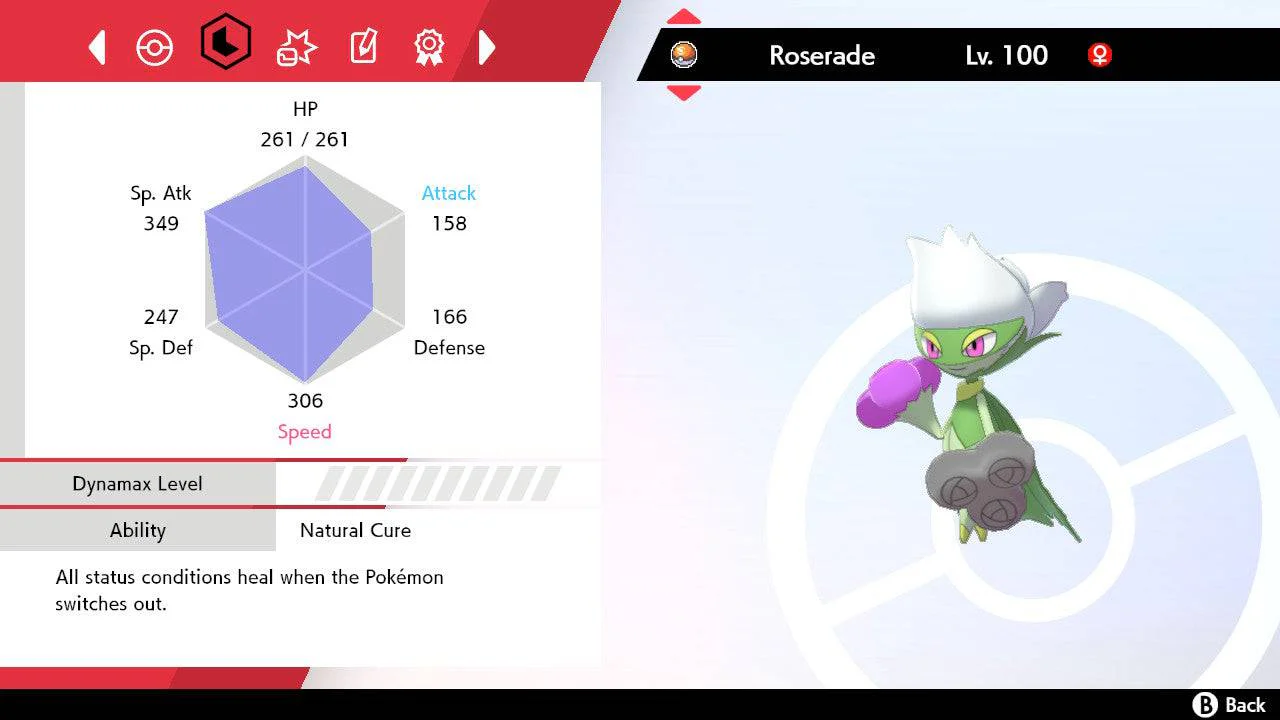
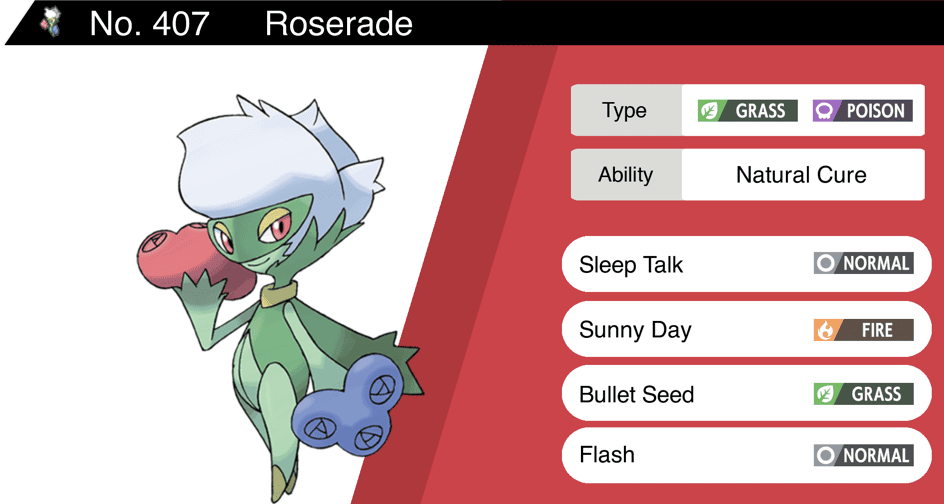
Roserade is a dual-type Grass and Poison Pokémon introduced in Generation IV. It holds National Pokédex number 407 and is classified as the Bouquet Pokémon.
It is the final evolution in the Budew line, sitting after Budew and Roselia. Roserade evolves from Roselia when exposed to a Shiny Stone.
It appears in Pokémon Diamond, Pearl, Platinum, HeartGold, SoulSilver, Black, White, Black 2, White 2, X, Y, Omega Ruby, Alpha Sapphire, Sword, Shield, Brilliant Diamond, Shining Pearl, Legends: Arceus, and Pokémon GO.
Roserade Base Stats at a Glance
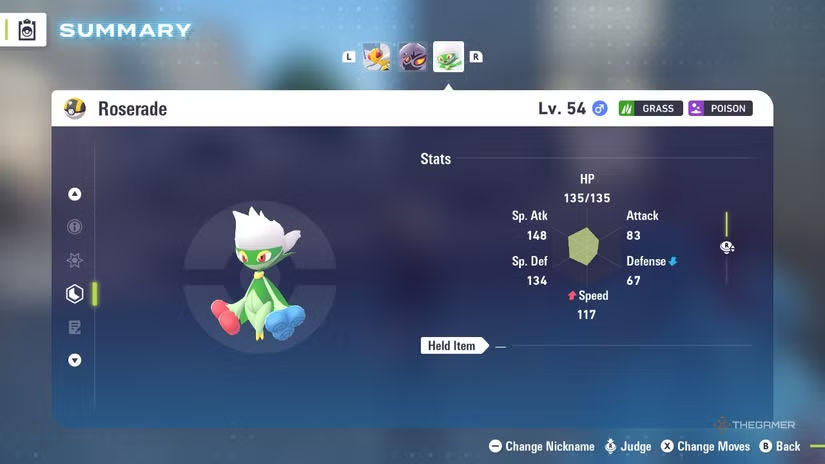
Roserade stats total 515 base points across six categories. This places it firmly in the high-end tier for non-legendary Pokémon and gives it an exceptional offensive profile.
| Stat | Base Value | Min (Lv.100) | Max (Lv.100) |
|---|---|---|---|
| HP | 60 | 220 | 314 |
| Attack | 70 | 130 | 240 |
| Defense | 65 | 121 | 229 |
| Special Attack | 125 | 229 | 383 |
| Special Defense | 105 | 193 | 339 |
| Speed | 90 | 166 | 284 |
| Total | 515 | — | — |
Maximum values assume a beneficial nature, 252 EVs, and 31 IVs. Minimum values use a hindering nature with 0 EVs and 0 IVs.
The standout number here is that 125 Special Attack — the highest base stat on the entire card and one of the best Special Attack values among Grass-type Pokémon in the entire franchise.
Breaking Down Every Roserade Stat
Understanding each stat individually helps you build Roserade correctly for every situation, whether you are playing story mode, competitive singles, or Pokémon GO.
HP — 60
Roserade’s HP is its most obvious weakness. At 60 base HP, it is not a Pokémon that can take many hits before going down.
This means you always want to attack first, switch out strategically, or use items like Focus Sash to protect it on the first turn.
The low HP stat is a deliberate design tradeoff. In exchange, Roserade gets incredible offensive and special defensive power.
Attack — 70
Roserade’s physical Attack stat is average at best. It is not designed to use physical moves, and almost every competitive build ignores this stat completely.
If you use Roserade in battle, you should never invest EVs here. Physical moves like Poison Jab are available in its learnset but are almost always outclassed by its special moves.
The only exception is Technician-boosted physical moves in niche builds, but even then the special attack sets are superior in most matchups.
Defense — 65
Roserade’s physical Defense is its second-biggest weakness after HP. At 65 base Defense, a strong physical hit from many common threats can knock it out in one shot.
In Generation 4 and 5, this stat was actually only 55, making it even more fragile on the physical side. It received a minor buff in later generations.
Competitive players typically do not invest EVs in Defense. The preferred approach is to keep Roserade away from physical attackers entirely and use Natural Cure to recover from status.
Special Attack — 125
This is the star of the Roserade stats sheet. A 125 base Special Attack is outstanding — it puts Roserade on the same level as Hydreigon, Gardevoir, and Alakazam in terms of raw special attacking power.
It means Roserade can fire off devastating Grass Knot, Energy Ball, Leaf Storm, and Sludge Bomb attacks without needing any held item to deal massive damage.
With a Modest nature and 252 Special Attack EVs, Roserade can reach 383 Special Attack at Level 100 — enough to threaten or OHKO a huge portion of the Pokémon roster.
Special Defense — 105
Roserade’s Special Defense is its best defensive stat by far and gives it a surprising durability against special attackers. At 105 base Special Defense, it can survive hits from many common special moves that would destroy other Grass-types.
This stat is why Roserade sees use on bulkier builds as well as offensive builds. A defensive set with Rest and Natural Cure is viable precisely because of this 105 base number.
Water, Electric, Fighting, and Fairy-type special moves deal reduced damage to Roserade thanks to its typing and this solid Special Defense base.
Speed — 90
Roserade’s 90 base Speed sits in a tricky spot. It is fast enough to outspeed a lot of walls and bulky Pokémon but slow enough to get outsped by many common sweepers and revenge killers.
With a Timid nature and Speed investment, Roserade hits 284 Speed at Level 100, which is competitive enough for many tiers but not enough to reach the very top of the speed tier.
Many competitive builds run Timid nature with Speed EVs to maximize Roserade’s ability to fire first against threats like Rotom-W, Togekiss, and various bulky Water-types.
Roserade Type and Type Chart
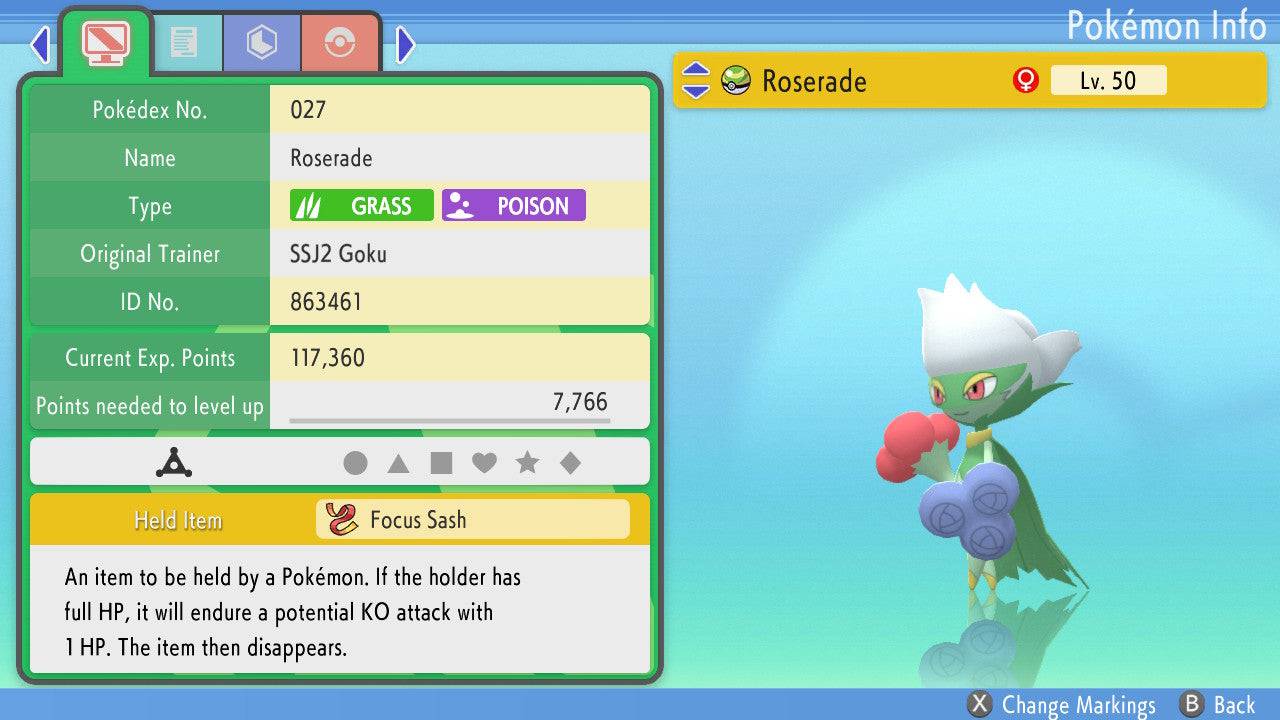
Roserade is a Grass and Poison dual-type Pokémon. This combination gives it an interesting balance of resistances, weaknesses, and immunities.
Type: Grass / Poison
| Attacking Type | Damage Multiplier |
|---|---|
| Fire | 2× (Weak) |
| Flying | 2× (Weak) |
| Ice | 2× (Weak) |
| Psychic | 2× (Weak) |
| Water | 0.5× (Resistant) |
| Electric | 0.5× (Resistant) |
| Fighting | 0.5× (Resistant) |
| Fairy | 0.5× (Resistant) |
| Grass | 0.25× (Double Resistant) |
| Bug | 1× (Neutral) |
| Ground | 1× (Neutral) |
The Grass/Poison typing is particularly good offensively. Both STAB types cover a wide range of Pokémon, and the Poison typing lets Roserade check Fairy-types that would otherwise wall pure Grass-type attackers.
Defensively, the quad resistance to Grass is notable. Roserade has just four weaknesses, with Fire and Flying being the most common threats to watch out for.
Roserade Abilities — Full Breakdown
Roserade has access to three abilities total: two standard abilities and one hidden ability. Choosing the right one is critical to how you build and play Roserade in any format.
Natural Cure (Standard)
Natural Cure is Roserade’s best and most commonly used ability. When Roserade switches out of battle, any non-volatile status condition — such as burn, paralysis, poison, or sleep — is instantly cured.
This ability completely changes how you manage Roserade in battle. You can freely switch Roserade into a predicted Sleep Powder or Thunder Wave, absorb the status, then switch out to cure it with zero lasting consequence.
Natural Cure also synergizes beautifully with the Rest move. If you use Rest to heal HP, Natural Cure cures the sleep the instant you switch out, making Roserade a very hard Pokémon to wear down with attrition strategies.
Poison Point (Standard)
Poison Point is Roserade’s weaker standard ability. When an opponent uses a direct contact move on Roserade, there is a 30% chance that the opponent becomes poisoned.
While 30% is a decent activation rate, this ability requires the opponent to hit Roserade with a contact move, which many special attackers never do. It is also not useful in most competitive settings.
Poison Point is occasionally useful in story mode when you want to passively punish physical attackers, but Natural Cure is almost always the superior choice in any competitive context.
Technician (Hidden Ability)
Technician is Roserade’s hidden ability and offers a completely different playstyle. Any move Roserade uses with a base power of 60 or less has its power boosted by 1.5 times.
This is significant because Roserade has access to Hidden Power (base 60), Weather Ball (base 50), and Magical Leaf (base 60), all of which become much stronger under Technician. Weather Ball in particular becomes an 150-power move under specific weather conditions when boosted.
Technician opens the door to creative sets and makes Roserade a serious threat in sun or rain team compositions. It is the preferred ability on certain offensive builds at the competitive level.
| Ability | Best Use | Rating |
|---|---|---|
| Natural Cure | Competitive singles, bulky offensive sets | S-Tier |
| Technician | Offensive sun/rain builds, Hidden Power sets | A-Tier |
| Poison Point | Story mode only | C-Tier |
Roserade Evolution Line
Understanding the full Budew-Roselia-Roserade evolution chain helps you plan when and how to obtain Roserade in every game.
Budew — Stage 1
Budew is the baby form of the line. It is a pure Grass-type Pokémon at this stage and one of the earliest Pokémon you can obtain in the Sinnoh region games.
Budew evolves into Roselia when leveled up with high friendship during the daytime. This is the same friendship-based mechanic used by Pokémon like Togepi and Eevee.
Budew’s stats are very low — it is a pre-evolution that is only useful early in a story playthrough before you have the resources to evolve it.
Roselia — Stage 2
Roselia is the middle evolution with a respectable 400 total base stats. It has the same type combination as Roserade — Grass and Poison — and shares much of the same learnset.
Roselia was introduced in Generation III and only gained the Roserade evolution when Diamond and Pearl released. Many trainers used Roselia as a standalone Pokémon before Roserade existed.
Roselia evolves into Roserade using a Shiny Stone. In Pokémon GO, Roselia requires a Sinnoh Stone and 100 Candies to evolve.
Roserade — Stage 3 (Final)
Roserade is the final form and where all the action happens. The jump from Roselia to Roserade is dramatic — Special Attack jumps from 100 to 125, and both defensive stats increase significantly.
No further evolution exists for Roserade as of 2026. It does not Mega Evolve, and no Regional Forms have been announced for this Pokémon.
| Pokémon | Type | BST | Evolution Method |
|---|---|---|---|
| Budew | Grass/Poison | 250 | Level up with high friendship (Daytime) → Roselia |
| Roselia | Grass/Poison | 400 | Shiny Stone → Roserade |
| Roserade | Grass/Poison | 515 | Final Evolution |
Best Roserade Movesets
Roserade’s deep and varied learnset is one of the reasons it stays relevant across game generations. Here are the most effective movesets for every context.
Competitive Offensive Set (Singles)
This is the standard sweeper build used in competitive play. It maximizes Special Attack output and coverage.
| Slot | Move | Type | Power | Notes |
|---|---|---|---|---|
| 1 | Leaf Storm / Energy Ball | Grass | 130 / 90 | Primary STAB |
| 2 | Sludge Bomb | Poison | 90 | Secondary STAB, 30% poison chance |
| 3 | Shadow Ball | Ghost | 80 | Coverage vs. Psychic/Ghost |
| 4 | Sleep Powder / Extrasensory | — / Psychic | — / 80 | Utility or coverage |
Recommended Item: Choice Specs or Life Orb Recommended Nature: Modest (+SpA, -Atk) or Timid (+Spe, -Atk) Recommended EV Spread: 252 SpA / 252 Spe / 4 HP Recommended Ability: Natural Cure or Technician
Leaf Storm is the highest-damage Grass-type move available, hitting at 130 base power with STAB. The Special Attack drop after use is manageable since Roserade is primarily a hit-and-run attacker.
Energy Ball is the more reliable option if you need consistent Grass-type damage without the stat drop.
Hazard Setter Build (Competitive Support)
Roserade is one of the best Toxic Spikes and Spikes setters in the game. This support build is designed to lay entry hazards while also threatening offensive pressure.
| Slot | Move | Type | Notes |
|---|---|---|---|
| 1 | Spikes | — | Damages opposing Pokémon on switch-in |
| 2 | Toxic Spikes | — | Poisons switching Pokémon |
| 3 | Sludge Bomb | Poison | Primary STAB, 30% poison |
| 4 | Leaf Storm / Giga Drain | Grass | Offensive threat / Recovery |
Recommended Item: Black Sludge or Rocky Helmet Recommended Nature: Timid or Modest Recommended EV Spread: 252 SpA / 252 Spe / 4 SpD Recommended Ability: Natural Cure
This set is particularly dangerous because opponents cannot simply ignore Roserade — its 125 Special Attack means they have to engage with it offensively while also dealing with the hazards it sets.
Sleep Powder can also slot into this build in place of one hazard, making Roserade a sleep-and-spikes abuser that can put opposing Pokémon to sleep before stacking entry hazards.
Bulky Offensive Set
This set uses Roserade’s solid Special Defense to stay on the field longer while dealing consistent damage.
| Slot | Move | Type | Notes |
|---|---|---|---|
| 1 | Giga Drain | Grass | HP recovery while attacking |
| 2 | Sludge Bomb | Poison | STAB coverage |
| 3 | Rest | — | Full HP recovery |
| 4 | Sleep Powder | — | Utility |
Recommended Item: Shell Bell or Leftovers Recommended Ability: Natural Cure (synergizes perfectly with Rest)
This set is the reason Natural Cure is considered S-Tier. Using Rest restores full HP, then switching out cures the sleep immediately. Giga Drain provides additional sustainable recovery while threatening damage.
Technician Set
For players with access to Roserade’s hidden ability, this set maximizes Technician’s power boost.
| Slot | Move | Type | Notes |
|---|---|---|---|
| 1 | Grass Knot | Grass | 60 BP = boosted to 90 effective |
| 2 | Magical Leaf | Grass | 60 BP, never misses, boosted by Technician |
| 3 | Weather Ball | Normal/Variable | 50 BP becomes 75 with Technician, 150 in weather |
| 4 | Hidden Power (Fire/Ice) | Variable | 59 BP boosted, covers key weaknesses |
Recommended Item: Life Orb or Choice Specs Recommended Ability: Technician (required)
Roserade in Pokémon GO — Complete Stats
Roserade stats in Pokémon GO follow a different system than the main series games. Here is the complete breakdown.
Pokémon GO Base Stats
| Stat | Value |
|---|---|
| Attack | 243 |
| Defense | 185 |
| Stamina | 155 |
| Max CP (Level 50) | 3,359 |
Roserade’s 243 Attack in Pokémon GO is exceptional for a Grass-type attacker. Its 155 Stamina reflects the same bulk weakness present in the main games.
Best Pokémon GO Moveset
Best PvE Moveset: Poison Jab + Grass Knot DPS: 14.12 (Damage Per Second) TDO: 223.8 (Total Damage Output)
Best PvP Moveset (Gym offense): Magical Leaf + Solar Beam
Roserade functions as a dual-duty attacker in Pokémon GO raids. It can serve as either a top Grass-type attacker or a top Poison-type attacker depending on which moveset you equip.
Pokémon GO Fast Moves
| Move | Type | DPS |
|---|---|---|
| Poison Jab | Poison | High |
| Magical Leaf | Grass | Medium-High |
| Bullet Seed | Grass | Medium |
| Razor Leaf | Grass | Medium |
Pokémon GO Charge Moves
| Move | Type | Notes |
|---|---|---|
| Grass Knot | Grass | Top DPS charge move |
| Solar Beam | Grass | Highest power, slower |
| Sludge Bomb | Poison | Best Poison-type option |
| Dazzling Gleam | Fairy | Coverage |
| Petal Blizzard | Grass | Alternative Grass option |
| Weather Ball (Fire) | Fire | Limited, legacy |
Weather Boosts: Roserade is boosted in Sunny and Cloudy weather in Pokémon GO.
Shiny Roserade: Shiny Roserade is available in Pokémon GO and features noticeably different coloring on its bouquets.
Where to Find Roserade in Main Series Games
Roserade locations vary significantly across generations. Here is a quick reference for the most popular games.
| Game | How to Obtain |
|---|---|
| Diamond / Pearl | Evolve Roselia with Shiny Stone |
| Platinum | Evolve Roselia with Shiny Stone |
| HeartGold / SoulSilver | Evolve Roselia with Shiny Stone |
| Black / White | Evolve Roselia with Shiny Stone |
| X / Y | Evolve Roselia or trade |
| Sword / Shield | Max Raid Dens (Wild Area, Isle of Armor DLC) or evolve Roselia |
| Brilliant Diamond / Shining Pearl | Evolve Roselia with Shiny Stone |
| Legends: Arceus | Available in several locations in the Hisui region |
In Sword and Shield, Roserade appears in certain high-level Max Raid Dens in the Wild Area and the Isle of Armor DLC, making it one of the few Pokémon catchable without evolution in that generation.
In Pokémon GO, Roserade is obtained by evolving Roselia using 100 Candies and a Sinnoh Stone. Wild Roserade encounters are extremely rare.
Roserade Egg Groups and Breeding
Roserade belongs to the Fairy and Grass Egg Groups. This gives it access to a wide range of potential egg move parents.
The Medium Slow growth rate means Roserade gains experience points at a moderate pace — not the fastest, but not the slowest either.
Key Egg Moves:
- Spikes (from compatible parents)
- Toxic Spikes (from compatible parents)
- Sleep Powder (from compatible parents)
- Leaf Storm (by level up in some games)
- Synthesis (by level up or TM)
Roserade Notable Moves by Category
Here is a comprehensive look at the most important moves in Roserade’s full learnset, organized by category.
STAB Grass-Type Moves
| Move | Base Power | Notes |
|---|---|---|
| Leaf Storm | 130 | Highest power, lowers SpA by 2 after use |
| Petal Blizzard | 90 | Reliable physical alternative |
| Energy Ball | 90 | 10% chance to lower target’s SpD |
| Giga Drain | 75 | Recovers HP equal to half damage dealt |
| Grass Knot | Variable | Power based on opponent’s weight |
| Magical Leaf | 60 | Never misses; Technician-boosted |
| Solar Beam | 120 | Requires one charge turn or Sun |
| Petal Dance | 120 | Lasts 2-3 turns, confuses afterward |
STAB Poison-Type Moves
| Move | Base Power | Notes |
|---|---|---|
| Sludge Bomb | 90 | 30% poison chance; standard competitive choice |
| Poison Jab | 80 | Physical; best in Pokémon GO context |
| Venoshock | 65 | Doubles in power if target is already poisoned |
| Toxic Spikes | — | Entry hazard; poisons switching Pokémon |
Coverage and Utility Moves
| Move | Base Power | Type | Notes |
|---|---|---|---|
| Shadow Ball | 80 | Ghost | Hits Psychic and Ghost types |
| Extrasensory | 80 | Psychic | Hits Poison-type switch-ins |
| Dazzling Gleam | 80 | Fairy | Coverage vs. Dragon/Dark |
| Sleep Powder | — | Grass | Puts target to sleep |
| Stun Spore | — | Grass | Paralyzes target |
| Spikes | — | Ground | Entry hazard |
| Synthesis | — | Grass | Restores HP (amount varies by weather) |
| Rest | — | Psychic | Full HP restore; pairs with Natural Cure |
| Substitute | — | Normal | Blocks status moves |
| Leech Seed | — | Grass | Drains HP from opponent each turn |
Roserade Competitive Tier and Usage
Roserade has held a consistent place in competitive play across generations. It has appeared in RU, NU, and UU tiers in Smogon’s tiering system depending on the generation, reflecting its consistent but not overwhelming competitive power.
Its unique combination of Sleep Powder access, Spikes and Toxic Spikes, a 125 Special Attack stat, and Natural Cure ability creates a role that very few other Grass-type Pokémon can replicate.
In the UU (UnderUsed) tier, Roserade is particularly dangerous. Teams that lack a reliable counter to Grass/Poison coverage backed by 125 Special Attack can get swept by a well-played Roserade.
In generation-specific formats:
| Generation | Typical Tier | Role |
|---|---|---|
| Gen 4 (DP/Pt) | UU | Offensive attacker / Hazard setter |
| Gen 5 (BW) | RU / UU | Technician attacker / Spiker |
| Gen 6 (XY) | RU | Spiker / Offensive |
| Gen 7 (SM) | RU / NU | Hazard setter |
| Gen 8 (SwSh) | RU | Special sweeper / Support |
| Gen 9 (SV) | NU | Special attacker |
Roserade Counters and Checks
Knowing what beats Roserade is just as important as knowing what Roserade beats. These are the most effective ways to deal with it.
Fire-types are the most reliable Roserade counters. Heatran, Chandelure, Arcanine, and Talonflame all threaten to OHKO Roserade on the switch with their STAB Fire moves.
Flying-types like Talonflame, Salamence, and Togekiss outspeed or tank Roserade’s moves and retaliate with super-effective hits.
Psychic-types such as Alakazam, Gardevoir, and Latias can outspeed Roserade (or match its speed) and hit hard with STAB Psychic moves.
Ice Beam from common Water-types is a threat, even if Water itself is resisted. Starmie and Slowbro can carry Ice Beam and threaten Roserade.
Poison immunity on Steel-types like Heatran and Skarmory makes Sludge Bomb useless against them, leaving Roserade reliant on Shadow Ball or other coverage.
Roserade Pokédex Entries and Lore
Roserade’s Pokédex entries across games reveal a fascinating and slightly sinister personality behind the elegant appearance.
Diamond: “With the movements of a dancer, it strikes with whips that are densely lined with poison thorns.”
Pearl: “Luring prey with a sweet scent, it uses poison whips on its arms to poison, bind, and finish off the prey.”
Platinum: “After captivating opponents with its sweet scent, it lashes them with its thorny whips.”
HeartGold/SoulSilver: “The poison in its right hand is quick acting. The poison in its left hand is slow acting. Both are life threatening.”
The design of Roserade draws from the image of a masquerade ball dancer — elegant, mysterious, and dangerous underneath a charming surface. Its mask, cape made of green leaves, and bouquets of red and blue roses all reinforce this theme.
Roserade is one of the few Pokémon that holds different types of items in each hand with distinct properties — the right bouquet contains fast-acting poison and the left contains slow-acting poison, both lethal according to in-game lore.
Roserade in the Pokémon Anime and Media
Roserade has appeared notably in the Pokémon anime in several memorable roles.
Gardenia, the Eterna City Gym Leader in the Diamond and Pearl anime, used Roserade as her final and strongest Pokémon. Her Roserade defeated Ash’s Turtwig in battle, showcasing the Pokémon’s combat power on screen.
Drew, May’s Pokémon Contest rival, evolved his beloved Roselia into Roserade during the Diamond and Pearl saga. This evolution was revealed by May in a tag battle episode.
Barry, a rival character in the Diamond and Pearl anime, also had a Roserade that defeated Ash’s Chimchar using Poison Jab.
Cynthia, Sinnoh Champion and one of the most beloved characters in the franchise, owned a Roserade that appeared in The Arceus Chronicles.
In Pokémon Mystery Dungeon: Explorers of Time and Darkness, Roserade is a member of Team Raider, the legendary exploration team alongside Gallade and Rhyperior — a fitting trio for one of the most elegant Pokémon in the franchise.
Roserade Compared to Other Grass/Poison Types
How does Roserade measure up against other Pokémon sharing its dual typing?
| Pokémon | BST | SpA | Speed | Notable Advantage |
|---|---|---|---|---|
| Roserade | 515 | 125 | 90 | Best SpA of the group, Sleep Powder |
| Venusaur | 525 | 100 | 80 | Higher BST, Thick Fat ability |
| Amoonguss | 464 | 85 | 30 | Better bulk, Regenerator ability |
| Victreebel | 490 | 100 | 70 | Better Attack stat |
| Vileplume | 490 | 100 | 50 | Bulkier |
Roserade has the highest Special Attack of any Grass/Poison type in the franchise. The tradeoff is the lower HP and Defense, making it a glass cannon that must be played carefully.
Roserade Natures — What Works Best
Choosing the right nature is essential to maximizing Roserade stats in battle.
| Nature | Effect | Use Case |
|---|---|---|
| Modest (+SpA, -Atk) | Maximizes Special Attack | Pure offensive sets |
| Timid (+Spe, -Atk) | Maximizes Speed | Faster sets, outspeeds threats |
| Mild (+SpA, -Def) | SpA up, Defense down | Risky; rarely used |
| Calm (+SpD, -Atk) | Better special bulk | Bulky defensive builds |
| Bold (+Def, -Atk) | Better physical bulk | Rarely beneficial |
Modest is the top choice for maximum damage output. Timid is preferred when the extra speed is needed to outpace specific threats in your tier.
Frequently Asked Questions (FAQs)
What are Roserade’s base stats?
Roserade has 60 HP, 70 Attack, 65 Defense, 125 Special Attack, 105 Special Defense, and 90 Speed — totaling 515 base stat points across all six categories.
What type is Roserade?
Roserade is a dual-type Grass and Poison Pokémon. This gives it four weaknesses (Fire, Flying, Ice, Psychic) and five resistances including a 4× resistance to Grass-type moves.
What is Roserade’s best ability?
Natural Cure is Roserade’s best ability for competitive play since it cures all status conditions when switching out. Technician is the best choice for Hidden Power and Weather Ball sets.
How does Roserade evolve?
Roserade evolves from Roselia when exposed to a Shiny Stone in main series games. In Pokémon GO, Roselia requires 100 Candies and a Sinnoh Stone to evolve into Roserade.
What is Roserade’s max CP in Pokémon GO?
Roserade reaches a maximum CP of 3,359 at Level 50 in Pokémon GO. Its best moveset for PvE raids is Poison Jab and Grass Knot with 14.12 DPS.
Is Roserade good in competitive Pokémon?
Yes. Roserade is a strong competitive Pokémon in UU and RU tiers thanks to its 125 Special Attack, access to Sleep Powder, Spikes, Toxic Spikes, and Natural Cure. It is one of the best Grass-type hazard setters in the game.
What is Roserade weak against?
Roserade is weak to Fire, Flying, Ice, and Psychic-type moves. Of these, Fire and Psychic are the most common threats in competitive play that trainers must account for.
What is Roserade’s best moveset for battles?
The most effective competitive moveset is Leaf Storm or Energy Ball as the primary Grass STAB, Sludge Bomb for Poison STAB, Shadow Ball for coverage, and Sleep Powder or Spikes for utility.
What is Roserade’s Pokédex number?
Roserade is Pokédex number 407 in the National Pokédex. It was introduced in Generation IV alongside Pokémon Diamond and Pearl.
Is Roserade available in Pokémon Legends: Z-A?
Yes. Roserade is confirmed to be available in Pokémon Legends: Z-A and can learn moves through level-up and the Remember Moves feature in that game.
Conclusion
Roserade stats tell the story of one of Generation IV’s most elegantly designed and competitively viable Pokémon.
A 125 Special Attack stat paired with a diverse learnset that includes Sleep Powder, Spikes, Toxic Spikes, Leaf Storm, and Sludge Bomb gives Roserade a role that almost no other Grass-type can fill.
The Natural Cure ability makes it resilient against status strategies, while Technician opens up creative offensive builds for more advanced players.
Whether you are playing through the main story, building a competitive VGC or Smogon team, raiding in Pokémon GO, or just trying to understand every number on the stat sheet, Roserade rewards knowledge and careful play.
Its low HP and Defense are real weaknesses that must be respected — but in the right situation, with the right moveset and the right team support, Roserade is capable of dismantling entire teams with the elegance and precision of a masquerade ball dancer.
That combination of beauty, danger, and strategy is exactly what makes Roserade one of the most beloved Pokémon in the franchise heading into 2026.