When Synonyms: Common Words to Replace When 2026
When synonyms are words and phrases that carry the same or very similar meaning as “when” — and knowing which one to use can instantly elevate your writing from ordinary to precise.
The word “when” is one of the most overused conjunctions in the English language. Writers use it for time, conditions, situations, and questions without realizing that better alternatives exist for every context.
What Does “When” Mean and Why Replace It?
“When” is a versatile English word. It can function as a subordinating conjunction, an interrogative adverb, a relative pronoun, and even a conditional marker. Because it handles so many jobs at once, it ends up being used far too broadly.
Overusing “when” creates writing that feels repetitive and flat. Readers notice the same word appearing in sentence after sentence. More importantly, using a precise synonym often clarifies exactly what relationship you mean — whether that is timing, simultaneity, condition, or sequence.
When synonyms help you say more with greater accuracy. They signal to readers and search engines alike that your writing is deliberate and varied.
The Four Main Roles of “When” and Its Best Synonyms
Understanding how “when” functions in a sentence is the key to choosing the right synonym. Each role calls for a different set of replacements.
| Role of “When” | What It Means | Best Synonyms |
|---|---|---|
| Temporal (time marker) | At the moment that | As, while, at the time that, the moment |
| Sequential (order) | After one event | Once, after, upon, following, as soon as |
| Conditional (if-then) | In the case that | If, provided that, in the event that, assuming |
| Interrogative (question) | At what time? | At what point, on what occasion, how soon |
| Relative (referring back) | At which time | At which point, at that time, whereupon |
When Synonyms for Temporal Meaning (Time Context)
The most common use of “when” is to describe the time at which something happens. These are the when synonyms that work in temporal sentences.
As
“As” is one of the closest and most natural when synonyms for describing two simultaneous events. It carries a slightly more formal tone than “when” and works especially well in literary or academic writing.
Example: “As the meeting ended, the tension in the room lifted.” This feels more deliberate than writing “when the meeting ended.”
“As” is best used when both events happen at exactly the same time, overlapping completely. It implies immediate co-occurrence more strongly than “when” does.
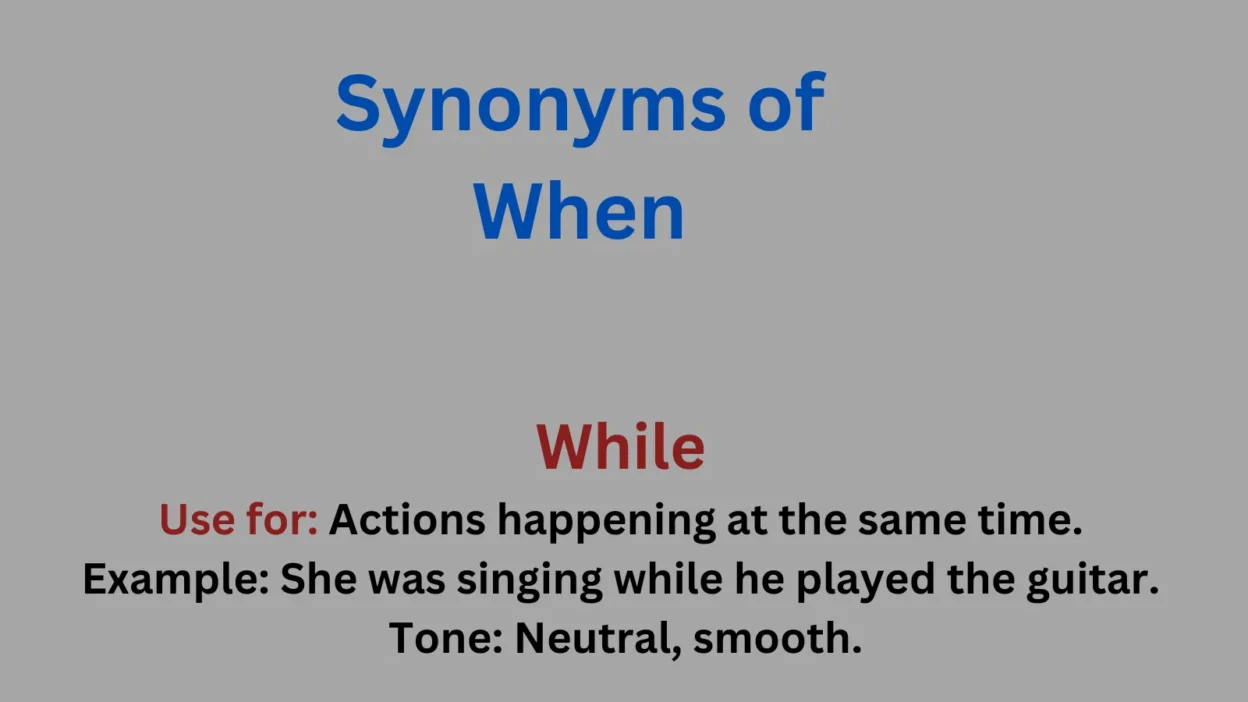
While
“While” is used when two events or actions run parallel to each other over a period of time. It emphasizes duration and overlap rather than a single point in time.
Example: “She reviewed the documents while her team prepared the presentation.” Use “while” whenever the two actions happen throughout the same stretch of time.
Avoid using “while” for single-moment events. It sounds awkward in sentences like “While she sneezed, the light flickered,” where “as” or “when” would be more natural.
At the Moment That
This phrase replaces “when” with more precision, drawing attention to a specific, defined instant. It is useful in legal, technical, and formal writing where pinpointing exact moments matters.
Example: “At the moment that the contract was signed, the deal became binding.” This is longer than “when” but considerably more precise.
It is not ideal for casual writing. Save it for contexts where exactness is the priority over conciseness.
The Instant / The Moment
These phrases serve as more dramatic or emphatic when synonyms. They create urgency or highlight significance.
Example: “The moment she walked in, the room fell silent.” Compare to the flatter: “When she walked in, the room fell silent.” The synonym adds weight.
“The instant” is even more abrupt and creates a stronger sense of immediacy. Both are excellent when synonyms for narrative writing.
When Synonyms for Sequential Meaning (Order Context)
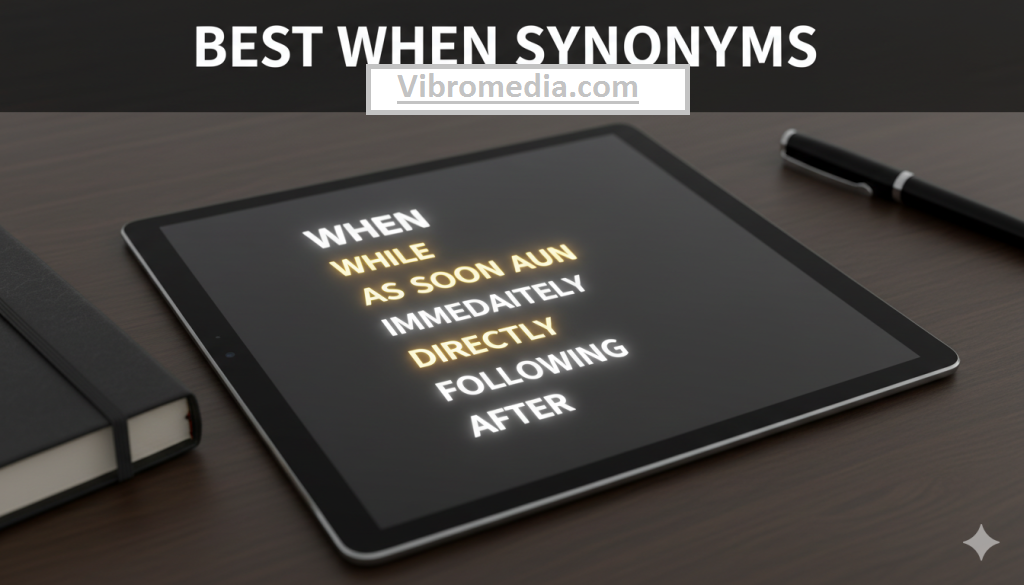
When “when” signals that one event follows another in a sequence, these synonyms deliver more clarity about the order of events.
Once
“Once” is one of the most useful and popular when synonyms. It implies that one action is complete before the next begins, making the sequence unambiguous.
Example: “Once the data is collected, the analysis begins.” This is cleaner than “when the data is collected,” because “once” makes clear that the data must be fully collected first.
“Once” works especially well in instructions, processes, and procedures. It is precise without being formal.
After
“After” directly signals sequence and is one of the clearest and most commonly taught when synonyms. It leaves no ambiguity about which event comes first.
Example: “After the storm passed, residents began clearing the roads.” The sequence is unmistakable with “after” in place of “when.”
It is a versatile choice across registers — equally natural in casual writing and formal documentation.
As Soon As
This phrase emphasizes immediacy following completion of the first event. It tells the reader that no time was wasted between the two actions.
Example: “As soon as the results are published, we will notify all participants.” This makes the immediacy clear in a way that “when” does not.
“As soon as” is one of the most commonly recommended when synonyms for professional and business communication. It implies urgency and responsiveness.
Upon
“Upon” is a formal and elegant when synonym. It works well in legal documents, official notices, and polished written communication.
Example: “Upon receiving your application, we will begin the review process.” It is more concise and formal than “as soon as we receive” and more specific than “when we receive.”
Use “upon” in professional and ceremonial contexts. It sounds stiff in casual conversation but authoritative on paper.
Following
“Following” is a formal sequential synonym for “when.” It clearly places one event after another and is particularly common in business writing, journalism, and official reporting.
Example: “Following the announcement, shares in the company rose by eight percent.” This works better than “when the announcement was made” in news or report writing.
It is a strong choice when you want to emphasize that the first event triggered or preceded the second.
When Synonyms for Conditional Meaning (If-Then Context)
Sometimes “when” is used to mean “if” or “in the case that.” These when synonyms help clarify that you mean a conditional relationship, not just a time-based one.
If
“If” is the most direct swap when “when” is being used conditionally. Replacing “when” with “if” removes any ambiguity about whether you mean a time relationship or a conditional one.
Example: Compare “When you are unsure, ask a supervisor” with “If you are unsure, ask a supervisor.” The second version makes clear that asking is the appropriate response to the condition of uncertainty, not just to a particular moment in time.
This is one of the most important distinctions in precise English writing. Grammar guides consistently recommend choosing “if” for hypothetical situations and reserving “when” for expected or inevitable events.
Provided That
“Provided that” is a formal conditional synonym that introduces a requirement. It signals that one event will follow only if a specific condition is met.
Example: “Provided that all documents are submitted, the application will be processed within 10 business days.” This is far more legally precise than using “when.”
It is ideal for contracts, policy documents, academic writing, and any text that requires conditional clarity.
In the Event That
This phrase is used for situations that may or may not occur. It is a common when synonym in formal and legal English.
Example: “In the event that the service is unavailable, customers should contact support.” This is clearer than “when the service is unavailable,” which implies the disruption is expected.
Use this phrase in policies, user agreements, emergency instructions, and risk-related communications.
Assuming
“Assuming” introduces a conditional situation with an underlying sense of expectation. It is softer than “provided that” and more natural in conversational and semi-formal writing.
Example: “Assuming the weather holds, the event will proceed as planned.” This is a natural and sophisticated alternative to “when the weather is good.”
It works well in emails, proposals, and everyday professional communication.
When Synonyms for Interrogative Meaning (Question Context)
When “when” asks a question about time, these phrases can replace or vary it in formal or academic writing.
At What Point
This phrase replaces interrogative “when” with a more analytical feel. It is common in academic and investigative writing.
Example: “At what point did the project begin to fall behind schedule?” This is more precise than “when did the project fall behind?” in a formal audit or review.
On What Occasion
This phrase adds specificity and formality to time-based questions. It implies that the event in question is distinct and identifiable.
Example: “On what occasion was this policy last reviewed?” This sounds more deliberate and formal than asking simply “when was it reviewed?”
How Soon
“How soon” replaces “when” in questions that carry a sense of urgency or expectation about timing. It is very common in customer service, project management, and everyday conversation.
Example: “How soon can you deliver the final report?” This communicates urgency more effectively than “when can you deliver it?”
When Synonyms for Relative Pronoun Use
When “when” is used as a relative pronoun to refer back to a time already mentioned, these phrases work as precise replacements.
At Which Point
“At which point” replaces relative “when” with a phrase that links clearly and formally back to the referenced time. It is common in academic and journalistic writing.
Example: “The negotiations ran for six weeks, at which point both parties reached an agreement.” Compare to “when both parties reached an agreement,” which is slightly looser in reference.
Whereupon
“Whereupon” is a formal and somewhat literary when synonym that means “immediately after which.” It creates strong logical flow between two clauses.
Example: “The manager reviewed the report, whereupon she approved the budget.” It is a sophisticated choice for narrative and formal descriptive writing.
At That Time
“At that time” is a clear and neutral phrase that replaces relative “when” without adding formality or drama. It simply points back to a specific period already identified.
Example: “The policy was introduced in 2019. At that time, the regulatory environment was very different.” This is cleaner and more precise than using “when” repeatedly to refer back to the same period.
Complete Master Table: When Synonyms by Category

| Context | Synonym | Formality Level | Best Used In |
|---|---|---|---|
| Temporal | As | Medium | Literary, academic |
| Temporal | While | Low–Medium | General writing |
| Temporal | At the moment that | High | Legal, technical |
| Temporal | The moment / The instant | Low–Medium | Narrative, creative |
| Sequential | Once | Low | Instructions, process |
| Sequential | After | Low | All registers |
| Sequential | As soon as | Low–Medium | Business, professional |
| Sequential | Upon | High | Legal, formal |
| Sequential | Following | High | Journalism, reports |
| Conditional | If | Low | All registers |
| Conditional | Provided that | High | Legal, contracts |
| Conditional | In the event that | High | Policies, agreements |
| Conditional | Assuming | Medium | Emails, proposals |
| Interrogative | At what point | Medium–High | Academic, formal |
| Interrogative | How soon | Low | Conversational |
| Relative | At which point | High | Academic |
| Relative | Whereupon | High | Literary, formal |
| Relative | At that time | Low–Medium | All registers |
How to Choose the Right When Synonym
Choosing among when synonyms comes down to three questions. First, what function is “when” performing — is it marking time, sequence, condition, or a question? Second, what register or tone does your writing call for — formal, academic, conversational, or narrative? Third, how much precision does the context demand?
For everyday emails and casual writing, “once,” “after,” and “as soon as” are the safest and most natural when synonyms to reach for.
For formal writing, legal documents, and academic papers, “upon,” “provided that,” “at which point,” and “in the event that” deliver the authority and precision those contexts require.
For creative and narrative writing, “the moment,” “the instant,” “as,” and “whereupon” add rhythm, weight, and emphasis that plain “when” cannot match.
When Synonyms in Academic Writing
Academic writing benefits most from precise when synonyms. Vague temporal language is a common weakness in student essays and research papers, and replacing overused “when” with accurate synonyms immediately strengthens the writing.
In research writing, “upon” and “following” signal clear cause-and-effect sequences. In theoretical discussion, “provided that” and “assuming” frame conditional arguments with logical clarity. In historical or analytical narrative, “at which point” and “at that time” anchor events firmly in their context.
One of the most effective habits academic writers can develop is to review every use of “when” in a draft and ask whether a more specific synonym would sharpen the meaning. In most cases, it will.
When Synonyms in Professional and Business Writing
Business writing rewards precision, concision, and clarity. Every one of those goals is served by knowing your when synonyms.
“As soon as” replaces vague “when” in client communications, setting expectations about timelines. “Upon receipt” is the standard formal phrase for initiating action. “Following the review” is more professional than “when we review it.”
Using varied and precise when synonyms also signals to readers that the writer has command of the language. That impression matters in proposals, reports, executive summaries, and client-facing documents.
When Synonyms in Creative and Narrative Writing
For fiction writers, poets, and storytellers, when synonyms are tools of pacing and emphasis. The right word at the right moment can slow down time for a reader, or accelerate it.
“The moment she opened the letter” hits differently than “when she opened the letter.” The former makes the moment feel singular and weighted. “As the clock struck midnight” feels more atmospheric than “when the clock struck midnight.”
Creative writers should experiment with all the temporal when synonyms available to them. Each one creates a slightly different emotional and rhythmic effect.
Common Mistakes When Replacing “When”
The most frequent error writers make when looking for when synonyms is choosing one that changes the meaning of the sentence. “While” and “when” are not interchangeable — “while” implies overlapping duration while “when” can mark a single point.
Confusing “if” and “when” is another persistent mistake. Using “when” for hypothetical situations implies the event will definitely occur, which may not be the intended meaning. “When it rains” implies it will definitely rain. “If it rains” makes it conditional.
Over-formalizing is also a risk. Replacing casual “when” with “in the event that” in a friendly email creates an unintentional tone of distance or legal caution. Match the synonym to the register of the writing.
When Synonym Quick Reference by Register
| Register | Avoid | Use Instead |
|---|---|---|
| Legal / Formal | When | Upon, provided that, in the event that |
| Academic | When | Once, following, at which point |
| Business / Professional | When | As soon as, upon, following |
| Creative / Narrative | When | The moment, as, whereupon |
| Conversational | When (fine to keep) | Once, after, as soon as |
| Instructional | When | Once, after, upon completion |
Frequently Asked Questions (FAQs)
What is the most common synonym for “when”?
“As,” “once,” and “while” are the most commonly used when synonyms. Each is best suited to a slightly different context — “as” for simultaneous events, “once” for sequential actions, and “while” for overlapping durations.
What is the difference between “when” and “while”?
“When” marks a specific point in time, while “while” describes two events happening over the same stretch of time. Use “when” for single-moment actions and “while” for parallel ongoing actions.
Can “if” replace “when” in a sentence?
Yes, but only when “when” is being used conditionally to mean “in the case that.” Use “if” for hypothetical situations and “when” for events that are expected to definitely occur.
What is a formal synonym for “when”?
“Upon,” “at which point,” “provided that,” and “following” are all formal when synonyms suited to legal, academic, and professional writing contexts.
What does “whereupon” mean and when should I use it?
“Whereupon” means “immediately after which” and is a formal, literary when synonym. Use it to create strong logical or narrative flow between two closely linked clauses in formal or creative writing.
Is “once” a good replacement for “when”?
Yes. “Once” is one of the clearest when synonyms for sequential writing. It signals that one action must be complete before the next begins, which is more precise than the ambiguous “when.”
What is the difference between “as soon as” and “when”?
“As soon as” implies immediacy — no delay between the two events. “When” is more neutral about timing. Use “as soon as” whenever you want to communicate that the second action follows without delay.
How do I avoid overusing “when” in my writing?
Identify every instance of “when” in your draft, determine what role it is playing — temporal, sequential, conditional, or interrogative — and substitute the most precise synonym from each category.
What are when synonyms for academic writing?
The best academic when synonyms include “once,” “upon,” “following,” “at which point,” “provided that,” and “assuming.” These signal precision and analytical rigor in formal academic contexts.
Can “as” always replace “when”?
No. “As” works for simultaneous events but sounds awkward when used for sequential events where “once” or “after” would be more accurate. Always check whether the two events overlap or follow each other before choosing “as.”
Conclusion
When synonyms are one of the simplest and most powerful tools available to any writer looking to improve their precision, variety, and overall quality.
The word “when” is indispensable, but it should never be the only tool you reach for when expressing time, sequence, condition, or reference.
From the clean simplicity of “once” and “after” to the formal authority of “upon,” “provided that,” and “at which point,” the English language offers a rich vocabulary of temporal and conditional connectives waiting to be used.
Whether you are writing an academic essay, a business report, a legal document, or a piece of creative fiction, the right when synonym in the right place will always sharpen your meaning, strengthen your voice, and make your writing more memorable.
Start by auditing your next draft for every instance of “when” — you may be surprised how many can be replaced with something better.