To Whom It May Concern Synonyms: Easy Alternatives 2026
To Whom It May Concern synonyms are something every professional needs in 2026. This once-popular salutation has become outdated, impersonal, and even damaging in modern correspondence.
Whether you are writing a cover letter, a formal complaint, a recommendation letter, or a business email, the greeting you choose sets the tone for everything that follows.
What Does “To Whom It May Concern” Mean?
“To Whom It May Concern” is a formal salutation used at the start of a letter or email when the writer does not know the name of the recipient. It is addressed to whoever reads the message.
It was widely accepted before the digital age, when finding contact information was genuinely difficult. Today, with LinkedIn, company websites, and search engines, most professionals can find a name in minutes.
The phrase is now considered generic, impersonal, and a signal of low effort by many hiring managers and business professionals.
Why “To Whom It May Concern” Is Considered Outdated
The way this phrase is perceived has shifted dramatically in recent years. What once showed professionalism now often signals the opposite.
According to a 2026 survey by TopResume, 76% of recruiters spend fewer than 10 seconds on an initial cover letter review. A generic opener like “To Whom It May Concern” can immediately signal that the applicant did not research the company or the role.
Senior talent acquisition directors at Fortune 500 companies have noted publicly that seeing this phrase leads them to question a candidate’s attention to detail and research skills. It is still grammatically correct and not rude, but it is simply no longer the best choice in most situations.
How to Properly Format “To Whom It May Concern”
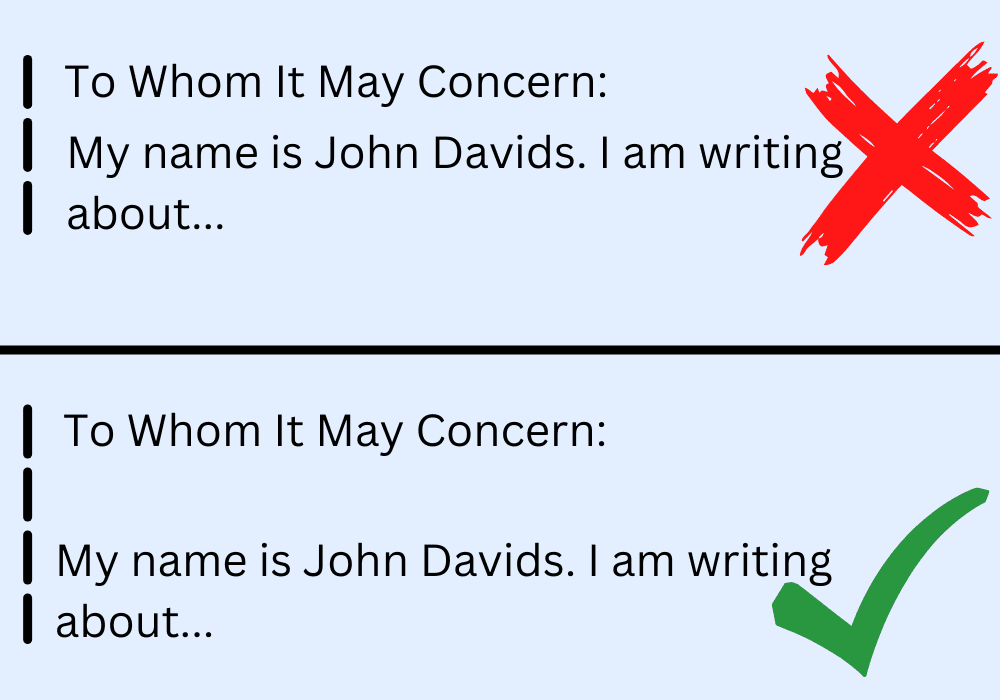
If you must use it, formatting it correctly matters. Every major word should be capitalized.
Correct format: To Whom It May Concern:
Incorrect formats:
- to whom it may concern (no capitalization)
- To Whom It May Concern, (comma instead of colon)
- To Whom This May Concern (wrong pronoun)
The phrase should always be followed by a colon, not a comma. A colon increases formality and is the accepted standard in professional writing. It is placed at the top of the letter, followed by a double space before the body text begins.
When Is “To Whom It May Concern” Still Acceptable?
Despite its outdated reputation, there are situations where this phrase remains appropriate and even preferred.
| Situation | Is It Acceptable? |
|---|---|
| Reference or recommendation letter for multiple uses | Yes |
| Formal complaint to an organization | Yes |
| Legal notices or official public documents | Yes |
| Open letters to a broad or unknown audience | Yes |
| Job application cover letter | Not recommended |
| Cold outreach email to a specific company | Not recommended |
| Networking emails | No |
| Internal workplace emails | No |
Use it only when you have genuinely no way to identify the recipient and the communication is formal in nature.
50+ To Whom It May Concern Synonyms and Alternatives
Here is a comprehensive list of alternatives, organized by formality and use case.
Formal Alternatives
These replacements carry the same level of professionalism as the original phrase and are suitable for official correspondence.
- Dear Sir or Madam — Traditional, gender-neutral, still widely used in formal business letters. Note: some style guides consider this dated as well, and it does not include non-binary individuals.
- Dear Hiring Manager — The most widely recommended replacement for cover letters. Direct, professional, and clearly signals who you are writing to.
- Dear Recruitment Team — A good choice when you are not sure whether one or multiple people will read your letter.
- Dear Human Resources Manager — Appropriate when submitting job applications or HR-related correspondence.
- Dear Talent Acquisition Team — A modern, specific alternative used widely in recruitment contexts.
- To the Hiring Committee — Best when applying for academic, government, or formal institutional positions.
- Attention: [Job Title] — Common on routed documents and cover letters when you know the title but not the name.
- Dear [Department Name] Team — For example, “Dear Marketing Team” or “Dear Operations Team.”
- Dear Head of [Department] — Shows research and specificity without requiring a name.
- Dear [Company Name] Team — A personalized but name-free option for company-wide correspondence.
Semi-Formal Alternatives
These are appropriate for modern professional environments and digital communication where strict formality is not required.
- Hello [Name or Title] — Friendly, modern, and widely used in business emails today.
- Greetings — Neutral and respectful. Works well as a standalone opener or with a name appended.
- Good Morning / Good Afternoon — Context-appropriate and adds warmth without losing professionalism.
- Dear [First Name Last Name] — When you have found the name through research, this is the gold standard.
- Dear [Job Title] — For example, “Dear Director of Marketing.” More specific than a generic greeting.
- Hello Hiring Manager — A slightly warmer version of “Dear Hiring Manager.”
- Hi [Department] Team — Appropriate for modern companies with informal cultures.
Informal Alternatives
These are for workplaces and messages where casual communication is the norm.
- Hi [Name] — Direct and warm. Best when the recipient’s name is known.
- Hey [Name or Team] — For startup cultures or close professional relationships. Not appropriate for formal applications.
- Hello Team — For internal emails or memos to a known group.
- Hi there — Casual opener for internal or semi-informal communication.
Use informal greetings only when you are confident they match the company culture. A creative agency or tech startup may welcome a casual opener; a law firm or government office would not.
The Best Alternatives by Use Case
For Job Application Cover Letters
The right opener for a cover letter depends on how much information you have about the recipient.
| Information Available | Best Greeting |
|---|---|
| Full name of hiring manager | Dear [First Name Last Name], |
| Name only, gender unknown | Dear [Full Name], |
| Job title only | Dear [Job Title], |
| Department known, no name | Dear [Department] Hiring Team, |
| No information at all | Dear Hiring Manager, |
Research the recipient before defaulting to a generic greeting. Check the company website, the job posting itself, and LinkedIn. Even knowing the department narrows your options and helps you write a more targeted opening.
For Business Emails and Cold Outreach
When writing a cold outreach email to a company, you usually have some information to work with. Use it.
- Dear Customer Service Team — for complaints or inquiries.
- Dear [Company Name] Support — for technical or service-related correspondence.
- Hello [Recipient Name] — when you have found the name through online research.
- Dear [Title] — for example, “Dear Head of Partnerships” when reaching out for collaboration.
Cold outreach performs significantly better when the opener is personalized. Even using a title or department name shows the reader you made an effort to learn something about them.
For Recommendation and Reference Letters
Reference letters are one of the few contexts where “To Whom It May Concern” is still widely accepted and even expected.
A professor writing a graduate school recommendation that a student may use for multiple applications cannot address it to a specific institution. In this case, “To Whom It May Concern” is the appropriate and conventional choice.
Other acceptable openers for recommendation letters include:
- To the Admissions Committee — for academic applications.
- To the Hiring Committee — for professional references.
- Dear Selection Committee — for competitive programs or fellowships.
- To the Scholarship Committee — for financial aid or award applications.
For Formal Complaints and Legal Correspondence
When writing a formal complaint to an organization, a regulatory body, or a legal authority, formal and impersonal greetings are appropriate.
- Dear Customer Relations Manager — specific and respectful.
- Dear [Company Name] Management Team — targets decision-makers without naming them.
- To the Relevant Authority — used in formal complaints when the specific department is unknown.
- Dear Office of [Department] — appropriate for government or institutional correspondence.
- To Whom It May Concern — still acceptable here given the genuinely unknown recipient.
For Internal Office Communication
Internal emails, memos, and announcements should never use “To Whom It May Concern.” It is unnecessarily cold for people you work with.
Better internal options include:
- Hi Team — warm and inclusive for group emails.
- Hello Everyone — for company-wide announcements.
- Dear [Colleague’s Name] — for individual correspondence.
- Good Morning, [Department] Team — for morning-specific team messages.
Industry-Specific Recommendations
Different industries have different communication norms. Choosing the right opener requires understanding those norms.
| Industry | Recommended Opener | Avoid |
|---|---|---|
| Legal / Law Firms | Dear Mr./Ms. [Last Name] | Hi, Hello informally |
| Tech Startups | Hello [Name], Hi Team | Dear Sir or Madam |
| Academia | Dear Professor [Name] | Hey, Hi informally |
| Healthcare | Dear Dr. [Name] | Overly casual openers |
| Finance / Banking | Dear [Mr./Ms. Last Name] | Informal greetings |
| Creative / Advertising | Hello [Name], Hi [Team] | Stiff formal openers |
| Government / Public Sector | Dear [Title/Position] | First names without titles |
| NGOs / Nonprofits | Dear [Name or Team] | Impersonal generic openers |
Always match your greeting to the culture of the organization you are writing to. A greeting that works perfectly in a startup could disqualify you in a conservative law firm.
How to Find the Recipient’s Name
Finding the right name eliminates the need for any generic opener. Here are the most effective ways to do it.
Check the job posting — Contact names are sometimes listed directly on the job listing or in the email address you are sending to.
Visit the company website — Most companies have an “About Us,” “Team,” or “Leadership” page that lists employees by name and title.
Search LinkedIn — Look up the company and filter by department or title. Search for “Hiring Manager,” “Recruiter,” “HR Manager,” or “Department Head” to find the right person.
Google the company and role — A simple search like “[Company Name] marketing director” often returns a name in news articles, press releases, or LinkedIn profiles.
Call the front desk — Politely ask the receptionist for the name of the person responsible for hiring for the specific role. This approach shows initiative and professionalism.
Email the company — Send a brief, professional email asking for the correct contact person for your application. Explain why you need the information so you are not confused for a spammer.
Taking these steps shows the employer that you are resourceful, detail-oriented, and genuinely interested in the role. Even if you cannot find a name, you will likely find a title or department that allows you to write a more specific opener.
Common Mistakes When Replacing “To Whom It May Concern”
Switching to an alternative does not guarantee a good opener. Here are mistakes to avoid.
Using a gendered assumption — Do not write “Dear Mr. Smith” if you are not certain of the person’s gender. Use the full name (“Dear Jordan Smith”) or the title without gender (“Dear Hiring Manager”).
Being too casual — “Hey [Name]” or “Hi there” is inappropriate in formal letters and most job applications.
Overcomplicating it — A long-winded opener like “Dear Distinguished Head of the Recruitment and Talent Acquisition Division” is awkward. Keep it simple and natural.
Guessing a name incorrectly — Using the wrong name is worse than a generic greeting. If you are not sure, use a title or department name instead.
Using “Dear Sir or Madam” as a default — This phrase is considered dated and does not include non-binary individuals. “Dear Hiring Manager” is a far better generic fallback in 2026.
Comparison Table: To Whom It May Concern vs. Alternatives
| Greeting | Formality | Best For | Modern? |
|---|---|---|---|
| To Whom It May Concern | Very High | Reference letters, legal docs | No (outdated) |
| Dear Sir or Madam | Very High | Formal letters, no name | No (dated) |
| Dear Hiring Manager | High | Cover letters | Yes |
| Dear [Full Name] | High | Any correspondence with known name | Yes |
| Dear [Department] Team | Medium-High | Business emails, applications | Yes |
| Hello [Name] | Medium | Business emails, networking | Yes |
| Greetings | Medium | General professional emails | Yes |
| Hi [Name] | Low-Medium | Internal emails, casual outreach | Yes |
| Hey [Name] | Low | Startups, informal teams | Context-dependent |
Tips for Writing a Strong Professional Greeting
A good greeting does more than fill space at the top of your letter. It sets the tone, shows effort, and creates a connection with the reader.
Keep it simple. Overloaded greetings with multiple titles and names look clumsy and insincere.
Use the recipient’s preferred name format. If someone goes by a nickname professionally, use that. If they go by their first name on LinkedIn, you can use it.
Match the formality to the medium. A letter sent by post warrants more formality than an email. A text message warrants even less.
Use a colon after formal greetings and a comma after informal ones. “Dear Hiring Manager:” for formal letters, “Hi Sarah,” for emails.
Always double-check name spelling. A misspelled name creates an immediate negative impression and undermines the effort you put into finding it.
Letter Endings That Match Your Greeting
The closing of a letter or email should match the formality of the opening. Here is a quick reference guide.
| Opening Greeting | Matching Closing |
|---|---|
| To Whom It May Concern: | Yours faithfully, |
| Dear Sir or Madam: | Yours faithfully, |
| Dear Mr./Ms. [Name]: | Yours sincerely, |
| Dear Hiring Manager: | Sincerely, / Best regards, |
| Dear [Full Name]: | Sincerely, / Kind regards, |
| Hello [Name]: | Best regards, / Warm regards, |
| Hi [Name]: | Thanks, / Best, |
Using “Yours faithfully” with a named greeting is a grammar error. Always pair the closing with the opener to maintain consistency and professionalism throughout your message.
Quick Reference: 20 Best Synonyms for “To Whom It May Concern”
Here is a fast-reference list of the top 20 alternatives you can use right now.
| # | Alternative | Best Context |
|---|---|---|
| 1 | Dear Hiring Manager | Cover letters |
| 2 | Dear [Full Name] | Any, when name is known |
| 3 | Dear Recruitment Team | Job applications |
| 4 | Dear Human Resources Manager | HR correspondence |
| 5 | Dear Talent Acquisition Team | Modern job applications |
| 6 | Dear [Department] Team | Departmental emails |
| 7 | Dear Head of [Department] | Business outreach |
| 8 | To the Hiring Committee | Academic or formal applications |
| 9 | Dear [Company Name] Team | Company-wide correspondence |
| 10 | Hello [Name or Title] | Business emails |
| 11 | Greetings | Neutral professional emails |
| 12 | Dear Selection Committee | Competitive applications |
| 13 | Dear [Job Title] | When title is known |
| 14 | Dear Customer Relations Manager | Formal complaints |
| 15 | To the Admissions Committee | Academic letters |
| 16 | Dear Office of [Department] | Government / institutional |
| 17 | Dear Recruiter | Job applications |
| 18 | Dear [Mx./Dr./Prof.] [Name] | When title is confirmed |
| 19 | Good Morning / Good Afternoon | Professional emails with timing context |
| 20 | Dear [Company Name] Support | Support or complaint emails |
Frequently Asked Questions (FAQs)
What is the best synonym for “To Whom It May Concern”?
“Dear Hiring Manager” is the most widely recommended alternative for job applications. For general professional emails, “Dear [Full Name]” or “Dear [Department] Team” are the best choices.
Is “To Whom It May Concern” still professional in 2026?
It remains grammatically correct and is not rude, but it is widely considered outdated and impersonal in most modern professional contexts. Use it only for reference letters, legal documents, or when the recipient is genuinely unknown.
Should I use “Dear Sir or Madam” instead of “To Whom It May Concern”?
Both are considered outdated. “Dear Sir or Madam” also excludes non-binary individuals. “Dear Hiring Manager” or “Dear [Department] Team” are far more appropriate in 2026.
How do I address a cover letter if I don’t know the name?
Use “Dear Hiring Manager” as your default fallback. If you know the department, use “Dear [Department] Team.” Research the company website and LinkedIn before giving up on finding a name.
Is “To Whom It May Concern” correct with a comma or colon?
Always use a colon after “To Whom It May Concern:” in formal correspondence. A comma is used after informal greetings. Using a comma with this phrase reduces its formality and is technically incorrect in professional letters.
Can I use “To Whom It May Concern” in an email?
You can, but it is not recommended. Emails typically call for a slightly less formal tone. Better alternatives for emails include “Hello [Name],” “Dear [Title],” or “Hi [Name].” Save the original phrase for printed formal letters.
What is a gender-neutral alternative to “Dear Sir or Madam”?
“Dear Hiring Manager,” “Dear [Full Name],” “Greetings,” or “Dear [Department] Team” are all gender-neutral and modern alternatives. These avoid the outdated assumptions built into gendered salutations.
How do I end a letter that starts with “To Whom It May Concern”?
When your letter opens with “To Whom It May Concern,” it should close with “Yours faithfully,” followed by your name. Do not use “Yours sincerely” unless you have addressed the letter to a specific named person.
Does using “To Whom It May Concern” hurt my job application?
It can. Studies show that personalized greetings receive up to 50% more positive responses than generic ones. Hiring managers may view the phrase as a sign of laziness or lack of research, which reflects poorly on the overall application.
When is “To Whom It May Concern” still the right choice?
It remains appropriate for recommendation letters intended for multiple unknown recipients, formal legal notices, government correspondence with unknown departments, and open letters addressing a broad audience.
Conclusion
To Whom It May Concern synonyms give you the tools to communicate more professionally, personally, and effectively in 2026.
While the original phrase is not wrong, it carries a weight of impersonality that modern readers — especially hiring managers and business professionals — have grown to notice.
The good news is that swapping it out is easy. In most cases, a quick search on LinkedIn or a company website gives you a name. When a name is not available, a department title, a role, or a team name is always better than a generic opener.
Whether you are writing a cover letter, a cold outreach email, a recommendation letter, or a formal complaint, matching your greeting to the context and the reader shows effort, professionalism, and care.
Use the tables and lists in this guide as your go-to reference and never default to the outdated phrase again.