What Is the Meaning of Synonyms? Definition & Examples 2026

What is the meaning of synonyms is one of the most searched grammar questions in the English language, and for good reason — synonyms are the building blocks of rich, engaging, and precise communication.
Simply put, a synonym is a word or phrase that shares the same or nearly the same meaning as another word in the same language.
They exist across every part of speech — nouns, verbs, adjectives, and adverbs. Understanding synonyms helps you write better, speak more clearly, expand your vocabulary, and avoid the repetition that makes writing feel flat and boring.
What Is the Meaning of Synonyms — The Core Definition
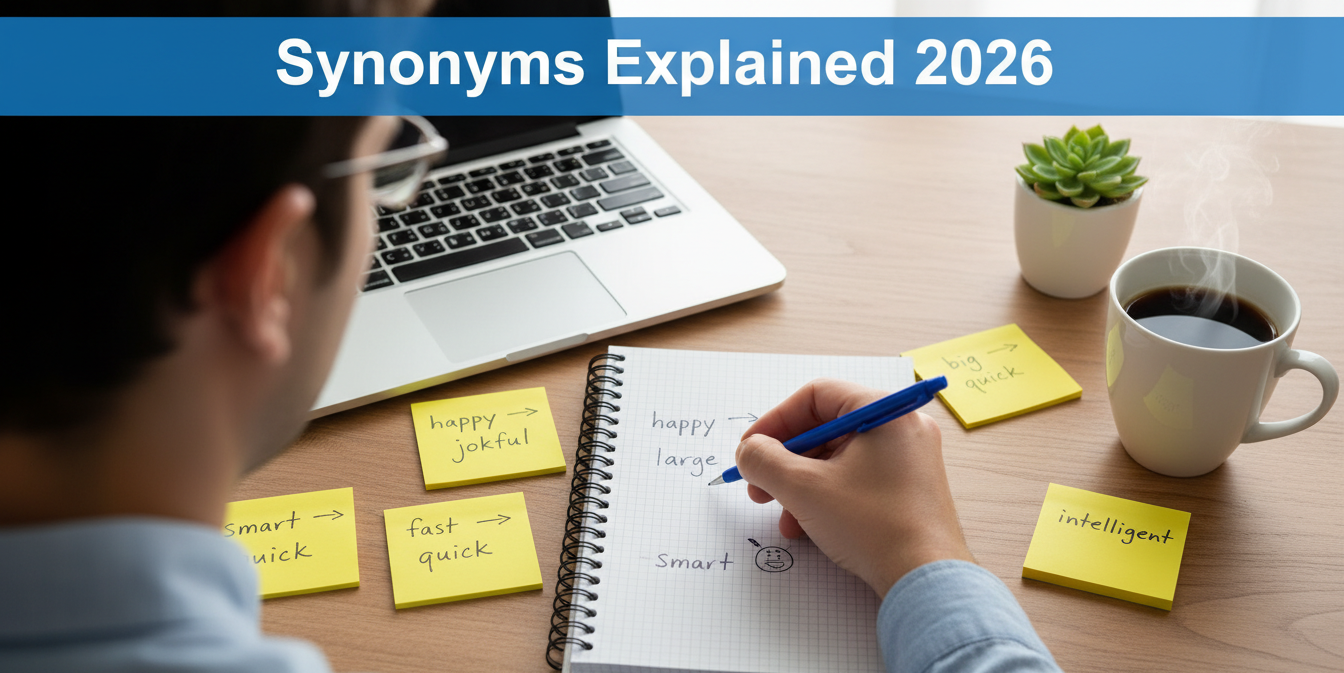
A synonym is a word, morpheme, or phrase that has a similar or identical meaning to another word in the same language. The word itself comes from the Ancient Greek words syn, meaning “together,” and onyma, meaning “name.”
So synonyms are, quite literally, words that share a name — or more accurately, words that share a meaning. For example, the words begin, start, commence, and initiate are all synonyms of each other because they all describe the action of something getting underway.
Merriam-Webster defines a synonym as “one of two or more words or expressions of the same language that have the same or nearly the same meaning in some or all senses.” This definition matters because synonyms do not always mean exactly the same thing in every context.
The Greek and Latin Origins of the Word Synonym
The etymology of the word “synonym” traces back more than 2,000 years. It entered English through the Latin synōnymum, which itself came from the Ancient Greek synōnymon.
The Greek root syn means “together” or “alike,” and onyma means “name.” Combined, the word describes things that share a name — or in language terms, words that share a meaning.
The word has been in use in the English language for over 500 years, predating the word antonym by several centuries. This tells us how central the concept of synonymy has always been to human communication and literacy.
Why Synonyms Are Essential in the English Language
The English language has one of the largest vocabularies of any language on Earth, with over 170,000 words currently in active use. A significant portion of that vocabulary exists because of synonymy — the phenomenon of multiple words sharing similar meanings.
This richness comes partly from English being a blend of Germanic, Latin, French, Norse, and Greek linguistic roots. Words from each language tradition survived and became synonyms of each other. The Germanic word freedom and the Latin-derived word liberty mean essentially the same thing.
Synonyms give speakers and writers the ability to fine-tune their message, match their tone to their audience, and keep language fresh and engaging across any form of communication.
What Is Synonymy in Linguistics
Synonymy is the formal linguistic term for the relationship between two or more words that share the same or very similar meanings. It is one of the core areas of lexical semantics — the branch of linguistics that studies word meaning.
Synonymy sits alongside related concepts like antonymy (opposite meanings), polysemy (one word with multiple meanings), and hyponymy (a hierarchical word relationship). Most linguists agree that true absolute synonymy — where two words mean exactly the same thing in every context — is actually quite rare in real language use.
In practice, most synonyms have subtle differences in tone, formality, connotation, or usage that make them better suited to different situations rather than perfectly interchangeable.
The Three Main Types of Synonyms
Understanding the different types of synonyms helps writers use them more precisely. Most linguists recognize three primary categories of synonymy in English.
Absolute Synonyms
Absolute synonyms are two words that mean exactly the same thing in every context and can be swapped interchangeably without changing meaning. True absolute synonyms are relatively rare in English.
Widely cited examples include couch and sofa, autumn and fall, and the scientific pair sodium and natrium. Even these examples sometimes carry subtle regional or contextual differences depending on where they are used.
Linguist Laurence Urdang famously noted that there is no such thing as a perfectly identical synonym, because frequency, regional use, and connotation always introduce some degree of difference between any two words.
Partial Synonyms
Partial synonyms are words that share a broadly similar meaning but are not fully interchangeable in every sentence. They overlap in meaning but differ in degree, formality, connotation, or specificity.
For example, happy and ecstatic both describe positive emotional states, but ecstatic is far more intense. Thin and slender both describe lack of physical bulk, but slender carries a more flattering connotation.
Partial synonyms are by far the most common type in English and require the most care and judgment when choosing between them in writing.
Contextual Synonyms
Contextual synonyms are words that function as synonyms only in specific situations but not in others. The meaning overlap is situational rather than universal across all uses.
The words close and shut are a classic example. You can close or shut a door — the words are synonyms in that sentence. But you can close a bank account, not shut one. The synonymy only holds in certain contexts.
Understanding contextual synonymy is especially critical for language learners who may assume two words are always interchangeable when they only overlap in specific uses.
Synonyms Across Every Part of Speech
One of the most important features of synonyms is that they exist in every grammatical category — nouns, verbs, adjectives, and adverbs. Below are organized examples from each major part of speech.
Synonyms for Nouns
| Word | Synonyms |
|---|---|
| House | Home, dwelling, residence, abode |
| Car | Vehicle, automobile, motor, ride |
| Child | Kid, youngster, youth, minor |
| Friend | Companion, ally, comrade, pal |
| Job | Occupation, profession, career, vocation |
Synonyms for Verbs
| Word | Synonyms |
|---|---|
| Walk | Stroll, march, saunter, trudge, amble |
| Say | Declare, utter, state, announce, express |
| Look | Glance, stare, gaze, peer, observe |
| Help | Assist, aid, support, guide, facilitate |
| Make | Create, build, construct, produce, craft |
Synonyms for Adjectives
| Word | Synonyms |
|---|---|
| Happy | Joyful, content, pleased, delighted, ecstatic |
| Big | Large, huge, enormous, vast, colossal |
| Bad | Terrible, awful, poor, inferior, dreadful |
| Fast | Quick, swift, rapid, speedy, fleet |
| Smart | Intelligent, clever, bright, sharp, astute |
Synonyms for Adverbs
| Word | Synonyms |
|---|---|
| Quickly | Rapidly, swiftly, hastily, promptly, briskly |
| Happily | Joyfully, cheerfully, gladly, merrily |
| Carefully | Cautiously, precisely, meticulously, diligently |
| Loudly | Noisily, boisterously, thunderously, blaring |
The Difference Between Synonyms and Antonyms
Synonyms and antonyms are two of the most fundamental vocabulary concepts in the English language, and they are often taught together because they represent two sides of the same coin.
A synonym shares a similar meaning with another word. An antonym carries the opposite meaning. Both relationships are organized by meaning, which is why they both belong to the field of lexical semantics.
| Concept | Definition | Example |
|---|---|---|
| Synonym | Same or similar meaning | Fast = Quick |
| Antonym | Opposite meaning | Fast vs Slow |
| Homonym | Same spelling or sound, different meaning | Bank (river) / Bank (money) |
| Hypernym | General category word | Animal (includes dog, cat, bird) |
| Hyponym | Specific word under a general category | Dog (under animal) |
Knowing these five vocabulary relationships makes you a more precise reader, writer, and communicator. All five appear regularly on standardized vocabulary tests, grammar exams, and language learning programs.
Synonyms vs Homonyms vs Polysemy — Key Differences
These three terms are frequently confused by students and language learners. Understanding the distinction is essential for studying English grammar correctly.
Synonyms involve different words sharing a similar meaning. Happy and joyful are two different words that mean similar things.
Homonyms are words spelled or pronounced the same but with completely different meanings. Bat (the animal) and bat (the cricket equipment) look and sound identical but are unrelated in meaning.
Polysemy describes a single word with multiple related meanings. The word head can refer to a body part, a company leader, or the top of a bed — one word carrying several connected meanings.
These three phenomena operate under completely different linguistic rules. Confusing them is one of the most common mistakes in English grammar study at every level.
The Role of Synonyms in Writing
Synonyms are one of the most powerful tools any writer possesses. They serve multiple functions that together make writing more effective, engaging, and precise.
The first major function is avoiding repetition. Reading the same word used ten times in a paragraph is tedious. Synonyms allow writers to express the same idea multiple times without the monotony of word repetition.
The second function is tone and register control. Every synonym carries a different level of formality. The word purchase is more formal than buy. The word children is more formal than kids. Choosing the right synonym signals the appropriate register for your audience.
The third function is specificity and precision. Rather than saying a character walked into a room, a skilled novelist might have them stride, shuffle, or creep — each synonym painting a sharply different picture of the scene.
How Synonyms Build Vocabulary Faster
Learning synonyms is one of the fastest and most effective ways to expand your vocabulary. When you learn a new word by connecting it to a word you already know, the new word sticks in memory far more reliably than learning it in isolation.
Research in language acquisition consistently supports synonymous pairing as a vocabulary learning strategy. When you learn that colossal means the same as big, the unfamiliar word becomes immediately memorable because it is anchored to a familiar meaning.
Studying synonyms also deepens your understanding of the subtle differences between words — what linguists call connotation and denotation — which moves your language skills from functional to sophisticated.
Connotation vs Denotation in Synonyms
Every synonym carries two layers of meaning. The denotative meaning is the literal dictionary definition. The connotative meaning is the emotional, cultural, or evaluative association attached to the word.
Two synonyms can share the same denotation but carry very different connotations. Slim and skinny both denote a lack of physical bulk, but slim carries a positive connotation while skinny often implies an unflattering extreme.
Cheap and economical both refer to low cost, but cheap implies low quality while economical implies smart financial thinking. Choosing between synonyms based on connotation is one of the highest-level skills in advanced writing.
Understanding connotation protects you from the common mistake of using a synonym that fits technically but sends the wrong emotional signal to your reader.
Synonyms in Literature and Creative Writing
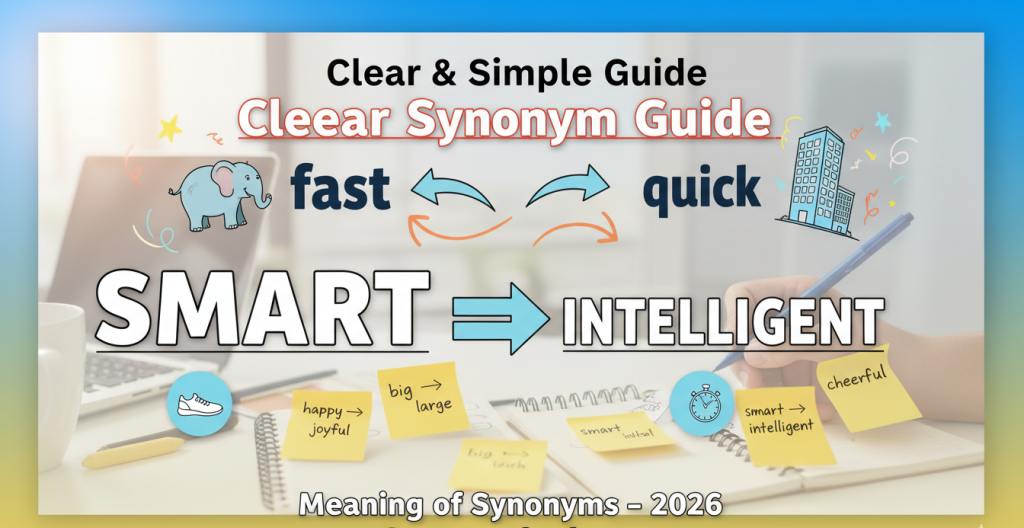
Great literature depends heavily on precise synonym selection. Skilled authors understand that swapping one word for a synonym can completely change the emotional register of a sentence.
A character who walks across a room versus one who trudges, saunters, or storms across that same room — each synonym creates an entirely different impression of that character’s state of mind.
William Shakespeare was famous for his masterful use of synonym variation to create rhythm, emphasis, and emotional depth in his plays and sonnets. The richness of Elizabethan English gave him an enormous vocabulary of synonymous options.
Modern style guides, including Strunk and White, advise writers to prefer specific, precise words over vague general ones. This is fundamentally advice about choosing the right synonym — always selecting the word that most exactly captures your intended meaning.
The Thesaurus — Your Synonym Reference Tool
A thesaurus is a reference book or digital tool specifically designed to help writers find synonyms and related words. The most famous thesaurus in English is Roget’s Thesaurus, first published by British lexicographer Peter Mark Roget in 1852.
Unlike a dictionary, which provides definitions, a thesaurus organizes words by meaning and provides lists of synonyms and antonyms for each entry.
| Tool | Purpose | Format |
|---|---|---|
| Dictionary | Define words | Alphabetical with definitions |
| Thesaurus | Find synonyms and antonyms | By meaning with word lists |
| Online thesaurus | Instant synonym search | Digital, searchable |
| Word processor tool | In-document synonym help | Right-click in MS Word or Google Docs |
Online thesauruses such as Thesaurus.com, Merriam-Webster’s thesaurus, and Power Thesaurus are free, fast, and widely used. Word processors including Microsoft Word and Google Docs also have built-in synonym tools accessible by right-clicking any word.
Synonyms in Formal vs Informal English
One of the most practical applications of synonyms is managing the level of formality in your writing and speech. English has an unusually rich set of formal and informal synonym pairs because of its mixed Germanic and Latinate vocabulary heritage.
Germanic-origin words tend to be shorter, more common, and more informal. Latinate words tend to be longer, less common, and more formal. This gives English speakers an enormous range of register options through synonym selection.
| Informal Word | Formal Synonym |
|---|---|
| Use | Utilize |
| Help | Assist |
| Ask | Inquire |
| Buy | Purchase |
| End | Terminate |
| Start | Commence |
| Show | Demonstrate |
| Need | Require |
| Get | Obtain |
| Tell | Inform |
Choosing the right register through synonym selection is critical in professional writing, academic papers, business emails, and formal presentations.
Common Synonym Mistakes to Avoid
The most frequent mistake writers make with synonyms is choosing a word based solely on its general meaning without checking its connotation, register, or contextual fit.
A classic example is using infamous as a synonym for famous. While both relate to being well known, infamous specifically means known for negative or disreputable reasons — a very different connotation from simple fame.
Another common error is using synonyms to disguise plagiarism. Replacing words with synonyms while keeping the original sentence structure and ideas is still considered academic plagiarism. Original ideas must be expressed in your own words with proper citation.
A third mistake is overusing rare or overly formal synonyms in an attempt to sound impressive, which typically has the opposite effect. Precision and clarity — not vocabulary display — should always guide synonym selection.
A to Z Reference Table of Common Synonyms
Below is a quick-reference table of common English words and their most frequently used synonyms, organized for easy use in writing.
| Word | Synonym 1 | Synonym 2 | Synonym 3 |
|---|---|---|---|
| Angry | Furious | Irritated | Enraged |
| Beautiful | Gorgeous | Stunning | Lovely |
| Brave | Courageous | Bold | Fearless |
| Calm | Peaceful | Serene | Tranquil |
| Dark | Dim | Shadowy | Gloomy |
| Easy | Simple | Effortless | Straightforward |
| Famous | Renowned | Celebrated | Well-known |
| Good | Excellent | Fine | Superior |
| Happy | Joyful | Content | Delighted |
| Important | Significant | Critical | Essential |
| Kind | Generous | Compassionate | Gentle |
| Loud | Noisy | Boisterous | Thunderous |
| New | Fresh | Novel | Recent |
| Old | Ancient | Aged | Elderly |
| Poor | Impoverished | Destitute | Needy |
| Quiet | Silent | Hushed | Still |
| Rich | Wealthy | Affluent | Prosperous |
| Sad | Unhappy | Sorrowful | Melancholy |
| Strong | Powerful | Robust | Sturdy |
| Tired | Exhausted | Weary | Fatigued |
Synonyms in Different Languages
Synonymy is a universal feature of human language, not unique to English. Every language has its own set of synonymous word pairs arising from the same historical forces of language mixing and borrowing.
In Turkish, kara and siyah both mean “black” — kara from native Turkish and siyah borrowed from Persian. Ottoman Turkish famously had three synonyms for nearly every concept, drawn simultaneously from Turkish, Persian, and Arabic vocabularies.
In Spanish, bonito, hermoso, and bello are all synonyms for beautiful, each carrying different regional and emotional weight depending on the Spanish-speaking country and context.
French distinguishes between maison (house as a physical building) and foyer (home as a concept of comfort and belonging) — synonyms that share meaning but diverge significantly in emotional resonance.
Synonyms in SEO and Natural Language Processing
In the digital age, synonyms have taken on new strategic importance in search engine optimization and natural language processing. Search engines like Google use algorithms based on semantic indexing to recognize that different words can share the same search intent.
When someone searches for car and another person searches for automobile, Google recognizes the synonymy and returns similar results for both queries. This means effective SEO writing uses a range of synonymous terms rather than mechanically repeating one exact keyword phrase.
AI language models are trained on synonym relationships as part of their core understanding of word meaning. The better a language model understands synonymy, the more naturally and precisely it can generate and interpret human text. This makes synonymy not just a grammar topic but a foundational concept in modern computational linguistics.
How to Choose the Right Synonym Every Time
Choosing the right synonym is a skill that improves with deliberate practice. A consistent process helps writers select the most appropriate synonym for any situation.
First, identify exactly what you intend to convey — including the emotional dimension and degree of intensity. Second, consult a thesaurus to generate several synonym candidates. Third, look up each candidate in a dictionary to verify its precise meaning, connotation, and any usage warnings.
Fourth, consider the register — is your writing formal, informal, academic, or conversational? Choose the synonym that matches. Fifth, read the sentence aloud with the new word in place. If it sounds natural and precise, it is the right choice.
Frequently Asked Questions (FAQs)
What is the meaning of synonyms in simple terms?
A synonym is a word that has the same or nearly the same meaning as another word in the same language. For example, happy and joyful are synonyms.
What is a synonym with an example?
A synonym is a word sharing a similar meaning with another word. Big and large are synonyms because both describe something of great size and can often replace each other.
What are the three types of synonyms?
The three types are absolute synonyms (identical meaning in all contexts), partial synonyms (similar but not identical meaning), and contextual synonyms (synonymous only in specific situations).
What is the difference between a synonym and an antonym?
A synonym shares the same or similar meaning as another word, while an antonym carries the opposite meaning. Fast and quick are synonyms; fast and slow are antonyms.
Why are synonyms important in writing?
Synonyms prevent repetition, control tone and formality, add precision, and make writing more dynamic and engaging for any reader in any genre.
Where does the word synonym come from?
The word comes from Ancient Greek synōnymon, combining syn meaning “together” and onyma meaning “name,” describing words that share a name or meaning.
Can two synonyms always be used interchangeably?
Not always. Most synonyms are partial synonyms with subtle differences in connotation, degree, or context. Always check a synonym’s exact meaning before substituting it in a sentence.
What is the tool used to find synonyms called?
A thesaurus is the primary reference tool for finding synonyms. Famous examples include Roget’s Thesaurus, Merriam-Webster’s online thesaurus, and Thesaurus.com.
What is the difference between a synonym and a homonym?
A synonym is a different word with a similar meaning. A homonym is a word that sounds or looks the same as another word but carries a completely different and unrelated meaning.
Are synonyms the same in every language?
No. Every language has its own synonyms shaped by its unique vocabulary history, regional variation, and cultural context. Synonymy is universal as a language feature, but its specific examples differ completely by language.
Conclusion
What is the meaning of synonyms is a question at the very heart of English language study, and the answer shapes how we read, write, and communicate every single day.
A synonym is a word or phrase that shares the same or nearly the same meaning as another word, found across every part of speech and present in every language on Earth.
From the three core types — absolute, partial, and contextual — to their vital roles in writing quality, vocabulary acquisition, and even SEO content strategy, synonyms are truly indispensable communication tools.
Understanding the difference between denotation and connotation within synonym pairs elevates writing from adequate to precise and compelling.
Whether you are a student building your vocabulary, a professional crafting clear and persuasive content, or a writer searching for exactly the right word, mastering the meaning and use of synonyms gives you full command of the English language.
A good thesaurus, careful judgment, and a deep understanding of connotation are all you need to use synonyms correctly, confidently, and creatively in 2026 and beyond.